
STEEL BUILDING KIT GUIDE | Updated April 2026 | 12 min read
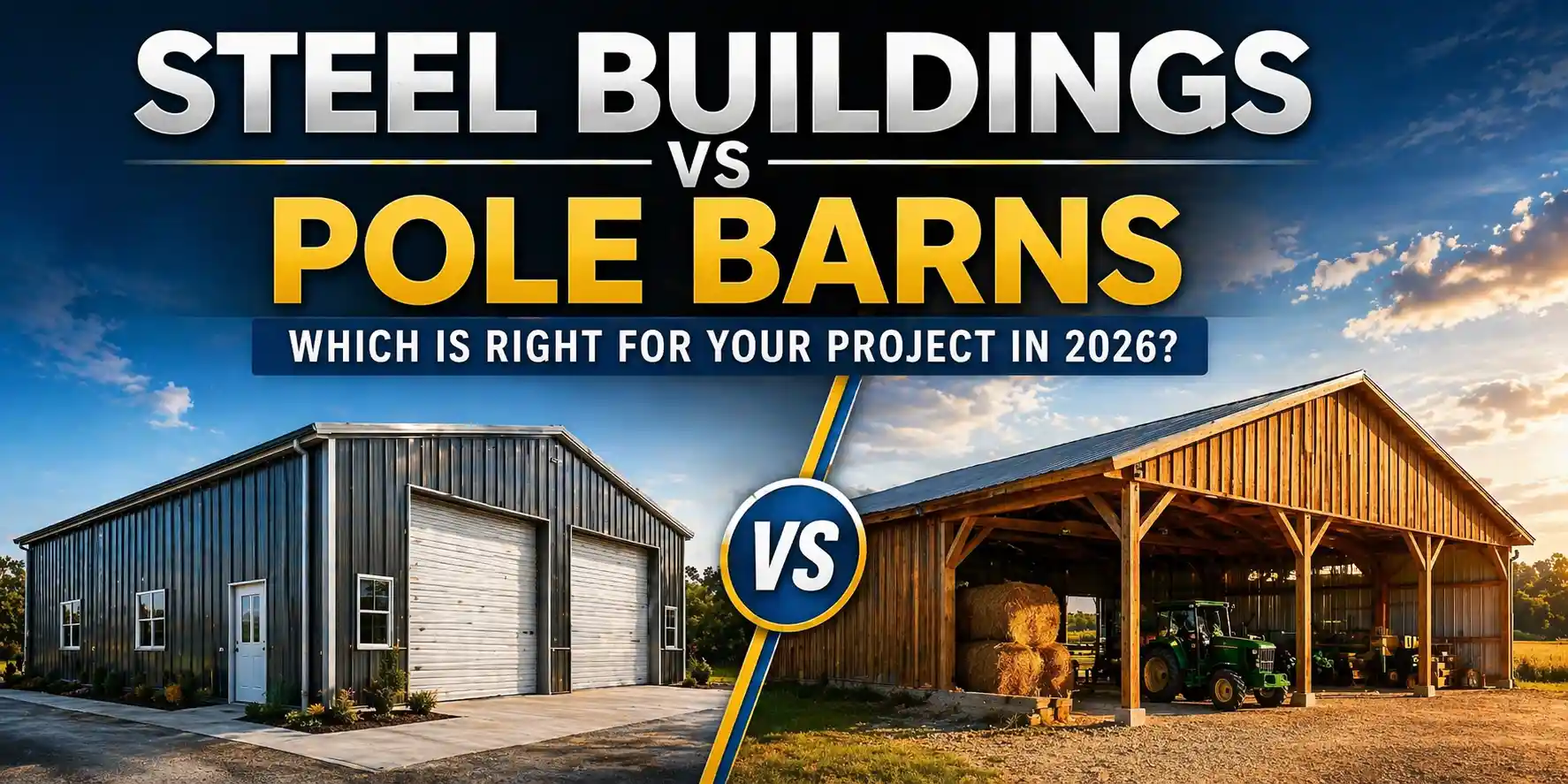
Steel Buildings vs Pole Barns: Which Is Right for Your Project in 2026?
- The real cost difference between steel buildings and pole barns per square foot
- Durability and lifespan comparisons with maintenance schedules
- Insurance cost implications for each type
- Construction timeline and labor differences
- Customization flexibility and design limits
- Resale value and long-term investment value
- Specific use case recommendations
- Common buyer mistakes that cost money
The Decision That Saves You Thousands
You’re standing at a crossroads. Maybe you need a garage, workshop, agricultural building, or barndominium. You’ve heard about steel buildings and pole barns. Everyone has an opinion. Your neighbor swears by his pole barn. Your contractor recommends steel. The YouTube guy just built a barndominium and won’t stop talking about it.
Here’s the reality: both work, but they’re fundamentally different solutions for different situations. The choice isn’t about which is universally better, it’s about matching the right structure to your needs, budget, and long-term goals. We’ve helped thousands of buyers navigate this decision at SteelBuildingKit.com, and we’re going to give you the unfiltered truth that most salespeople won’t.
We’ve independently reviewed steel building vs pole barn options for every budget and use case. Whether you’re comparing a 30×40 garage or a 50×100 workshop, this guide walks you through the real differences. Check out our complete guide to steel building kits and costs for additional options and our top steel building kit companies review for specific manufacturers.
1. The Complete Cost Comparison: Steel Buildings vs Pole Barns
Let’s start with what matters most to your wallet. The cost difference between steel buildings and pole barns is more nuanced than the simple per-square-foot numbers most sites throw at you.
Material Costs
Steel buildings typically cost $12-$18 per square foot for materials. A 50×100 steel building kit (5,000 sq ft) runs $60,000 to $90,000 just for the structural components. Pole barns, by comparison, cost $15-$25 per square foot in materials, because you’re buying posts, framing lumber, and fasteners instead of engineered steel frames.
Here’s where it gets interesting: steel is engineered and manufactured to precise tolerances in a factory. You get exactly what you ordered. Pole barn materials are often sourced locally, and quality varies significantly. A cheap pole barn kit might run $15/sq ft; a quality structure with treated wood and proper engineering runs $25/sq ft.
Labor Costs
This is where the curves cross. Pole barns erect faster. A crew can typically frame a 50×100 pole barn in 5-10 days. The same structure in steel takes 10-20 days because bolt installation requires more precision and coordination. Labor costs run 40-60% higher for steel, but you pay for fewer total days. Steel buildings typically cost $5-$10/sq ft in labor; pole barns $6-$12/sq ft.
Total Installed Costs: Side-by-Side
| Aspect | Steel Building | Pole Barn |
|---|---|---|
| Material Cost (per sq ft) | $12-$18 | $15-$25 |
| Labor Cost (per sq ft) | $5-$10 | $6-$12 |
| Foundation Requirements | Concrete slab or strip footings | Post holes with concrete |
| Typical Total (per sq ft) | $18-$28 | $21-$37 |
| 50×100 Building Total | $90,000-$140,000 | $105,000-$185,000 |
| 40×60 Building Total | $43,200-$67,200 | $50,400-$88,800 |
| 30×40 Building Total | $21,600-$33,600 | $25,200-$44,400 |
Use our steel building cost calculator to estimate costs for your specific project.
Don’t Forget Hidden Costs
Pole barns require wood treatment. Budget $3,000-$8,000 every 10-15 years to restain or re-treat the wood framing. Steel requires none. Insulation costs are roughly equivalent for both structure types, running $3-$8/sq ft depending on R-value and materials. See our guide to insulating steel buildings for details.
2. Durability and Lifespan Comparison
This is where steel buildings separate themselves from the pack.
Steel Building Longevity
A properly constructed steel building lasts 50-60 years or longer. We’re talking about structures that survive hurricanes, heavy snow loads, and extreme weather. The steel frame itself is virtually indestructible under normal conditions. What fails first are secondary components: roofing materials (15-25 year lifespan), fasteners (30-50 years), and sealants (10-15 years).
Because the structure is metal, it doesn’t rot, warp, or attract termites. A 40-year-old steel building looks virtually unchanged if the roof hasn’t failed.
Pole Barn Durability
Pole barns typically last 30-40 years, sometimes longer if constructed from premium treated wood. But here’s the catch: wood is living material. It expands and contracts with humidity and temperature. Over 20-30 years, the wood develops checking (surface cracks), nail pops, and potential wood rot if moisture gets trapped behind siding.
The posts themselves are the structural integrity point. If those bottom 4 feet of posts rot from ground moisture, the building is compromised. This happens more often than builders admit, especially in areas with high humidity, heavy rain, or poor drainage.
3. Maintenance Comparison
Let’s talk about what you actually have to do to keep each structure standing.
Steel Building Maintenance Schedule
Year 1-5: Inspect sealant around penetrations (doors, vents, skylights), check bolt tightness annually. Budget: 4 hours per year, negligible cost.
Year 5-10: First major inspection. Check fastener corrosion, inspect roof condition. Budget: 8 hours, $200-$500.
Year 10-20: Roof will likely need attention. Expect recoating or panel replacement. Budget: $2,000-$6,000.
Year 20-40: Repaint exterior if desired (cosmetic, not structural). Inspect and replace worn sealants. Budget: $3,000-$8,000.
Total 40-year maintenance cost: $5,200-$14,500 plus roof replacement.
Pole Barn Maintenance Schedule
Year 1-5: Inspect wood for checking, check fastener tightness. Budget: $100-$300/year.
Year 5-10: First wood treatment or restaining. Critical. Budget: $3,000-$8,000.
Year 10-20: Additional nail pops, wood movement, potential rot. Budget: $5,000-$15,000.
Year 20-30: Significant wood treatment needed again. Budget: $4,000-$10,000.
Year 30-40: Major decision point. Extend lifespan or replace. Budget: $8,000-$25,000.
Total 40-year maintenance cost: $20,100-$58,000.
| Maintenance Item | Steel Building | Pole Barn |
|---|---|---|
| Annual Inspection | $0-$200 | $100-$300 |
| Wood Treatment (every 10-15 yrs) | N/A | $3,000-$8,000 |
| Structural Repairs (40 yrs) | 0-2 events | 2-5 events |
| Total 40-Year Cost | $5,200-$14,500 | $20,100-$58,000 |
4. Insurance Cost Comparison
This factor surprises most buyers. Your building type directly impacts insurance premiums.
Steel buildings are preferred by most insurance companies. The structures are fire-resistant (non-combustible), withstand severe weather well, and have a proven track record. You’ll pay 15-25% less in premiums for a steel building compared to a pole barn.
For a 50×100 steel building insured for $150,000 replacement value, expect $800-$1,200 annually ($0.16-$0.24/sq ft/year). The same 50×100 pole barn runs $1,000-$1,500 annually ($0.20-$0.30/sq ft/year). Over 30 years, the insurance difference alone can exceed $6,000-$9,000 in favor of steel.
5. Construction Timeline Comparison
Timeline matters, especially if you’re trying to open a business, move operations, or beat a season.
Steel Building Timeline: Foundation (1-2 weeks), Manufacturing (2-4 weeks), Delivery (1-2 weeks), Assembly (2-4 weeks), Finishing (2-6 weeks). Total: 10-20 weeks.
Pole Barn Timeline: Foundation (3-5 days), Materials (1 week), Framing (1-2 weeks), Roofing/Siding (2-3 weeks), Finishing (2-4 weeks). Total: 6-14 weeks.
Pole barns are 20-30% faster through the framing stage. If you need a basic open structure quickly, pole barns win. If you need a finished, insulated, climate-controlled space, the timeline difference shrinks because both require similar interior finish time. See our DIY steel building assembly guide for more on steel building construction timelines.
6. Customization and Design Flexibility
Steel Building Flexibility
Steel buildings are design-friendly. Wide-span clear-floor designs are standard (50-100 feet without interior columns). Want a 40×100 with zero interior posts? Steel does it easily. Want high ceilings? Steel handles 14-20 foot sidewalls comfortably. Want mezzanines? Steel bolts them in.
You can customize colors, door placement, window configurations, and add aesthetic details. Modern steel buildings can look sleek and professional or agricultural, depending on your choice. Expansion is straightforward because you can source matching components. Browse our top steel building kit manufacturers for companies offering full customization.
Pole Barn Limitations
Pole barns require interior posts if you exceed 60 feet in width without expensive engineered trusses. The aesthetic is limited to the classic barn look. You can’t easily remove posts to create open space; they’re structural. Expansion is harder because matching wood posts 15-20 years later is difficult.
7. Resale Value and Investment Comparison
A steel building installed properly holds 70-85% of its installed cost in resale value if you sell the property within 10-15 years. The structure is durable, low-maintenance, and attractive to buyers. A pole barn holds 50-65% of its installed cost, mainly because buyers know maintenance costs are coming and the building’s age relative to its lifespan is more apparent.
8. Insurance and Financing Considerations
Banks prefer steel buildings. They’re more attractive for collateral. You’ll get better loan terms (0.25-0.5% lower interest rates) and easier approval for construction financing. Some lenders won’t finance certain pole barn applications because of the perceived risk. For a $100,000 steel building at 6.5% over 15 years, you pay roughly $9,000 less in interest compared to 7% financing.
9. Use Cases: Where Each Building Excels
Choose Steel Buildings For: Warehousing and storage, light manufacturing, barndominiums and residential uses, high-wind/snow load areas, long-term investment properties, facilities that need aesthetics, and 40×60 and larger projects. Check our steel building codes by state guide for local requirements.
Choose Pole Barns For: Pure agricultural use (hay, equipment, animals), budget-constrained projects under 30×40, temporary or short-term structures (10-15 years), areas with established pole barn contractors, open workspace where columns are acceptable, and quick-deployment agricultural situations.
10. The Steel Buildings vs Pole Barns Decision Matrix
| Decision Factor | Steel Building Winner | Pole Barn Winner |
|---|---|---|
| Upfront cost (under 30×40) | Close | Slight edge |
| Upfront cost (40×60+) | Clear winner | N/A |
| Long-term total cost (30 years) | Clear winner | N/A |
| Construction speed | Clear winner | |
| Design flexibility | Steel | Limited |
| Resale value | Steel | |
| Maintenance burden | Steel | |
| Insurance cost | Steel | |
| Durability/lifespan | Steel | |
| Agricultural fit | Both equal | Slight edge |
Common Mistakes That Cost Thousands
| Mistake | Why It Costs You | Fix |
|---|---|---|
| Comparing only material costs | You overpay because you pick the cheaper option on partial information | Always compare total delivered cost (materials + labor + foundation + delivery) |
| Skipping wood treatment on pole barns | Untreated wood develops rot; repair costs $15,000-$30,000 later | Budget for professional wood treatment every 10-15 years |
| Choosing pole barn for climate-controlled space | You’ll spend $20,000-$40,000 more on insulation and sealing over time | Choose steel when climate control is required |
| Failing to compare insurance quotes first | Pole barn costs 25% more annually to insure | Get insurance quotes for both options during planning |
| Underestimating long-term maintenance | $25,000 in surprise repairs at year 25 | Budget 30-year total cost including all treatments and repairs |
| Choosing based on one contractor’s recommendation | You build what your contractor prefers, not what’s best | Get quotes from both steel and pole barn specialists |
| Forgetting post hole and footing costs | Excavation adds $5,000-$15,000 to pole barn installations | Get detailed foundation quotes for both options |
| Assuming clear-span pole barn trusses save money | Engineered trusses cost nearly as much as steel | Compare clear-span steel vs clear-span pole barn costs directly |
Steel Buildings vs Pole Barns: Article Summary
- Steel buildings cost $12-$25/sq ft installed; pole barns cost $15-$30/sq ft. Advantage shifts to steel above 40 feet wide.
- Steel buildings last 50-60 years with minimal maintenance; pole barns last 30-40 years and require regular wood treatment.
- 40-year maintenance costs run $5,000-$14,500 for steel versus $20,000-$58,000 for pole barns.
- Insurance premiums are 15-25% lower for steel buildings because they’re less fire risk.
- Resale value favors steel buildings by 15-25%.
- Steel buildings offer superior design flexibility: wider clear-span options, height variations, and professional aesthetics.
- Pole barns excel for pure agricultural storage, quick deployment, and tight budgets under 30×40 square feet.
- Financing is easier for steel buildings; lenders prefer non-combustible structures.
- Construction timelines are similar (10-20 weeks total); pole barns frame faster, but finish times are comparable.
- The long-term total cost favors steel buildings by 30-50% over 30-40 years.
- For barndominiums, light manufacturing, storage with climate control, or any installation over 40×60, steel buildings are the superior choice.
- For pure agricultural storage or severe budget constraints under 30×40, pole barns are viable alternatives.
For detailed cost calculations, explore our steel building cost calculator and steel building kit companies directory.
Frequently Asked Questions
How much does a 50×100 steel building cost versus a pole barn of the same size?
A 50×100 steel building runs $90,000-$140,000 installed; a comparable pole barn costs $105,000-$185,000. While the pole barn sometimes appears cheaper in material quotes, total installed costs usually favor steel. After 30 years, the steel building’s lower maintenance costs create a savings of $15,000-$40,000.
Can you get 60-foot clear span with a pole barn without posts down the middle?
Yes, but it requires engineered clear-span trusses that cost nearly as much as steel trusses. You lose the budget advantage. A 60-foot clear-span steel building is simpler and cheaper than a pole barn with special trusses.
Do steel buildings rust?
Properly galvanized steel buildings (G-90 or G-185 coating) resist rust for 50+ years under normal conditions. Rust occurs only in extreme environments (coastal salt spray) or if coatings are damaged. Pole barns face wood rot issues that are arguably worse. See our glossary of steel building terms for more on steel coatings and materials.
Which type of building is easier to insulate?
Both are equally insulatable. Steel buildings have cold-bridging at metal framing; pole barns have thermal bridges at posts. The difference is negligible. Choose based on other factors, not insulation performance. Our insulation guide covers all options.
What happens if you need to expand a building 15 years later?
Steel buildings are expansion-friendly because you source matching components from any major steel building manufacturer. Pole barn expansions are harder because finding matching aged wood and posts is difficult.
Are pole barns actually cheaper long-term?
No. Over 40 years, maintenance costs for pole barns (wood treatment, repairs, potential post replacement) exceed steel building maintenance by $15,000-$45,000. Steel buildings are cheaper over the long haul despite similar upfront costs.
What’s the best use case for a pole barn in 2026?
Pure agricultural storage (hay, grain, equipment) where aesthetics don’t matter and you won’t need climate control. If your project involves finished space, climate control, resale value, or expansion potential, choose steel. You can also check out our Quonset hut kits guide for another affordable steel building alternative.