**STEEL BUILDING KIT GUIDE** | Updated April 2026 | 10 min read
—
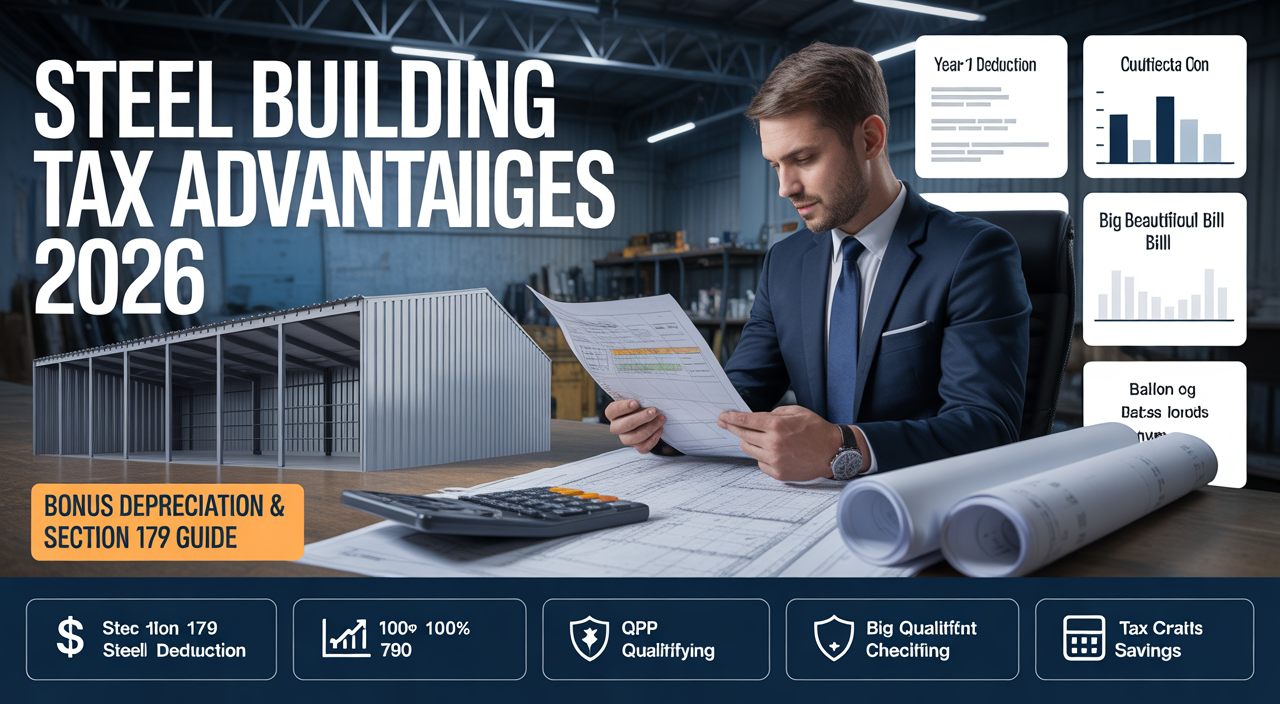
# Steel Building Tax Advantages 2026: Bonus Depreciation, Section 179 & the New Tax Law
—
+————————————————–+
| **WHAT YOU’LL LEARN IN THIS GUIDE** |
| |
| • How the Big Beautiful Bill restored 100% first-|
| year bonus depreciation for qualifying steel |
| buildings in 2026 |
| • What Section 179 expensing covers and the new |
| $2.5 million cap for 2026 |
| • Which steel building types qualify as |
| Qualified Production Property (QPP) |
| • How movable/unbolted steel buildings may |
| qualify as equipment for faster write-offs |
| • Real dollar examples of what these deductions |
| mean for a $50K–$200K building project |
| • What documentation you need to claim these |
| deductions and when to act |
| • How to combine multiple deductions to maximize |
| your 2026 tax savings on a steel building |
+————————————————–+
If you are planning to buy a steel building kit in 2026, the tax picture has changed significantly in your favor. Steel building tax advantages in 2026 are stronger than they have been in years, thanks to new legislation that restored 100% first-year bonus depreciation and expanded Section 179 expensing limits. Whether you are building a commercial facility, a workshop, a warehouse, or an agricultural structure, the timing right now may save you tens of thousands of dollars compared to prior years.
This guide covers every major tax benefit available to steel building buyers in 2026, how the new law changed the rules, and what you need to do to qualify. For context on what buildings cost before you start running tax numbers, use the [Steel Building Cost Calculator](https://steelbuildingkit.com/steel-building-cost-calculator/) to get a baseline on your project budget.
—
+————————————————–+
| **QUICK ANSWER: Steel Building Tax Advantages |
| 2026** |
| |
| In 2026, steel building buyers can take |
| advantage of 100% first-year bonus depreciation |
| (restored by the Big Beautiful Bill), Section |
| 179 expensing up to $2.5 million, and Qualified |
| Production Property deductions for manufacturing |
| facilities. A business that purchases a $150,000 |
| steel building kit and qualifies for 100% bonus |
| depreciation could deduct the full cost in year |
| one instead of spreading it over 39 years. |
+————————————————–+
—
## 1. What Changed in 2026: The Big Beautiful Bill Explained
The tax rules for commercial property depreciation had been heading in the wrong direction for several years. Under the Tax Cuts and Jobs Act of 2017, bonus depreciation was set at 100% through 2022, then scheduled to phase down by 20% per year. By 2026, it was supposed to drop to just 20%, and by 2027, it would have disappeared entirely.
The Big Beautiful Bill (OBBBA) changed that trajectory completely.
**What the new law did:**
– Permanently restored 100% first-year bonus depreciation on qualifying property
– Eliminated the placed-in-service deadlines that had been tied to the TCJA phase-out schedule
– Increased the Section 179 expensing cap from $1.16 million to $2.5 million
– Raised the Section 179 phase-out threshold to $4 million
– Created the Qualified Production Property (QPP) category for manufacturing facilities built after December 31, 2024
The effective date for most of these changes is January 20, 2025, which means the full 2026 tax year benefits from the restored rules.
**Why this matters for steel building buyers:**
Without this law, a business that purchased a $120,000 steel building in 2026 would have been limited to a 20% first-year deduction of just $24,000, spreading the remaining $96,000 over 39 years. With the law restored, that same business may be able to deduct the entire $120,000 in 2026.
+————————————————–+
| **KEY INSIGHT** |
| |
| The phase-down from the TCJA had already cost |
| businesses real money: in 2023, bonus |
| depreciation dropped to 80%; in 2024, it fell to |
| 60%; in 2025 (before the new law took effect), |
| it was 40%. The Big Beautiful Bill eliminated |
| all future phase-downs permanently. |
+————————————————–+
—
## 2. How 100% Bonus Depreciation Works for Steel Buildings
Bonus depreciation allows businesses to deduct the full cost of qualifying property in the year it is placed in service, rather than depreciating it over the IRS-assigned useful life. For most commercial buildings, that useful life is 39 years under MACRS, which makes standard depreciation almost meaningless in year one.
**What qualifies for bonus depreciation in a steel building project:**
Not every part of a steel building project automatically qualifies. The key is whether the property is considered “qualified improvement property” or shorter-life equipment rather than a standard commercial structure.
Here is how it typically breaks down:
| Component | Classification | Bonus Depreciation? |
|—|—|—|
| Red iron structural frame (if movable/unbolted) | May qualify as equipment (5–7 yr life) | Yes, if classified as equipment |
| Nonresidential building (permanently attached) | 39-year commercial real property | No (unless QPP applies) |
| Dedicated electrical systems | Qualified improvement property (15-yr life) | Yes |
| HVAC systems | Qualified improvement property (15-yr life) | Yes |
| Roofing (improvements to existing building) | Qualified improvement property (15-yr life) | Yes |
| Fire protection/security systems | Section 179 eligible building system | Yes (Section 179) |
| Manufacturing production equipment | 5–7 year equipment | Yes |
**The movable building angle:**
This is one of the most important and least-discussed steel building tax advantages. Some manufacturers, including General Steel, engineer their buildings specifically to be unbolted and relocated. A building that is not permanently affixed to the ground may qualify as equipment rather than real property, which opens the door to much faster depreciation schedules. If this applies to your project, the entire structure could potentially qualify for 100% bonus depreciation. Talk to your CPA before assuming this classification applies.
+————————————————–+
| **BUYER WARNING** |
| |
| Not every steel building automatically qualifies |
| for equipment-level depreciation. The IRS looks |
| at permanence of attachment, intent, and |
| structural characteristics. Always get a written |
| tax opinion from a qualified CPA before making |
| building decisions based on depreciation |
| classification. |
+————————————————–+
—
## 3. Section 179 Expensing: The $2.5 Million Deduction Cap
Section 179 works differently from bonus depreciation. Instead of applying to all qualifying property automatically, Section 179 is an election that allows businesses to expense the full cost of qualifying property in the first year, up to a dollar limit.
**2026 Section 179 limits:**
– **Maximum deduction:** $2.5 million
– **Phase-out begins at:** $4 million in total qualifying purchases
– **Phase-out:** Dollar-for-dollar above $4 million
This means most small and mid-size business buyers will not hit the phase-out threshold on a single steel building project.
**What Section 179 covers in a steel building context:**
Section 179 explicitly covers certain building improvements and systems for nonresidential property:
– HVAC units (rooftop or ground-mounted)
– Roofing improvements
– Fire protection and alarm systems
– Security systems
It does NOT cover the building structure itself under standard rules. However, if your building qualifies as equipment (see the movable building discussion above), the entire structure may be Section 179 eligible.
**Section 179 vs. Bonus Depreciation: Which is better?**
| Feature | Section 179 | Bonus Depreciation |
|—|—|—|
| Annual limit | $2.5 million | No limit |
| Can create a tax loss? | No | Yes |
| Applies to used property? | Yes | Yes |
| Requires profitability? | Yes (must have taxable income) | No |
| Carryforward if limited? | Yes (unused amount carries forward) | Yes (carries to future years) |
For most steel building buyers, using bonus depreciation on qualifying components and Section 179 on eligible building systems together gives the maximum first-year deduction.
—
## 4. Qualified Production Property (QPP): The Manufacturing Facility Deduction
This is the newest and most powerful steel building tax advantage created by the Big Beautiful Bill, and it specifically targets new manufacturing, refining, and production facilities.
**What QPP covers:**
Nonresidential buildings (including steel buildings) used directly for manufacturing or refining are eligible for a first-year deduction under QPP rules if:
– Construction begins after December 31, 2024
– The facility is placed in service before January 1, 2034
– The primary use is manufacturing, production, or refining
**What QPP does NOT cover:**
– Residential structures
– Office-only buildings
– Warehouses used purely for storage (not production)
– Agricultural buildings (these may have other deduction options)
**Real-world example of QPP impact:**
A manufacturing company builds a 60×100 steel building kit for $180,000 as a production facility. Under QPP, the entire $180,000 may be deductible in 2026. Without QPP, the building would depreciate over 39 years, generating a first-year deduction of roughly $4,615.
For manufacturing businesses, this deduction alone justifies building now rather than waiting. For context on what a commercial-scale steel building kit costs, review our [complete guide to steel building costs and companies](https://steelbuildingkit.com/steel-building-kits-the-complete-guide-to-cost-companies-and-best-options-in-2025/).
—
## 5. Energy Efficiency Deductions (Section 179D)
Steel buildings that incorporate energy-efficient systems may qualify for an additional deduction under Section 179D, which covers commercial building energy-efficiency improvements.
**Qualifying systems include:**
– High-efficiency insulation (spray foam, rigid board with high R-values)
– Energy-efficient HVAC systems
– Advanced lighting systems (LED with controls)
– Thermal envelope improvements
The Section 179D deduction for new commercial construction can reach up to $5.00 per square foot for buildings that meet the highest energy-efficiency standards. On a 40×60 building (2,400 square feet), that is a potential additional deduction of $12,000.
For reference on insulation types and costs that would feed into this calculation, see our [steel building insulation guide](https://steelbuildingkit.com/guide-to-insulating-steel-buildings/).
—
## 6. Agricultural Steel Buildings: Special Rules
Farm and agricultural steel buildings have access to additional deduction pathways that commercial buildings do not.
**Section 168(e) — Agricultural Building Classification:**
Single-purpose agricultural structures (grain storage, livestock housing) may qualify for a 10-year depreciation life rather than 39 years, which significantly improves year-one deductions even without bonus depreciation.
**USDA Farm Service Agency Considerations:**
Farm buildings financed through FSA programs may have specific depreciation rules tied to the loan structure. Always coordinate your tax strategy with the financing arrangement.
**Bonus depreciation and farm buildings:**
Agricultural buildings that are not permanently affixed can qualify for equipment-level depreciation treatment under the same principles as movable commercial buildings. A portable grain bin on a concrete pad, for example, frequently qualifies.
For financing options that affect how depreciation interacts with your loan, see our [steel building financing guide](https://steelbuildingkit.com/steel-building-financing-options-guide/).
—
## 7. Real Dollar Examples: What These Deductions Mean for Your Project
Here is how the 2026 steel building tax advantages stack up across different project sizes. Assumptions: business taxpayer, 25% effective federal tax rate, building placed in service in 2026.
| Project Size | Kit Cost (Approx.) | Scenario | Year-1 Deduction | Estimated Tax Savings |
|—|—|—|—|—|
| 30×40 Workshop | $22,000 | Bonus depreciation on movable frame + systems | $18,000–$22,000 | $4,500–$5,500 |
| 40×60 Commercial | $45,000 | Bonus depreciation on qualifying components | $25,000–$35,000 | $6,250–$8,750 |
| 50×100 Warehouse | $80,000 | QPP if manufacturing use | $80,000 | $20,000 |
| 60×100 Manufacturing | $150,000 | Full QPP deduction | $150,000 | $37,500 |
| 100×150 Industrial | $280,000 | QPP + Section 179 on systems | $200,000–$280,000 | $50,000–$70,000 |
These are illustrative ranges, not guarantees. Your actual deduction depends on property classification, business use percentage, and taxable income for the year.
To get accurate cost inputs for these calculations, start with real quote data from our [top-rated steel building companies](https://steelbuildingkit.com/top-10-steel-building-kit-companies-in-depth-reviews-scores-and-steel-building-buying-guide/).
+————————————————–+
| **KEY INSIGHT** |
| |
| The combination of 100% bonus depreciation and |
| QPP means a manufacturing company building a |
| $200,000 steel facility in 2026 could reduce |
| their taxable income by the full $200,000 in |
| year one. At a 25% effective rate, that is a |
| $50,000 tax savings in the first year alone. |
+————————————————–+
—
## 8. How Rising Tariffs and Depreciation Interact in 2026
Steel tariffs hit 50% in 2026, which has pushed kit prices up 8–15% compared to 2024 levels. The silver lining: if your building cost rises due to tariffs, the deductible amount increases proportionally.
A building kit that cost $60,000 in 2024 and now costs $69,000 due to tariff-driven price increases means your potential bonus depreciation deduction also increased by $9,000. The tariff pain is partially offset by a larger first-year tax deduction.
For a full breakdown of how tariffs are affecting steel building kit prices right now, see our [steel tariffs 2026 impact guide](https://steelbuildingkit.com/steel-tariffs-2026-impact-on-building-kit-prices/).
—
## 9. What Documentation You Need to Claim These Deductions
Claiming steel building tax advantages correctly requires proper documentation from the start of your project.
**Required documentation checklist:**
1. **Manufacturer invoice and contract** showing the building as a kit (not a permanent structure) if pursuing equipment classification
2. **Engineer-stamped drawings** confirming structural specifications (most major manufacturers provide these)
3. **Building permit records** showing the permit classification (equipment vs. structure)
4. **Site photographs** documenting foundation type and attachment method
5. **Written CPA opinion** on property classification before filing
6. **Form 4562** (Depreciation and Amortization) filed with your tax return
7. **Cost segregation study** (recommended for projects over $100,000) to identify which components qualify for accelerated treatment
8. **Certificate of occupancy or placed-in-service documentation** for the tax year
For QPP claims, additionally document:
– Nature of production activity conducted in the building
– Construction start date (must be after December 31, 2024)
– Expected placed-in-service date (must be before January 1, 2034)
—
## 10. Common Mistakes That Cost Buyers Their Deductions
| Mistake | Why It Costs You | Fix |
|—|—|—|
| Assuming the whole building qualifies for bonus depreciation | Permanently attached structures default to 39-year life | Get a cost segregation study; document movability if applicable |
| Not coordinating with a CPA before buying | Wrong property classification at purchase is hard to fix retroactively | Consult a CPA before signing any contract |
| Missing the QPP construction start date | Must begin construction AFTER Dec. 31, 2024 to qualify | Verify project start date documentation |
| Overlooking Section 179D on energy systems | Leaves $1–$5 per square foot deduction unclaimed | Get energy compliance certification from licensed engineer |
| Mixing personal and business use | Deduction must be prorated for any non-business use | Use building exclusively for business in qualifying year |
| Not filing Form 4562 | IRS will disallow the deduction without proper election | File correct forms with original return; amend if missed |
—
## Article Summary
– The Big Beautiful Bill permanently restored 100% first-year bonus depreciation on qualifying property, effective January 20, 2025.
– Without this law, bonus depreciation in 2026 would have dropped to 20%; it is now back to 100% with no phase-out schedule.
– Section 179 expensing was increased to $2.5 million per year with a $4 million phase-out threshold.
– Qualified Production Property (QPP) allows full first-year deduction of new manufacturing facilities placed in service before January 1, 2034.
– Steel buildings engineered to be unbolted and relocated may qualify as equipment (not real property), opening the door to faster depreciation.
– A business buying a $150,000 manufacturing steel building in 2026 could potentially deduct the full cost in year one, saving $37,500 at a 25% tax rate.
– Steel tariff increases in 2026 have raised kit prices 8–15%, but also increase the deductible basis proportionally.
– Section 179D provides an additional up to $5.00 per square foot deduction for energy-efficient building systems.
– Proper documentation, including a cost segregation study for larger projects, is essential to claiming these deductions.
– Always work with a qualified CPA to determine which classification applies to your specific project before finalizing your building purchase.
—
## Frequently Asked Questions
**Can I deduct a steel building kit purchase in full in 2026?**
It depends on how the building is classified. If your steel building qualifies as equipment (because it is engineered to be movable and not permanently affixed) or qualifies as Qualified Production Property for manufacturing use, the full cost may be deductible in 2026 under 100% bonus depreciation. If it is a standard permanently attached commercial structure, you would typically depreciate it over 39 years, though building systems like HVAC and roofing can still qualify for accelerated treatment under Section 179.
**What is the Section 179 limit for steel buildings in 2026?**
The Section 179 deduction limit for 2026 is $2.5 million, with a phase-out beginning at $4 million in total qualifying purchases. For most steel building buyers, this is well above the cost of a single project. Section 179 covers qualifying building systems (HVAC, roofing, fire protection, security) within a nonresidential building, and can cover the entire structure if it qualifies as equipment.
**Does a barndominium or residential steel building qualify for bonus depreciation?**
Residential steel buildings generally do not qualify for the commercial bonus depreciation rules. Barndominiums used partly or primarily as residences would be classified as residential real property (27.5-year life), not commercial property. The QPP deduction specifically excludes residential structures. That said, any portion used for business (like a home office or workshop space) may qualify for business deductions on that pro-rated share.
**What is Qualified Production Property and does my steel building qualify?**
QPP is a new category created by the Big Beautiful Bill for nonresidential buildings used directly in manufacturing, production, or refining. To qualify, construction must begin after December 31, 2024, and the building must be placed in service before January 1, 2034. If your business manufactures products in a steel building, it likely qualifies. Pure storage warehouses and office buildings generally do not qualify.
**How does rising steel tariffs in 2026 affect my depreciation deduction?**
Tariffs have raised steel building kit prices by 8–15% in 2026 compared to prior years. Since your depreciation deduction is based on the actual cost of the qualifying property, a higher purchase price means a larger potential first-year deduction. If your kit cost $10,000 more due to tariffs, your potential bonus depreciation deduction also increases by $10,000.
**Do I need a cost segregation study for my steel building?**
For projects under $100,000, a formal cost segregation study may not be cost-effective (typical studies cost $3,000–$10,000). For larger projects, a cost segregation study can identify components that qualify for 5, 7, or 15-year depreciation versus 39 years, significantly increasing your first-year deduction. For a $200,000+ project, the tax savings from proper cost segregation usually exceed the study cost many times over.
**Where can I find steel building kit companies that provide engineer-stamped plans I’ll need for my tax filing?**
Most reputable pre-engineered steel building manufacturers include engineer-stamped drawings with their kits. To see which companies include this as a standard feature, review our [steel building kit companies directory](https://steelbuildingkit.com/steel-building-kit-companies/) and individual company reviews. Our [General Steel review](https://steelbuildingkit.com/general-steel-buildings-review/) covers their specific documentation and kit inclusions in detail.