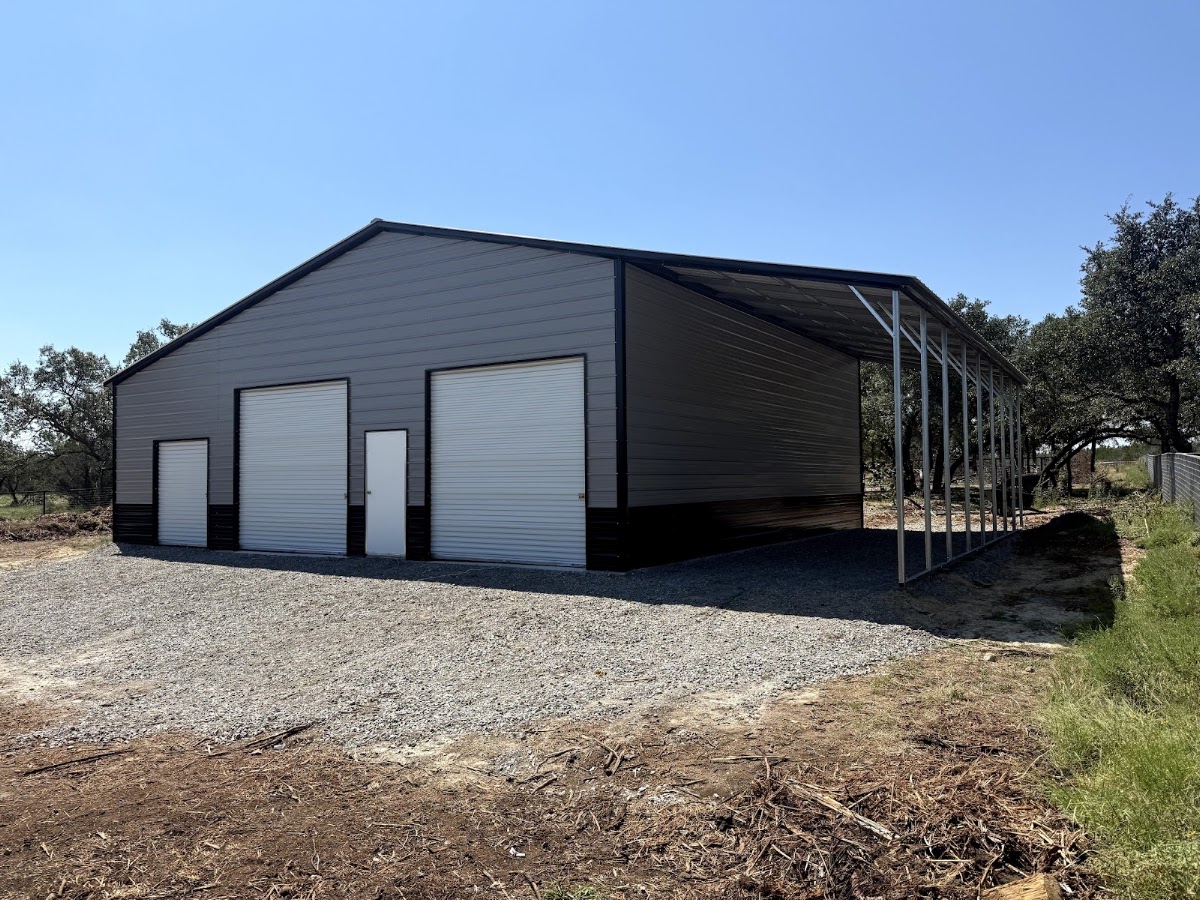


Steel building financing is the part of the buying process most buyers ignore until they’re ready to order, and that timing mistake routinely costs them months of delays and worse loan terms. A 30×40 shop, a 40×60 garage, or a 50×100 commercial warehouse all carry price tags that most buyers can’t cover from a checking account, and understanding your financing options before you request your first quote puts you in a significantly stronger negotiating position.
This guide breaks down every realistic steel building financing option available in 2026, what each one costs in terms of interest rates and fees, and how to structure your application for the best chance of approval. For a full overview of project costs before you begin, use our Steel Building Cost Calculator.
QUICK ANSWER: Steel Building Financing
Steel buildings can be financed through construction loans (7–12% APR), equipment loans (6–14% APR), personal loans (8–18% APR), USDA farm loans (4.5–6% for agricultural use), SBA 504 loans (6.5–8.5% for commercial projects), or manufacturer payment plans. The right option depends on the building’s use, your credit profile, and whether the structure is classified as real property or personal property.
1. Why Steel Building Financing Is Different From a Standard Mortgage
Before comparing loan products, it helps to understand why steel building financing operates differently from buying a house or financing a car.
The real property vs. personal property distinction matters. A steel building permanently anchored to a concrete foundation on land you own can be financed as real property, which opens doors to construction loans and commercial mortgages with lower rates. A steel building on leased land or not permanently affixed may only qualify as personal property, limiting you to equipment loans or personal loans at higher rates.
Kit-only vs. turnkey purchase matters too. Some lenders won’t finance a building kit alone. They want to see a complete project: site prep, foundation, building, and installation together. Others will finance just the kit. Knowing which type of financing you need before you apply saves you from wasted applications.
Intended use drives loan product eligibility. A farm shop qualifies for USDA farm loans. A commercial warehouse qualifies for SBA 504. A personal garage doesn’t qualify for either. Matching your building’s use to the right loan product is the first step.
2. Construction Loans for Steel Buildings
A construction loan is the most straightforward way to finance a complete steel building project when the building will be permanently affixed to your property.
- You apply with a lender and submit a complete project budget
- The lender approves a loan amount based on total project cost (site prep, foundation, building kit, erection)
- Funds are disbursed in draws as construction milestones are completed
- Upon project completion, the loan typically converts to a standard mortgage or commercial loan
| Loan Type | 2026 Rate Range | Down Payment | Min Credit Score |
|---|---|---|---|
| Residential construction | 7.0% – 9.5% APR | 10–20% | 680 (FHA: 580) |
| Commercial construction | 7.5% – 12.0% APR | 15–25% | 680+ |
| Agricultural construction | 6.0% – 8.5% APR | 10–20% | 650+ |
KEY INSIGHT
Most steel building construction loans require a complete set of engineered drawings and a licensed general contractor. If you’re planning to self-erect your building, check with the lender before applying. Some lenders accept owner-builders; most prefer a licensed GC.
3. Equipment Loans and Chattel Mortgages
If your steel building is not permanently affixed to land, or if you’re financing the kit as personal property, an equipment loan or chattel mortgage may be the most accessible option. The loan is secured by the building kit itself as collateral.
| Credit Profile | 2026 Rate Range | Typical Terms |
|---|---|---|
| Strong (720+) | 6.0% – 9.5% APR | Up to 15 years |
| Average (660–719) | 9.5% – 14.0% APR | 5–10 years |
| Below average (below 660) | 14.0% – 22.0% APR | 3–7 years |
Equipment loans approve in 24–72 hours and work for kit-only purchases, including buildings on leased land. The tradeoff is higher rates and shorter terms than construction loans.
4. USDA Farm Loans for Agricultural Steel Buildings
If your steel building will be used for agricultural purposes (farm shop, livestock shelter, grain storage, equipment barn), USDA Farm Service Agency (FSA) and USDA Rural Development loans offer some of the lowest rates available for any steel building project.
- USDA FSA Direct Farm Loans: As low as 4.5% (subsidized) to 6.5% APR; terms up to 40 years for real estate
- USDA Rural Development Business Loans: 5.5%–7.5% APR for rural businesses under 50,000 population
- Down payment: 0% for some FSA programs
KEY INSIGHT
USDA farm loans have the lowest available rates for steel building projects in 2026, but the application process takes 30–90 days. If your building qualifies for agricultural use, start the USDA application before you finalize your building order to avoid a construction start delay.
5. SBA 504 Loans for Commercial Steel Buildings
The SBA 504 loan program is the best financing option available for commercial steel building projects. It’s structured with 50% from a conventional lender, 40% from a Certified Development Company (CDC) backed by the SBA, and 10% down from the borrower.
| SBA 504 Component | 2026 Rate | Term |
|---|---|---|
| Conventional lender portion (50%) | 7.5% – 10.0% | Negotiated |
| SBA/CDC portion (40%) | 6.0% – 7.5% fixed | 20 years |
| Borrower down payment | 10% equity | — |
Eligibility: For-profit business, net worth under $20M, building must be 51%+ owner-occupied. Loan limit: up to $5.5 million. Best for commercial warehouses, manufacturing facilities, auto shops, and contractor yards.
BUYER WARNING
SBA 504 loans are excellent financing vehicles but require 60–120 days to close. Do not order your steel building kit until SBA financing is confirmed. Most manufacturers hold pricing for 30 days; SBA approvals routinely take longer. Get the loan pre-approved before requesting your final building quote.
6. Personal Loans for Smaller Steel Building Projects
For building kits under $30,000 or for buyers who want the simplest possible financing, personal loans offer same-day to 3-business-day approval with no collateral required.
| Credit Score | 2026 Personal Loan Rate |
|---|---|
| Excellent (750+) | 8.0% – 12.0% APR |
| Good (700–749) | 12.0% – 16.0% APR |
| Fair (650–699) | 16.0% – 22.0% APR |
Personal loans make sense for small 20×20 or 24×30 garage kits, adding a carport, or covering the gap between another loan and your total project cost. Most lenders cap personal loans at $50,000–$100,000, making them unsuitable for larger commercial projects.
7. Manufacturer Financing and Payment Plans
Several major steel building manufacturers offer in-house financing or third-party lending partnerships. This can be convenient but deserves scrutiny. Manufacturer financing typically runs 8.5%–16.0% APR, higher than bank options for qualified borrowers.
Manufacturer financing makes sense when you have difficulty qualifying for bank financing or your credit score is in the 600–660 range. If you have strong credit (680+), you can almost certainly do better through a bank or credit union. Always compare any manufacturer financing offer against at least one independent lender quote before accepting.
8. Tax Advantages of Steel Building Purchases in 2026
Steel buildings purchased for business use qualify for significant federal tax deductions that can dramatically reduce the true net cost of your project.
Section 179 Deduction: Businesses can deduct the full purchase price of qualifying property in the year of purchase. The 2026 Section 179 deduction limit is $1,220,000 (phase-out begins at $3,050,000 in total purchases). A $50,000 commercial steel building kit placed in service this year could yield a $50,000 deduction, reducing taxable income dollar-for-dollar.
Bonus Depreciation: bonus depreciation was restored to 100% in 2026 (per the One Big Beautiful Act signed in 2025) (restored from 40% to 100% by the One Big Beautiful Act signed in 2025), applying to remaining cost after Section 179. It is scheduled to drop to 20% in 2027.
KEY INSIGHT
A business purchasing a $75,000 steel building kit in 2026 and placing it in service before December 31 could potentially deduct $75,000 in Year 1 under Section 179, reducing the net cost by $16,500–$22,500 depending on the business tax bracket. Consult a tax professional to confirm eligibility for your specific project.
9. How to Improve Your Approval Chances
- Know your credit score. Pull your credit report from all three bureaus before applying. A 20-point improvement in your score can lower your rate by 0.5–1.5%.
- Prepare a complete project budget. Lenders want a full cost breakdown: site prep, foundation, building kit, erection, permits, and contingency. Use our Steel Building Cost Calculator to build this out.
- Get your building quotes first. Before applying for financing, request manufacturer quotes from our top-rated steel building companies. Having a real quote strengthens your application.
- Reduce existing debt. Your debt-to-income ratio significantly affects construction loan approvals. Pay down revolving debt before applying where possible.
- Apply to multiple lenders. Multiple hard inquiries for the same loan type within a 30-day window are treated as a single inquiry by FICO. Shop at least 3 lenders.
10. Common Steel Building Financing Mistakes
| Mistake | Why It Costs You | Fix |
|---|---|---|
| Applying before getting a building quote | Lenders need real project costs; estimates cause delays | Get a manufacturer quote first, then apply |
| Ignoring tax deductions | Missing Section 179 can cost $15,000–$25,000 in Year 1 tax savings | Consult a CPA before you close on financing |
| Accepting manufacturer financing without shopping | Manufacturer rates often run 3–5% higher than bank options | Get one bank/credit union quote before accepting |
| Not factoring in delivery and erection | Financing only the kit leaves a $10,000–$20,000 gap | Finance the full project cost, not just the kit |
| Applying with a weak credit profile | Higher rates and possible denial | Wait 6 months, pay down debt, then apply |
| Missing the SBA 504 opportunity | Paying 2–4% higher rate over 20 years costs tens of thousands | Check SBA 504 eligibility for any commercial building |
| Starting construction before financing closes | Lender may require all work to stop until close | Get financing confirmed before breaking ground |
Article Summary
- Steel building financing options in 2026 include construction loans, equipment loans, personal loans, USDA farm loans, SBA 504, and manufacturer payment plans
- Construction loans offer the lowest rates (7–9.5%) for permanently installed buildings on owned land
- USDA farm loans offer rates as low as 4.5% for qualifying agricultural structures
- SBA 504 loans are the best option for commercial steel building projects up to $5.5M
- Equipment loans provide fast approval (24–72 hours) but carry higher rates (6–22% depending on credit)
- Personal loans work for projects under $30,000 or as gap financing
- Section 179 allows businesses to deduct the full purchase price in Year 1 (up to $1.22M in 2026)
- bonus depreciation was restored to 100% in 2026 (per the One Big Beautiful Act signed in 2025), declining to 20% in 2027
- Always get a manufacturer quote before applying for financing
- Get at least 3 lender quotes before accepting any financing offer
- Use the Steel Building Cost Calculator to build your full project budget
- Review our top steel building companies to get accurate quotes for your financing application
Frequently Asked Questions
How do you finance a steel building?
Steel buildings can be financed through construction loans (7–12% APR), equipment or chattel loans (6–22% APR), personal loans (8–22% APR), USDA farm loans (4.5–6.5% for agricultural use), SBA 504 loans (6–8.5% for commercial projects), or manufacturer payment plans. The best option depends on the building’s intended use, whether it will be permanently anchored to land you own, and your credit profile.
Can you get a loan to buy a steel building kit?
Yes, you can finance a steel building kit through equipment loans, personal loans, or manufacturer financing. Kit-only purchases don’t qualify for construction loans, which require a complete project. Equipment loans approve quickly (24–72 hours) and are the most common option for kit-only financing.
What credit score do you need for a steel building loan?
Most construction loan lenders require a minimum credit score of 680. Equipment loans are available down to 600 but carry substantially higher rates. USDA farm loans have no hard minimum but require demonstrated farming need. SBA 504 loans generally require 650+. Personal loans are available from most lenders with scores as low as 580.
Are steel buildings tax deductible?
Yes, steel buildings used for business purposes qualify for significant tax deductions. Under Section 179, businesses can deduct up to $1,220,000 in 2026 for qualifying property placed in service that year. bonus depreciation was restored to 100% in 2026 (per the One Big Beautiful Act signed in 2025) on remaining cost after Section 179. Consult a CPA before your purchase to structure the timing for maximum tax benefit.
How much does it cost to finance a 40×60 steel building?
A 40×60 steel building full project costs approximately $70,000–$130,000 in 2026. Financing $90,000 over 10 years at 8% APR results in a monthly payment of approximately $1,092. See our 40×60 steel building kit cost guide for full project cost breakdowns. Use our Steel Building Cost Calculator to model payments for your specific project.
What is the SBA 504 loan for steel buildings?
The SBA 504 loan funds the purchase or construction of owner-occupied commercial real estate including steel buildings used as warehouses, manufacturing facilities, auto shops, or contractor yards. Structured with 50% from a conventional lender, 40% from an SBA-backed CDC, and 10% down from the borrower. The SBA portion carries a fixed rate of 6–7.5% in 2026 for 20 years, with loan limits up to $5.5 million.
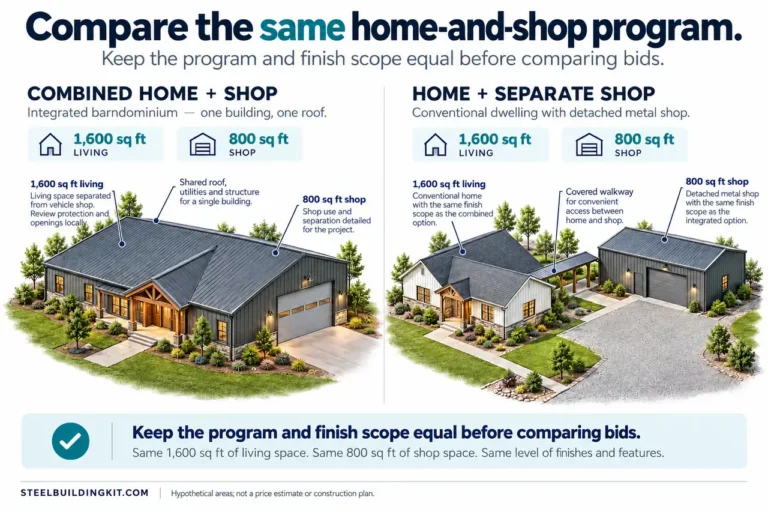
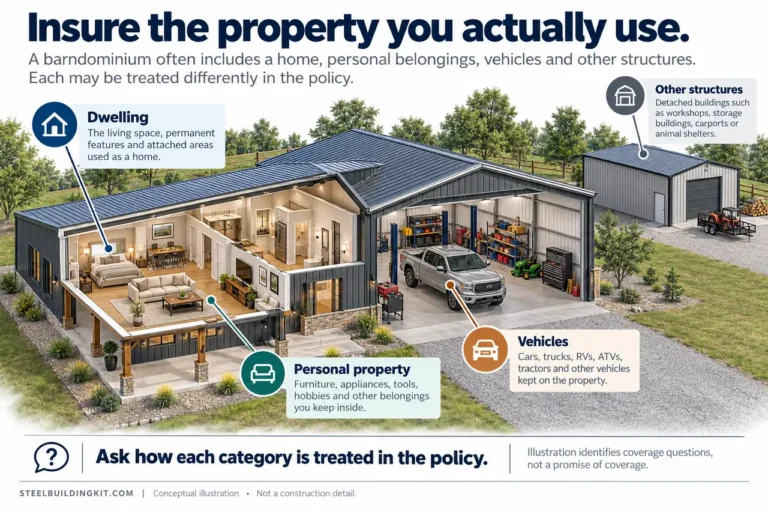
Can you finance a barndominium?
Yes, barndominiums can be financed through construction loans from agricultural or rural lenders, USDA Rural Development loans, or community bank programs. Fannie Mae and Freddie Mac conventional loans are rarely available for barndominiums due to appraisal challenges. See our barndominium kits guide for more detail on financing options.