


WHAT YOU’LL LEARN IN THIS GUIDE
• Real 2026 steel building insulation costs
per square foot by insulation type
• Which R-value you actually need by climate
zone and building use
• Fiberglass vs spray foam vs rigid board:
honest pros and cons for metal buildings
• What condensation (the “sweating” problem)
does to uninsulated steel and how to fix it
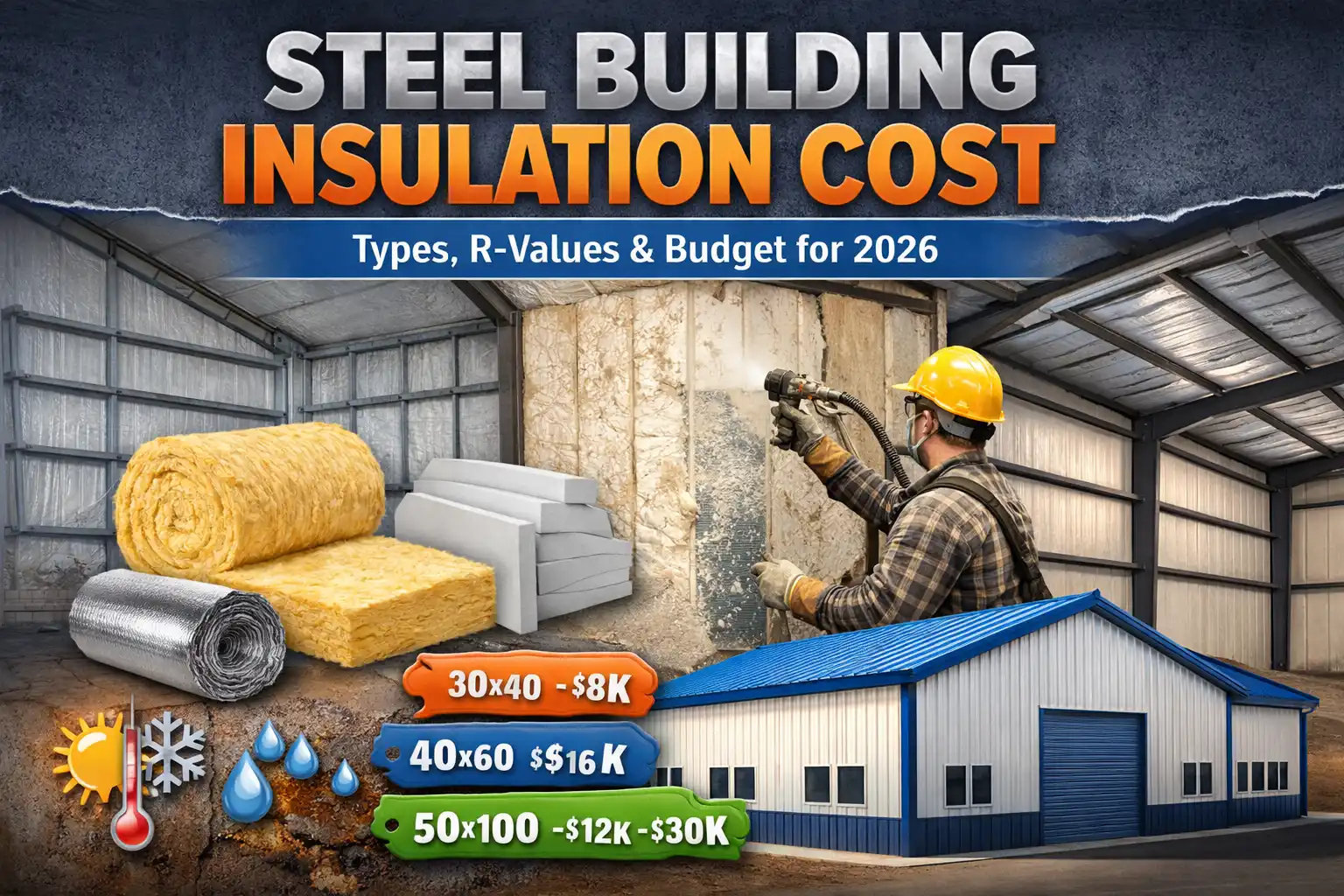
• Total insulation cost for 30×40, 40×60, and
larger buildings with real dollar estimates
• When to insulate during construction vs after
• The most common insulation mistakes and the
water damage they cause
Steel building insulation cost is one of the most underestimated line items in any metal building project. Most buyers budget for the kit and the slab, but forget that an uninsulated steel building is nearly unusable in summer heat, unbearable in winter cold, and prone to condensation damage year-round. Getting the insulation right from day one is far cheaper than retrofitting it after the fact.
This guide covers real 2026 costs for every major insulation type, which R-value you actually need based on your climate and use case, and the common mistakes that lead to mold, rust, and thousands in damage. For a broader look at the insulation methods we recommend, see our guide to insulating steel buildings.
QUICK ANSWER: Steel Building Insulation Cost
Steel building insulation costs $1.00–$4.00 per
square foot installed in 2026 depending on type.
Fiberglass batt is cheapest at $0.40–$1.50/sq ft.
Spray foam runs $1.50–$3.50/sq ft. Rigid foam
board costs $1.00–$2.50/sq ft. For a 40×60
building (2,400 sq ft walls and roof combined),
expect to pay $2,400–$9,600 for insulation alone,
depending on type, thickness, and R-value target.
1. Why Steel Buildings Need Insulation More Than Wood Buildings
Steel is an excellent conductor of heat and cold. That’s great for structural strength, but terrible for thermal performance. An uninsulated steel building has an effective R-value close to zero, meaning in summer it will reach temperatures 20–40 degrees above outdoor temperature, and in winter it will frost on interior surfaces.
The Condensation Problem
When warm, humid air hits a cold steel surface, it condenses into water droplets. This is called the “sweating” problem, and it is the leading cause of corrosion, mold, and structural damage in uninsulated metal buildings. Even in moderate climates, condensation builds up inside uninsulated buildings and drips onto floors, equipment, and stored goods.
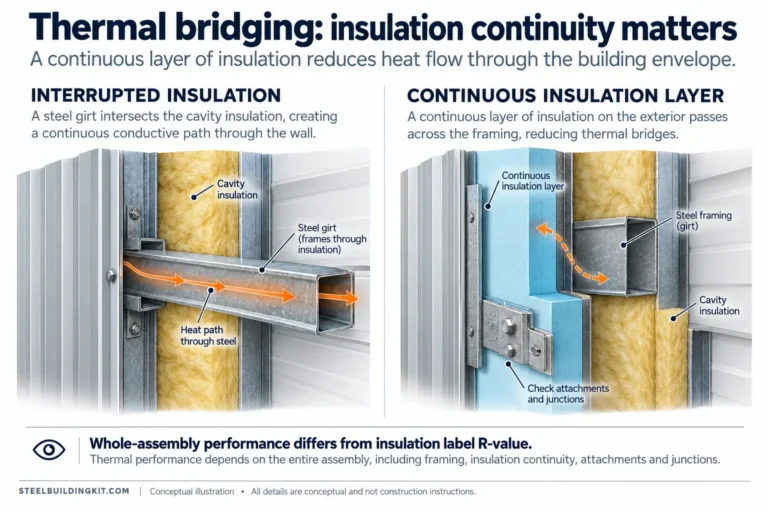
The Thermal Bridging Problem
Steel frames conduct heat between the exterior and interior of the building. Even when insulation is installed between panels, the steel frame itself bypasses that insulation like a highway for heat loss. Proper insulation systems address thermal bridging, not just the air spaces between framing members.
KEY INSIGHT
Studies show that thermal bridging through steel
framing members can reduce effective R-value by
30–50% compared to the rated R-value of the
insulation alone. A building insulated to R-19
with fiberglass between steel members may
perform closer to R-10 in practice without a
thermal break layer.
2. Steel Building Insulation Types: Cost and Performance Comparison
Here is how the main insulation types compare in a metal building application.
Type 1: Fiberglass Batt Insulation (Most Common)
| Spec | Data |
|---|---|
| Cost per sq ft (installed) | $0.40–$1.50 |
| R-value per inch | R-2.9–R-3.8 |
| Common thicknesses | 2″ (R-8), 4″ (R-13), 6″ (R-19), 8″ (R-25) |
| Best for | New construction, standard workshops, garages |
| Not ideal for | High-humidity climates, tightly sealed buildings |
Fiberglass batt insulation, also called blanket insulation, is the most widely used insulation in new metal building construction. It comes with a foil or vinyl vapor retarder facing and installs between the outer panel and an optional inner liner panel. It handles most applications well, is code-compliant in most Zone 1–4 climates at the right thickness, and is the most cost-effective solution per R-value point.
Type 2: Spray Foam Insulation
| Spec | Data |
|---|---|
| Cost per sq ft (installed) | $1.50–$3.50 |
| R-value per inch | R-6.0–R-7.0 (closed-cell) |
| Common thicknesses | 2″ (R-12), 3.5″ (R-21–R-25), 5″ (R-30–R-35) |
| Best for | Climate-controlled buildings, offices, barndominiums |
| Not ideal for | Open storage buildings, tight budgets |
Closed-cell spray foam is the highest-performing insulation option for metal buildings. It bonds directly to the steel surface, creates an air and vapor barrier, and eliminates thermal bridging because it encapsulates the frame rather than filling only the spaces between framing members. It is significantly more expensive than fiberglass but delivers the best results in climates with extreme heat or cold.
BUYER WARNING
Open-cell spray foam should NOT be used on
exterior steel surfaces. Open-cell foam absorbs
moisture and can hold water against the steel,
accelerating corrosion. Always specify closed-
cell foam for metal building wall and roof
applications.
Type 3: Rigid Foam Board Insulation
| Spec | Data |
|---|---|
| Cost per sq ft (installed) | $1.00–$2.50 |
| R-value per inch | R-4.0–R-6.5 (polyiso or EPS) |
| Common thicknesses | 1″ (R-4–R-6.5), 2″ (R-8–R-13), 3″ (R-12–R-20) |
| Best for | Thermal break layers, retrofits, walls with liner |
| Not ideal for | Standing-alone as primary insulation in cold climates |
Rigid foam boards are excellent as a thermal break layer between the steel frame and the outer panel. They eliminate the thermal bridging problem better than fiberglass. Many experienced builders use a combination: rigid foam board installed on the exterior of the frame as a thermal break, plus fiberglass batt in the cavity, getting the benefits of both.
Type 4: Double-Bubble Reflective Insulation
| Spec | Data |
|---|---|
| Cost per sq ft (installed) | $0.50–$1.00 |
| R-value (standalone) | R-1 to R-3 (controversial) |
| Best for | Condensation control only; radiant heat reflection |
| Not ideal for | Cold climates, primary insulation in any climate |
Double-bubble or foil reflective insulation is heavily marketed for metal buildings but provides minimal thermal performance as a standalone system. Its main value is condensation control by keeping the interior surface above the dew point. In warm climates, it adds real value for radiant heat reflection. In cold climates, it should not be used as a primary insulation system.
3. What R-Value Do You Need for a Steel Building?
R-value requirements depend on your climate zone, building use, and whether you plan to heat or cool the building.
| Building Use | Walls | Roof | Climate Zone |
|---|---|---|---|
| Open storage, no climate control | R-6 minimum | R-6 minimum | All zones |
| Workshop, heated in winter only | R-13 minimum | R-19 minimum | Zones 1–3 |
| Workshop, heated and cooled | R-19 | R-25–R-30 | Zones 4–6 |
| Residential/barndominium | R-19–R-25 | R-30–R-38 | Zones 4–6 |
| Climate-controlled commercial | R-25–R-30 | R-38–R-49 | Zones 5–7 |
Quick Climate Zone Reference
- Zone 1–2: Florida, Gulf Coast, Hawaii (mild winters)
- Zone 3–4: Mid-South, Pacific Coast, Texas, Southeast
- Zone 5–6: Midwest, Mountain West, Mid-Atlantic, New England
- Zone 7: Northern Minnesota, Montana, Alaska
For climate-controlled spaces in the upper Midwest or Mountain West, most building professionals recommend R-30 minimum for the roof. The roof gains and loses far more heat than the walls due to direct sun exposure and the natural tendency for heat to rise.
4. Real Insulation Costs by Building Size (2026)
Here are realistic total insulation cost estimates for common building sizes in 2026. These figures cover the full wall and roof surface area, not just the floor footprint.
30×40 Building (1,200 sq ft floor / ~3,200 sq ft total surface)
| Insulation Type | R-Value | Estimated Cost |
|---|---|---|
| Fiberglass batt (R-13) | R-13 walls, R-19 roof | $1,280–$4,800 |
| Spray foam (closed-cell) | R-21 walls, R-30 roof | $4,800–$11,200 |
| Hybrid (rigid board + fiberglass) | R-19 walls, R-25 roof | $3,200–$7,200 |
40×60 Building (2,400 sq ft floor / ~5,800 sq ft total surface)
| Insulation Type | R-Value | Estimated Cost |
|---|---|---|
| Fiberglass batt (R-13) | R-13 walls, R-19 roof | $2,320–$8,700 |
| Spray foam (closed-cell) | R-21 walls, R-30 roof | $8,700–$20,300 |
| Hybrid (rigid board + fiberglass) | R-19 walls, R-25 roof | $5,800–$13,050 |
50×100 Building (5,000 sq ft floor / ~11,000 sq ft total surface)
| Insulation Type | R-Value | Estimated Cost |
|---|---|---|
| Fiberglass batt (R-13) | R-13 walls, R-19 roof | $4,400–$16,500 |
| Spray foam (closed-cell) | R-25 walls, R-38 roof | $16,500–$38,500 |
For a personalized estimate with your building’s specific dimensions, use our steel building cost calculator.
5. Insulating During Construction vs Retrofitting: What It Costs
Insulating a steel building during initial construction is significantly cheaper than retrofitting insulation after the fact. Here is why.
New Construction Insulation
Fiberglass batt insulation is installed after the frame is up but before the inner liner panels are added. The panels sandwich the insulation in place, requiring no adhesive or additional fasteners. Labor is fast and material waste is minimal. This is the most cost-effective window to insulate.
Retrofit Insulation (Adding After Construction)
Retrofitting insulation into an already-enclosed steel building requires either: removing interior liner panels and reinstalling them with insulation, or spray-foaming the entire interior surface. Both approaches are more labor-intensive and expensive than new construction insulation. Spray foam retrofit is the most common approach, but adds $1.50–$3.50/sq ft in material and labor costs.
KEY INSIGHT
Retrofitting insulation into an enclosed steel
building typically costs 30–60% more than
installing the same insulation during original
construction. If you plan to heat or cool your
steel building at any point, insulate it during
the build, not after.
6. Vapor Barriers and Condensation Control
Every steel building in a climate with temperature swings needs a vapor retarder. This is separate from and in addition to the insulation itself.
What a Vapor Retarder Does
It slows the migration of moisture-laden air through the insulation toward the cold steel surface. Without it, condensation forms on the interior of the steel panels during cold weather, dripping onto stored goods and corroding the frame from the inside.
Standard Options
- Foil-faced fiberglass batt: includes an integrated vapor retarder on the building interior face. Best for new construction.
- 6-mil poly sheeting: installed on warm side of insulation. Low cost but must be carefully sealed at seams.
- Closed-cell spray foam: acts as its own vapor barrier. Best overall performance.
For buildings in high-humidity climates (Gulf Coast, Southeast), vapor control is even more critical. The guide to insulating steel buildings covers vapor control in detail for each climate type.
7. Common Insulation Mistakes in Steel Buildings
| Mistake | Why It Costs You | Fix |
|---|---|---|
| Installing no insulation on an “unheated” shop | Condensation destroys tools, flooring, and panels | Install R-6 minimum even for storage buildings |
| Using open-cell foam on exterior steel surfaces | Absorbs moisture, promotes corrosion | Specify closed-cell foam only for steel contact |
| Using reflective insulation alone in a cold climate | R-1 to R-3 is not adequate for freeze-thaw zones | Use as vapor control supplement only; add fiberglass |
| Skipping the vapor retarder to save money | Condensation drips and rusts interior frame | Foil-faced fiberglass costs almost nothing more |
| Insulating walls but not the roof | 70% of heat gain and loss is through the roof | Always insulate the roof to at least R-19 |
| Retrofitting insulation instead of new-construction | 30–60% more expensive | Budget for insulation from day one |
| Not accounting for thermal bridging | Effective R-value 30–50% lower than labeled | Add rigid foam thermal break layer at framing |
| Ignoring local energy codes | Fails inspection, requires reinstall | Check IECC requirements for your zone before ordering |
8. Article Summary
- Steel building insulation costs $1.00–$4.00 per square foot installed in 2026, depending on type and thickness
- Fiberglass batt is most cost-effective at $0.40–$1.50/sq ft; spray foam delivers best performance at $1.50–$3.50/sq ft
- Total insulation cost for a 40×60 building ranges from $2,320 (basic fiberglass) to $20,300 (full spray foam)
- Condensation is the primary reason to insulate even unheated storage buildings; it corrodes frames and destroys stored goods
- Thermal bridging through steel framing can reduce effective R-value by 30–50% without a foam thermal break layer
- R-19 walls and R-25–R-30 roof are the practical minimums for a heated, climate-controlled steel building in Zone 4–6
- Closed-cell spray foam is the highest-performance option but costs 2–4x more than fiberglass
- Always insulate during original construction; retrofits cost 30–60% more
- Open-cell foam should never contact exterior steel surfaces; it holds moisture and accelerates corrosion
- Use our steel building cost calculator to factor insulation into your full project budget
Frequently Asked Questions
How much does it cost to insulate a steel building?
Steel building insulation costs $1.00–$4.00 per square foot installed in 2026, depending on insulation type and R-value target. Fiberglass batt is cheapest at $0.40–$1.50/sq ft. Closed-cell spray foam runs $1.50–$3.50/sq ft. For a 40×60 building with 2,400 square feet of floor space, total insulation costs typically run $2,320–$20,300 depending on type and thickness. Use our steel building cost calculator for a detailed estimate.
What is the best insulation for a metal building?
For most metal buildings that will be heated or cooled, closed-cell spray foam delivers the best thermal and moisture performance but at the highest cost. For budget-conscious new construction, foil-faced fiberglass batt insulation with a thermal break layer of rigid foam board is the best value combination. For unheated storage buildings, R-6 minimum fiberglass with a foil vapor retarder is adequate to prevent condensation damage.
What R-value do I need for a steel building?
R-value needs depend on your climate zone and how you’ll use the building. For a heated workshop in a moderate climate (Zone 4), R-13 walls and R-19 roof is the minimum. In colder climates (Zone 5–7), R-19–R-25 walls and R-30–R-38 roof are more appropriate. For a barndominium or residential-use building, R-19–R-25 walls and R-30–R-38 roof should be the starting point. See our full insulation guide at guide to insulating steel buildings.
Can I insulate a steel building myself?
Fiberglass batt insulation in a steel building is a viable DIY project during new construction. The insulation blankets install between the outer panel and the inner liner panel using standard fasteners. Spray foam insulation requires professional equipment and certification and is not a DIY job. Rigid foam board installation can also be done by a skilled owner-builder. For retrofits of already-enclosed buildings, professional spray foam is the most practical approach.
Why is my steel building dripping condensation inside?
Condensation inside a steel building occurs when warm humid air contacts the cold steel skin. The fix is insulation plus a vapor retarder. Even for unheated storage buildings, a minimum R-6 fiberglass with foil facing prevents most condensation. If your building is already enclosed and condensing, the most practical retrofit solution is closed-cell spray foam applied to the interior steel surfaces. More detail on condensation solutions is in our guide to insulating steel buildings.
When is the cheapest time to insulate a steel building?
During original construction, before the inner liner panels are installed. Fiberglass insulation is dropped into place and sandwiched between the outer panel and liner with no additional labor for adhesive or fasteners. Retrofitting insulation after the building is closed costs 30–60% more than new-construction installation. If you’re ordering a steel building kit and plan to climate-control the space at any point, include insulation in the original build.
What insulation types should NOT be used on steel buildings?
Open-cell spray foam should not be used on exterior steel surfaces because it absorbs moisture and holds it against the steel, accelerating corrosion. Single-layer double-bubble reflective insulation should not be used as the sole insulation in cold climates; it provides R-1 to R-3 at best and is insufficient for freeze-thaw conditions. Kraft-faced fiberglass designed for wood-frame construction can also perform poorly in metal buildings due to different moisture dynamics.