


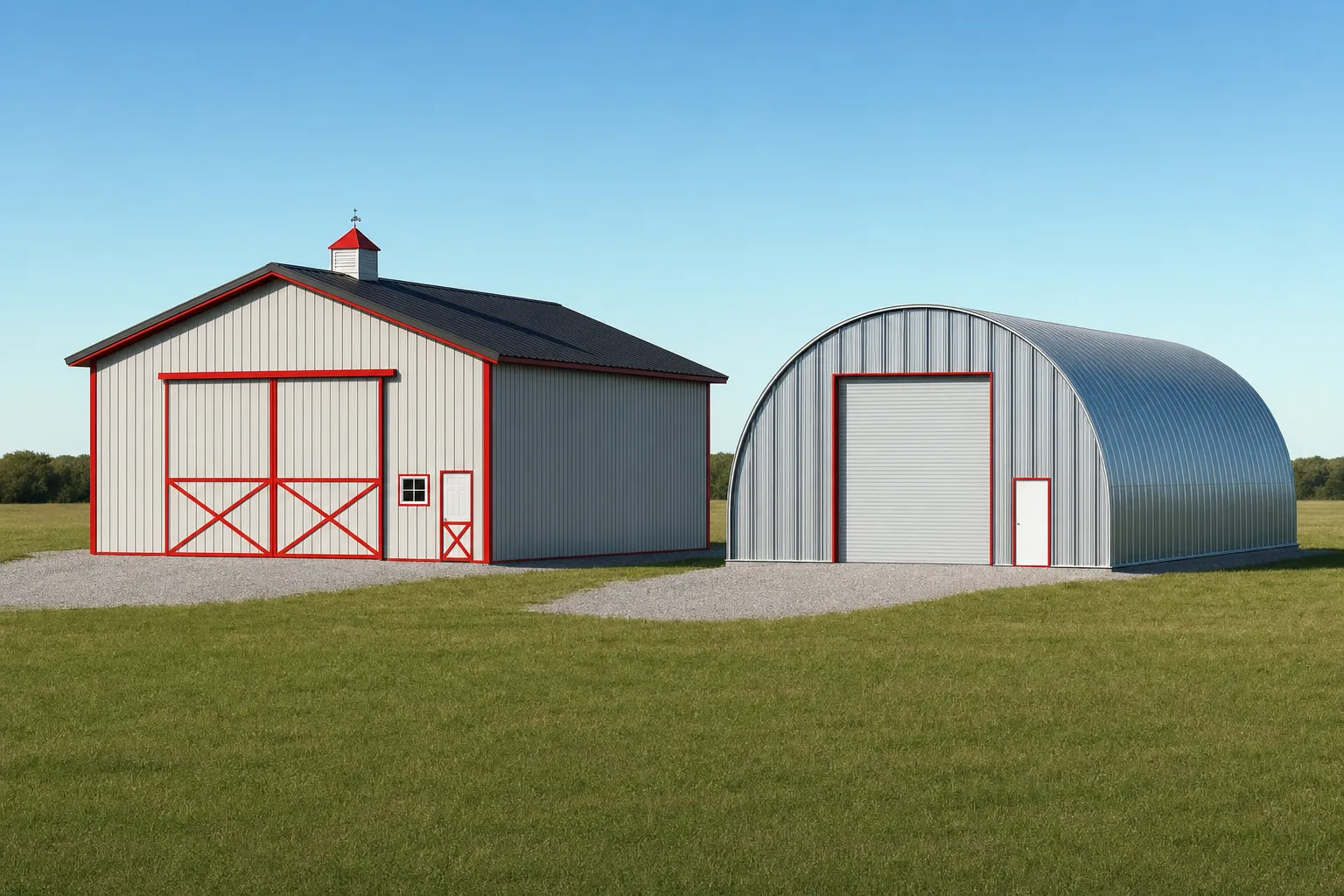
SteelBuildingKit Cost Index · Updated July 10, 2026 · Pricing collected June-July 2026
Upfront, the pole barn usually wins: at 30×40, a pole barn runs $26,000-$43,000 built against a quonset’s $32,000-$48,000 turnkey, and at 40×60 it is $44,000-$77,000 against $55,000-$85,000 (modeled national ranges, July 2026). Pole barns price 10-20% cheaper on small, simple builds. Over a decade of ownership the ledger flips: steel carries 10-25% lower insurance, no rot, and no $3,000-$6,000 per decade repaint bill, and by year 10 the quonset is usually the cheaper building.
This is the classic rural building decision, and both camps argue with real numbers that measure different things: the pole barn crowd quotes the build price, the steel crowd quotes the ownership price. This comparison, part of our quonset and framing cost hub, prices both honestly at the two sizes where the choice actually gets made, then runs the long-term ledger.
| Size | Quonset turnkey modeled | Pole barn built modeled | Upfront edge |
|---|---|---|---|
| 30×40 (1,200 sqft) | $32,000 – $48,000 | $26,000 – $43,000 | Pole barn by ~10-20% |
| 40×60 (2,400 sqft) | $55,000 – $85,000 | $44,000 – $77,000 | Pole barn by ~10-20% |
Quonset turnkey = arch kit, end walls, delivery, slab with thrust detail, and assembly. Pole barn = post-frame package, embedded posts, metal skin, and labor, on a gravel floor as commonly built; a concrete floor narrows the gap. Modeled national ranges, July 2026.
Quonset figures are modeled national estimates from published manufacturer price lists and advertised arch specials collected June-July 2026; pole barn figures are modeled from published post-frame package pricing over the same window, cross-checked against component benchmarks for concrete, framing labor, and metal skin. Both sides are labeled modeled and quoted as ranges; insurance and maintenance deltas are modeled from typical premium and repaint benchmarks, not carrier quotes. Full methodology in the SteelBuildingKit Cost Index.
Why the pole barn is cheaper on day one
The pole barn’s upfront edge comes from its foundation, or rather the lack of one. Treated posts embedded in concrete-collared holes replace an engineered slab, so a pole barn can stand on a gravel floor for thousands less than any steel building’s concrete package. Lumber packages price below arch steel at small sizes, and nearly every rural county has post-frame crews, which keeps labor competitive. Here is where the money sits at 30×40.
| Line item | Quonset modeled | Pole barn modeled |
|---|---|---|
| Structure package | $18,000 – $26,000 arch kit | $14,000 – $24,000 post-frame package |
| End walls | $3,000 – $12,000 each | Included in package |
| Foundation / floor | $9,200 – $20,400 slab + thrust | $2,000 – $5,000 posts, gravel floor |
| Labor | $0 DIY – $12,000 crew | $8,000 – $12,000 crew |
| Concrete floor later | Already included | +$7,200 – $14,400 if added |
| As commonly built | $32,000 – $48,000 | $26,000 – $43,000 |
Worked example at national mid-range rates: a mid-spec 30×40 quonset (kit $19,500, end walls $7,000, thrust slab $10,500, pro assembly $6,000, freight and permits $1,600) lands near $44,600; the equivalent pole barn (package $19,000, post setting $3,500, crew $10,000, permits $600) lands near $33,100 on gravel, or about $43,300 with a concrete floor poured. The upfront gap is real, and most of it is the floor. Run either building against your own county in the steel building cost calculator.
Choices that swing the comparison
| Choice | Typical impact modeled | Worth it when |
|---|---|---|
| Concrete floor in the pole barn | +$7,200 – $14,400 at 30×40 | Shop use; erases most of the upfront gap |
| DIY quonset assembly | -$6,000 – $15,000 | Owner has helpers and weekends; pole barns rarely offer this |
| Heavy snow engineering | +8% – 15% on the quonset kit | Arch sheds snow; wood trusses need upsizing too |
| Blanket insulation, either building | +$2.50 – $4.00 /sqft | Any heated use |
| Extra roll-up door | +$1,500 – $4,500 installed | Drive-through bays, either building |
The two lines at the top decide most contests. If the pole barn needs a concrete floor for shop use, its foundation advantage mostly evaporates. And if the owner assembles the quonset, the arch takes the upfront lead outright: a DIY 30×40 quonset near $38,000 undercuts a crew-built pole barn with a floor.
The 10-year ledger: where steel takes the lead
Purchase price is one payment; ownership is a stream of them, and the stream favors steel. Galvanized arches do not rot, do not feed termites, and never need paint; wood siding and trim want repainting or restaining at $3,000-$6,000 per decade (modeled). Embedded posts are the pole barn’s known weakness: ground contact eventually rots even treated lumber, and post repairs are structural work, not maintenance. Insurers price the difference too: all-steel, non-combustible construction typically runs 10-25% below wood-framed premiums, worth $1,200-$6,000 over 20 years on a typical $600-$1,200 annual policy (modeled, July 2026). Stack a decade of those lines against a $5,000-$8,000 upfront saving and the crossover lands around year 10, earlier in wet climates and termite country, later in dry ones. On resale, a permitted steel building on engineered concrete also appraises more cleanly than aging post-frame, though both trail their build cost as outbuildings do.
How your location moves this comparison
County conditions push the two buildings differently. Heavy snow adds 8-15% to the quonset kit but also forces truss and post upsizing on the pole barn, so snow country narrows the gap less than the steel premium suggests, and the arch sheds load better. Frost depth hits both foundations: deep footings add $1,000-$2,500 to a thrust slab and deepen post holes too. Wet climates and termite regions shorten pole life and tilt the ledger toward steel early; arid counties are the pole barn’s best case. Freight favors the pole barn (lumber is local; arches ship $800-$2,500), while labor favors whichever trade is thick in your county. Permits run $150-$2,500 either way, and a few jurisdictions treat embedded-post buildings less favorably for permanent occupancy, worth one phone call before you decide.
When each building wins
Choose the pole barn when the mission is a simple, dry-climate ag building on a gravel floor, built once by a local crew at the lowest possible upfront price, or when a wood-framed look matters for the property. Choose the quonset when you will own the building past year 10, when insurance and maintenance dollars matter, when snow loads are serious, or when you will assemble it yourself and pocket the $6,000-$15,000 labor line. Budget-first buyers should price both honestly: the full line-item stack for the arch side lives in our complete quonset hut cost guide, and the per-square-foot version in the quonset cost per square foot breakdown.
The comparison checklist
- Both quotes at the same floor spec: gravel-to-gravel or concrete-to-concrete, never mixed
- Quonset quote includes end walls and the thrust foundation detail, itemized
- Pole barn quote names post treatment rating and truss spacing for your snow load
- Insurance quotes pulled for BOTH constructions before deciding; the delta is real money
- Maintenance honestly budgeted: $3,000-$6,000 per decade for painted wood, near zero for galvanized steel
- County permit office asked how it treats embedded-post buildings for your intended use
- DIY assembly priced on the quonset side if you have helpers; it flips most contests
For the per-foot math behind these totals, the quonset cost per square foot guide breaks the arch pricing down.
For the adjacent questions, quonset vs red iron cost and cold-formed vs red iron cost run the same modeled worksheet on their own scope.
Quonset vs pole barn FAQs
Is a quonset hut cheaper than a pole barn?
Not upfront: pole barns run 10-20% cheaper on small, simple builds, about $26,000-$43,000 against $32,000-$48,000 at 30×40 (modeled July 2026). Over time the quonset wins: 10-25% lower insurance, no rot, no $3,000-$6,000 repaint per decade. By year 10 the steel building is usually the cheaper one to have owned.
Why are pole barns cheaper to build?
The floor. Embedded posts replace an engineered concrete slab, so a pole barn stands on gravel for $7,000-$18,000 less foundation money than a quonset’s thrust slab at 30×40 (modeled July 2026). Add a concrete floor for shop use and most of that advantage disappears, which is why the comparison flips for workshops.
How long does a pole barn last compared to a quonset?
Well-maintained post-frame commonly serves 30-50 years, with embedded posts the limiting part in wet ground; galvanized steel arches routinely exceed that with no structural maintenance. The cost difference while both stand: wood wants $3,000-$6,000 per decade in paint and repair budget; the arch wants roughly none (modeled July 2026).
Is insurance really cheaper on a steel building?
Typically yes: non-combustible, all-steel construction rates 10-25% below wood-framed buildings for comparable coverage, worth $1,200-$6,000 over 20 years on a $600-$1,200 annual policy (modeled July 2026). Pull real quotes for both constructions before deciding; the delta varies by carrier and county but rarely reaches zero.
Which is better for heavy snow country?
The arch, usually. Quonsets shed snow by shape and take heavy-load engineering at +8-15% on the kit (modeled July 2026), while pole barns meet the same loads through upsized trusses and tighter post spacing that erode their price edge. Snow country is where the upfront gap gets smallest and the ownership case for steel gets strongest.
Ready to price this building for real? Compare verified metal building companies for this project type, with real reviews and track records.
Sources and methodology: published supplier price lists and advertised kit pricing for quonset and post-frame packages (June-July 2026); component cost benchmarks for ready-mix concrete, erection labor, and freight; IBC and ASCE 7 for load context. All figures are modeled national estimates, labeled as modeled, and reviewed quarterly; see the full Cost Index methodology. This guide links to our independent company directory; listings never change published numbers.
Written by the Steel Building Editorial Team | Last updated July 10, 2026