

SteelBuildingKit Cost Index · Updated July 10, 2026 · Pricing collected June-July 2026
To compare metal building quotes safely, send every company one identical written spec, score each quote against a component scope table, and normalize the gaps before ranking anything. The stakes are real: advertised prices run ±30-40% from final cost, written quotes ±5-10%, and the classic omissions (freight, anchor bolts, framed openings) hide $3,000-$6,000 inside a “cheap” bid (modeled July 2026). Deposits should run 10-25%, never half.
Metal building quotes are hard to compare because sellers control the spec, and no two write it the same way. One prices a 26-gauge building with generic loads and freight left off; another prices 24-gauge with your county’s engineering and delivery included, and the second one looks expensive for being honest. The method below removes that advantage. It takes an afternoon, and it is the highest-paid afternoon of the project. It belongs to our buying decisions hub, alongside the rest of the choose-well playbook.
| Stage | Accuracy modeled | What it reflects | Use it for |
|---|---|---|---|
| Advertised price | ±30 – 40% | Teaser spec, generic loads, no freight | Curiosity only |
| Online calculator | ±10 – 20% | Your size and scope, generic assumptions | Setting a fair-price band |
| Written quote | ±5 – 10% | Your spec, your county loads, itemized scope | Comparing companies |
| Locked contract | ±0 – 5% | Stamped engineering, price-lock window | Signing and scheduling |
Accuracy bands are modeled from the typical gap between each stage and final project cost, July 2026. Only numbers from the same rung compare fairly; never rank an advertised price against a written quote.
The dollar figures in this guide are modeled national estimates from published supplier price lists and advertised kit pricing collected June-July 2026, cross-checked against component benchmarks for freight, doors, engineering, and erection labor. The worked three-quote comparison is a modeled illustration built from those benchmarks, labeled modeled throughout, not a reproduction of any company’s bid. Full methodology lives in the SteelBuildingKit Cost Index.
Step one: write the spec once, send it to everyone
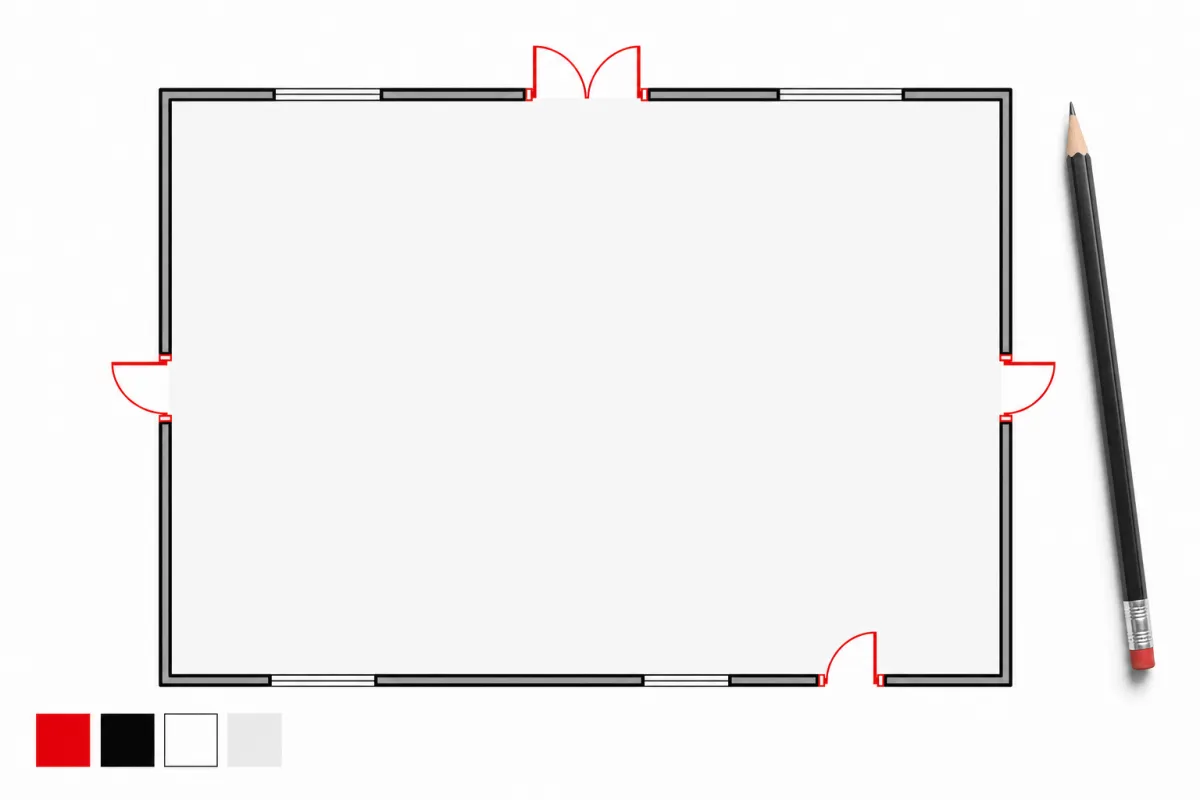
The whole method rests on one move: you write the spec, so every company prices the same building. One page covers it: dimensions and eave height, your delivery ZIP code, your county’s snow and wind loads (the building department will state them over the phone), panel gauge, the full door and window schedule, insulation if any, and the scope you want priced: kit only, kit plus erection, or turnkey. Email that page to every company and ask them to quote it as written, with any substitutions listed separately.
This one habit kills the two oldest tricks in the industry: quoting a lighter building than the one you described, and quoting generic 20 psf engineering that your 40 psf county will reject at permit time. It also makes the callback conversations shorter, because “does your number include freight to this ZIP?” is a yes-or-no question when the ZIP is on the spec sheet. Our steel building buyers guide walks through building this spec sheet in detail if you are starting from a blank page.
Step two: score every quote against the component menu
With quotes in hand, build a scope table: one row per component, one column per company, and a checkmark only where the quote states the item in writing. Price every empty cell at the component benchmarks below, because you will pay those numbers to someone even if this quote pretends otherwise.
| Component | Cost if missing modeled | What to ask |
|---|---|---|
| Freight to your ZIP | $500 – $3,000+ | “Delivered to my address, or FOB factory?” |
| Anchor bolts and base trim | $250 – $700 | “Itemized, included, or by others?” |
| Framed openings (each) | $300 – $800 | “Is every door opening framed in the price?” |
| Doors themselves | $1,500 – $4,500 roll-up; $400 – $1,200 walk | “Which doors are in, at what sizes?” |
| Engineering for MY county | $800 – $2,500 if re-done | “Stamped for these loads, in writing?” |
| Steel surcharge clause | 3 – 6% exposure if open | “How long is this price locked?” |
| Erection | $4 – $10 /sqft | “Included, referred, or mine to arrange?” |
| Concrete slab | $6 – $12 /sqft | “Included in turnkey, or excluded?” |
The classic gaps, and why they exist
Four omissions account for most quote-shopping regret. Freight quoted FOB factory means the price covers steel sitting at the plant; delivery to your site is extra, and you learn the number after deposit. Anchor bolts are excluded by long industry habit (“by others” on the drawings), a few hundred dollars that also decides who owns a mis-poured slab. Framed openings are the subtle one: a quote can include the roll-up door but not the framed opening it needs, or the reverse, and each half is real money. And the steel surcharge clause lets the price float with the steel market between deposit and fabrication; quotes lock for 7-30 days, so an unlocked price on a 10-week fabrication schedule is not a price, it is an opening offer. None of these are scams. They are conventions that favor whoever wrote the quote, which is exactly what normalization corrects.
A worked comparison: three quotes for the same 40×60
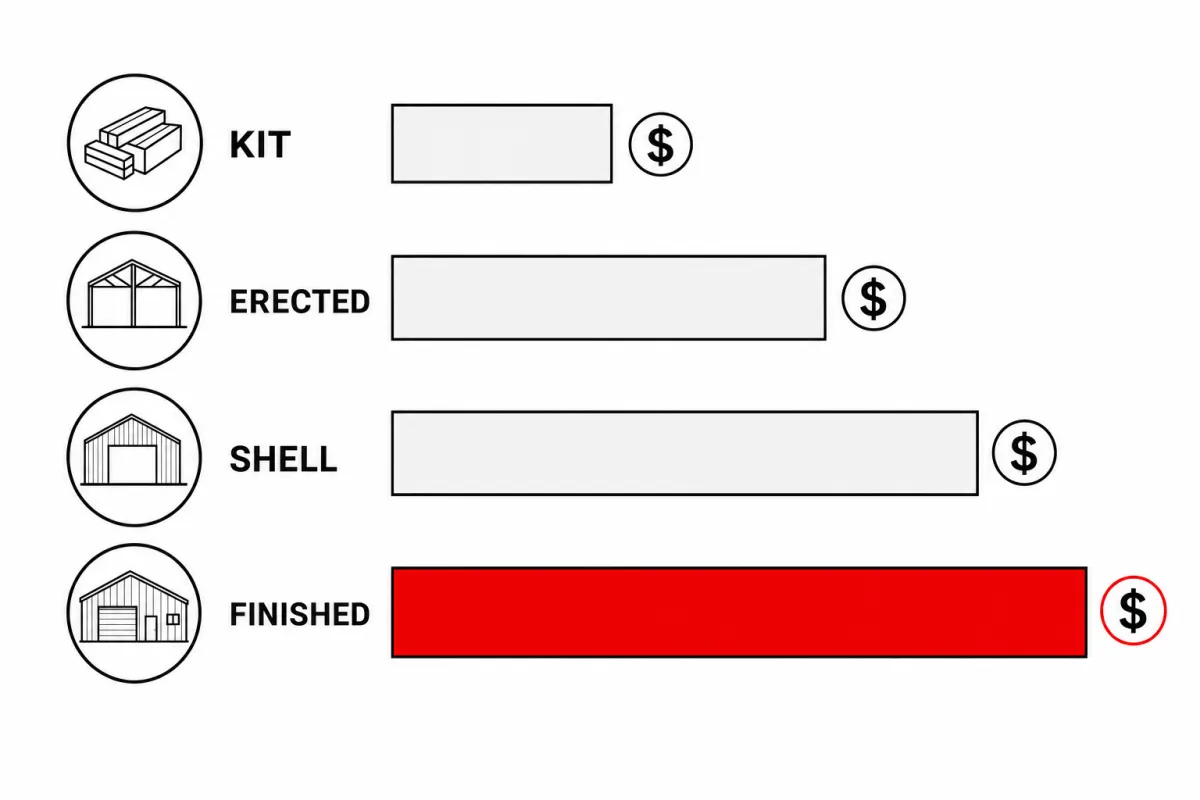
Modeled illustration, July 2026: three kit quotes for one written 40×60 spec with two framed openings, county loads stated, delivery 400 miles. As quoted, A looks like the winner by $3,500. The scope table says otherwise.
| Line | Quote A | Quote B | Quote C |
|---|---|---|---|
| As quoted | $28,400 | $31,900 | $33,700 |
| Freight to site | + $2,600 (FOB factory) | Included | Included |
| Anchor bolts and base trim | + $450 (by others) | + $400 (by others) | Included |
| Framed openings (2) | + $1,300 (one included) | Included | Included |
| Price lock | None: 3-6% exposure | 14 days | 30 days |
| Normalized total | $32,750 + open escalation | $32,300 locked | $33,700 locked |
After normalization, the $28,400 quote is the most expensive credible outcome: $32,750 before a surcharge clause that could add roughly $1,000-$1,900 during fabrication, worth treating as a $33,700-$34,700 planning number. Quote B wins at $32,300 locked, and C’s premium buys a longer lock that matters if your permit office is slow. Before any of this, know the fair band: a 40×60 kit models at $28,000-$44,000 (July 2026), and the steel building cost calculator will set that expectation for your own size and scope in two minutes. A quote far below the band is a spec problem you have not found yet.
Lock the spec levers before you shop
Every open decision is room for quotes to diverge. Settle these before the spec sheet goes out, because each one moves real money and “we assumed” is how comparisons die.
| Lever | Cost impact modeled | Worth it when |
|---|---|---|
| Eave height +2 ft | +6 – 9% on the kit | Lifts, RVs, racking, future flexibility |
| 24-gauge panels over 26 | +8 – 12% on panel cost | Hail country, longer warranty priorities |
| +10 ft of length | The cheapest square footage you can buy | Any doubt about space |
| Heavy snow/wind engineering | +8 – 15% on the kit | Not optional; set by your county |
| Each added roll-up door | +$1,500 – $4,500 installed | Real traffic patterns, not symmetry |
Deposits and payment schedules: the last safety check
Price is not the only thing to compare; the money schedule is a character reference. The industry standard is a 10-25% deposit, a progress payment when engineered drawings are approved, and the balance due at delivery. Erection bills on completion, and slab work runs roughly 50/50. Walk away from any seller wanting 50% or more upfront, full payment before delivery, or wire-only terms with no contract entity you can verify. And match the deposit to the accuracy ladder: money down belongs at the locked-contract rung, where the number is ±0-5%, never at the advertised-price rung. Companies with real backlogs do not need your cash months before they cut steel.
Know who is quoting you
Normalization also exposes what kind of company you are dealing with. Manufacturers quote their own steel and control fabrication dates; brokers resell from whichever plant is hungry, which can mean sharp prices and can also mean the freight and engineering vagueness the scope table catches. Neither model is wrong, and the honest ones in both camps survive normalization without drama, but the questions differ: ask a broker which plant fabricates and who holds the engineering; ask a manufacturer about their delivery radius and current backlog. The full breakdown lives in our guide to metal building manufacturers versus brokers.
Why quotes from different regions never match
If you collect quotes from national sellers, expect honest spread from geography alone before any seller behavior explains a gap. Your county’s snow and wind loads move the kit itself 8-15% against generic-load quotes, and a seller quoting without your loads is quoting a building your permit office will reject. Frost depth adds foundation cost in northern counties that a Gulf Coast quote never mentions. Freight runs $500-$3,000+ depending on plant distance, which is why the same building quotes differently from two companies in two states. Local erection labor swings thousands, and permits run $150-$4,000 by county. This is the deepest reason the one-spec method works: it forces every seller to price YOUR site, with your loads and ZIP in writing, instead of the friendliest site they can imagine. The full picture of these levers lives in the complete metal building cost guide.
The quote comparison checklist
Print this, one column per quote. A quote that fails three or more lines is not cheap; it is unfinished.
- All quotes price the same written spec: dimensions, eave, gauge, doors, loads, ZIP
- Scope named on every quote: kit, kit + erection, or turnkey, at one identical scope across quotes
- Your county’s snow and wind loads stated on the quote, not “engineered to code”
- Freight to your address included, with an offload plan, not FOB factory
- Anchor bolts, base trim, and closures itemized or marked included
- Every framed opening AND its door priced, both halves
- Price-lock window in writing, 7-30 days is normal, with surcharge language read
- Deposit 10-25%, progress at drawings, balance at delivery, nothing more aggressive
- Estimate rung respected: rank written quotes against written quotes only
- Normalized totals compared, never the as-quoted numbers
Before comparing anything, decode each document with the estimate reading guide, then roll the winning number into a complete project budget.
If this page answered your question, the natural next reads are buyer checklist and quote red flags.
Comparing metal building quotes FAQs
How many metal building quotes should I get?
Three to five, all against one written spec. Fewer than three gives no read on the fair band; past five, quotes repeat and you burn weeks. Mix manufacturers and brokers, then rank normalized totals, not as-quoted prices. The spread between honest quotes on an identical spec is usually 10-20%.
Why do metal building quotes vary so much?
Because each seller writes their own spec unless you write it first. Gauge, engineering loads, freight, doors, framed openings, and price-lock terms all move independently, and together they explain gaps of 20-40% between quotes for the "same" building. Geography adds honest spread on top: loads, frost, freight distance, and local labor.
Is the cheapest metal building quote a scam?
Usually not a scam, just unfinished. The low number typically excludes freight, anchor bolts, or framed openings, or floats on an open surcharge clause. Normalize it against the component menu and the gap usually closes or reverses, as in this guide’s worked example where a quote $3,500 cheaper finished last. If it survives normalization, verify the company and take the win.
What deposit is normal for a metal building?
10-25% at contract, a progress payment at approved drawings, balance at delivery. Slab work runs about 50/50 and erection bills on completion. Treat 50%+ upfront, full prepayment before delivery, or wire-only terms as walk-away signals regardless of how good the price looks.
How long is a metal building quote valid?
Most lock for 7-30 days, because sellers buy steel at market. That window is a comparison deadline: collect your quotes inside the same two weeks so they price the same steel market. An unlocked price with a surcharge clause can move 3-6% before fabrication, so a lock is worth paying a little for.
What does FOB factory mean on a metal building quote?
It means the price covers steel loaded at the plant, and freight to your site is your problem: $500-$3,000+ depending on distance. It is a legitimate shipping term abused as a teaser tactic. Always request delivered pricing to your ZIP with an offload plan, since the driver does not unload the truck either.
Should I tell companies about competing quotes?
Yes, once you hold normalized numbers. Naming a specific, real competing total invites a sharper pencil, and reputable sellers respond to it; 5-10% moves at this stage are common. Never bluff, and never trade away scope to win a discount: a price cut that quietly drops the framed openings is the oldest counter in the book.
Ready to price this building for real? Compare verified metal building companies for this project type, with real reviews and track records.
Sources and methodology: published supplier price lists and advertised kit pricing (June-July 2026); component cost benchmarks for ready-mix concrete, erection labor, and freight; IBC and ASCE 7 for load context. All figures are modeled national estimates, labeled as modeled, and reviewed quarterly; see the full Cost Index methodology. This guide links to our independent company directory; listings never change published numbers.
Written by the Steel Building Editorial Team | Last updated July 10, 2026