


SteelBuildingKit Cost Index · Updated July 10, 2026 · Pricing collected June-July 2026
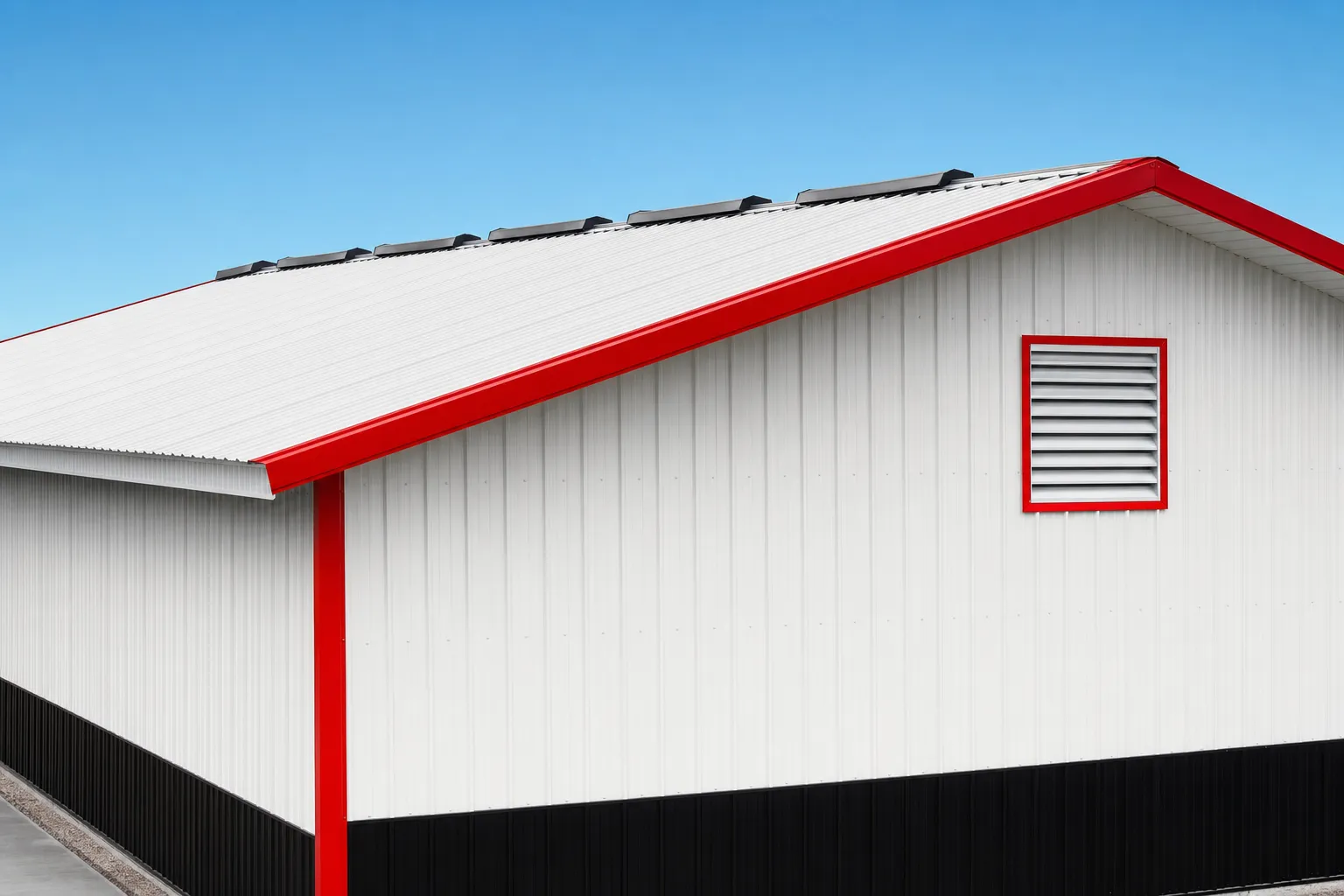
Metal building ventilation costs break down by component: ridge vents run $150-$350 each installed, wall louvers run $200-$500 each, and powered exhaust fans run $400-$1,200 each (modeled national ranges, July 2026). A complete gravity package for a typical shop lands at $700-$1,800; add powered exhaust and a full package reaches $1,100-$3,000. Small money, and the cheapest condensation insurance a steel building can buy.
Ventilation is the component buyers skip because nothing looks wrong on day one. Then the first cold morning arrives, warm moist air hits cold roof panels, and the building “rains” inside. This guide prices the components, sizes a real package, and explains the condensation math that makes the vent line worth protecting on every quote. It is part of our component costs hub.
| Component | Installed range modeled | What it does |
|---|---|---|
| Ridge vent (gravity) | $150 – $350 each | Continuous exhaust at the roof peak; no power |
| Wall louver (fixed) | $200 – $500 each | Intake air low on the walls; feeds the ridge |
| Exhaust fan (powered) | $400 – $1,200 each | Moves air on demand; shops, ag, and fume loads |
| Typical gravity package | $700 – $1,800 | 2-4 ridge vents plus 2 louvers, sized to the building |
| Gravity + powered package | $1,100 – $3,000 | Adds 1-2 fans with thermostat control |
Prices assume installation during erection on a new building. Ridge vents priced per unit (typically one per 20-25 feet of ridge). Fan range spans small thermostat fans to large belt-driven ag units. National mid-ranges, July 2026.
Ranges are modeled national estimates from published supplier price lists and advertised accessory pricing collected June-July 2026, cross-checked against component benchmarks for roof penetrations, framed openings, and erection labor. Ventilation needs scale with building volume and use, so package totals are labeled modeled and sized to common shop and storage configurations. Full methodology in the SteelBuildingKit Cost Index.
Why ventilation is really condensation insurance
Steel panels are excellent at one thing insulation buyers forget: getting exactly as cold as the night sky. When the air inside carries moisture (from concrete curing, parked vehicles, propane heat, animals, or plain humidity) and the roof panel drops below the dew point, water condenses on the underside and drips. Owners call it a roof leak; it is physics. The fix is a pair, not a choice: insulation with a vapor barrier keeps warm moist air off the cold steel, and ventilation carries the moisture out before it accumulates. A vented ridge with low wall louvers creates a continuous stack draft that costs nothing to run, which is why the $700-$1,800 gravity package appears on virtually every building we would call correctly specified. Price the other half of the pair in our insulation cost guide, and see how insulation and vapor barriers work together before deleting either line to save money. Deleting both is how a $40,000 building grows rust streaks by year three.
Sizing a real package: worked example
| Line item | Typical range modeled | Notes |
|---|---|---|
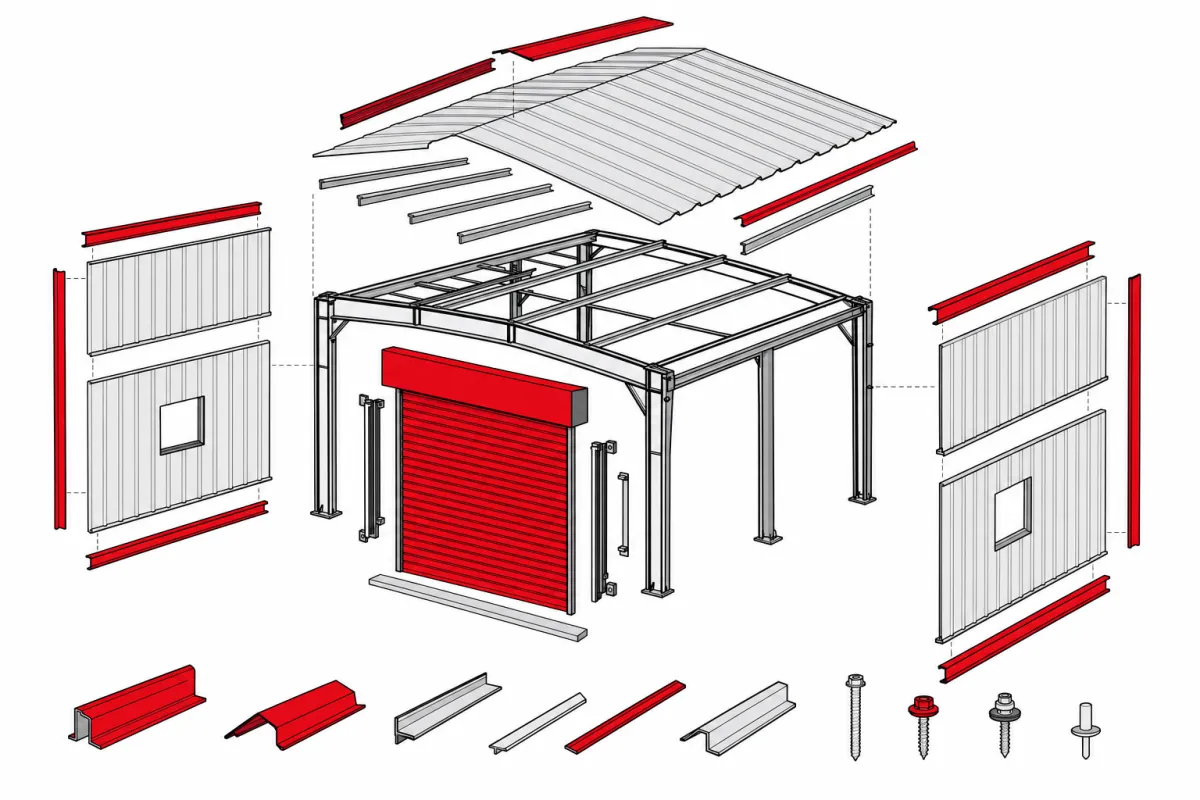
| Three ridge vents | $450 – $1,050 | One per 20 feet of 60-ft ridge |
| Two fixed wall louvers | $400 – $1,000 | Low on opposite walls for cross-feed |
| One thermostat exhaust fan | $400 – $1,200 | Summer heat purge and fume control |
| Package total | $1,250 – $3,250 | Order-time install during erection |
Worked example at national mid-range rates: three ridge vents at $250 each ($750), two louvers at $350 each ($700), and one $700 thermostat fan comes to $2,150 on a 40×60 shop, less than one percent of a typical turnkey budget for that footprint. Run the package against your whole project in the steel building cost calculator; it is usually the smallest line that changes how the building ages.
Gravity or powered: which does your building need?
Gravity ventilation (ridge vents fed by louvers) handles moisture control and mild heat relief in storage buildings, garages, and most hobby shops, and it never draws a watt. Powered exhaust earns its $400-$1,200 per fan in four cases: welding, painting, or engine fumes that must leave now; summer heat purge in work shops, where a thermostat fan dumps the 100-degree ceiling layer; animal buildings, where air changes are welfare, not comfort; and any building in a humid climate that stays closed for weeks. The two systems are not rivals; the fan rides on top of the gravity package and runs only when conditions ask.
| Option | Typical impact modeled | Worth it when |
|---|---|---|
| Thermostat / humidistat control | +$100 – $300 per fan | Set-and-forget moisture and heat control |
| Additional ridge vent | +$150 – $350 each | Ridges over 60 ft; one per 20-25 ft is the norm |
| Larger ag-class exhaust fan | Top of the $400 – $1,200 range | Animal buildings and fume-heavy shops |
| Motorized louver dampers | +$150 – $400 per louver | Heated buildings that must close tight in winter |
| Bird and insect screens | +$25 – $75 per opening | Always; retrofitting screens is miserable |
| Gable vents instead of ridge | Similar $150 – $350 each | Simple roofs where ridge access is awkward |
How your location moves these numbers
Climate decides how much ventilation is enough. Humid Gulf-style climates are the demanding case: buildings that sit closed sweat, so louver area grows and a humidistat fan moves from option to default. Cold northern climates flip the problem: winter condensation risk peaks exactly when owners seal buildings tight, so dampered louvers (+$150-$400 each) that close in January matter more than fan capacity. Dry western climates can live at the bottom of every range. Structure follows too: heavy-snow counties (part of the 8-15% kit engineering adder) want low-profile ridge vents rated with the roof, and high-wind coastal counties require rated louvers and fan hoods, worth 10-20% on those lines. Labor and permits move installed costs the usual $150-$4,000 county spread only when electrical work for fans triggers a separate permit. Net swing on a package: 15-25% either direction.
The ventilation quote checklist
- Ridge vent count and spacing stated (one per 20-25 ft of ridge is the norm)
- Intake louvers included; ridge vents without intake air do half their job
- Fan count, size, and control type (switch, thermostat, humidistat) itemized
- Vapor barrier and insulation spec confirmed alongside the vent package, not instead of it
- Bird screens on every opening, included or priced
- Snow and wind ratings on roof vents match the building’s stamped loads
- Electrical circuit for fans in someone’s scope, in writing
- Animal or fume uses: air-change target named, not “adequate ventilation”
Readers comparing options usually open window and skylight cost and gutters and downspouts cost next; both follow the same July 2026 cost model.
Metal building ventilation FAQs
How much does metal building ventilation cost?
By component (modeled July 2026): ridge vents $150-$350 each, wall louvers $200-$500 each, exhaust fans $400-$1,200 each, all installed at order time. A typical gravity package runs $700-$1,800; adding a thermostat fan takes a full package to $1,100-$3,000.
Do I really need ventilation in a metal building?
If the building ever holds moisture (vehicles, concrete, animals, humid air) and its panels ever get cold, yes. Ventilation paired with a vapor barrier is what stops condensation from dripping off the roof steel. The gravity package costs $700-$1,800; rust streaks, wet insulation, and flash-rusted tools cost more.
Will ventilation stop condensation by itself?
No; it is half the fix. Ventilation removes moist air, while insulation with a vapor barrier keeps that air off the cold steel in the first place. Buildings that skip either half still sweat in the wrong season. Budget both lines together; combined they are still one of the smallest items on the quote.
How many ridge vents does my building need?
The working norm is one ridge vent per 20-25 feet of ridge line, fed by at least two low wall louvers for intake. A 30×40 typically carries two; a 40×60 carries three. Ridge vents without intake louvers move far less air, which is the most common sizing mistake.
Gravity vents or powered fans: which is better?
Gravity (ridge plus louvers) handles moisture and mild heat in storage and hobby buildings free of operating cost. Powered fans at $400-$1,200 each earn their place for fumes, summer heat purge, animals, and humid-climate buildings that stay closed. Most correctly built shops run both: gravity always, the fan on a thermostat.
Can I add vents to a metal building later?
Louvers and gable vents retrofit reasonably; ridge vents are the painful one, because opening a finished ridge means flashing work at the roof’s most leak-sensitive line, typically 1.5-2x the order-time price (modeled July 2026). Order ridge ventilation with the building even if fans wait for later.
Ready to price this building for real? Compare verified metal building companies for this project type, with real reviews and track records.
Sources and methodology: published supplier price lists and advertised kit and accessory pricing (June-July 2026); component cost benchmarks for roof penetrations, framed openings, erection labor, and freight; IBC and ASCE 7 for load context. All figures are modeled national estimates, labeled as modeled, and reviewed quarterly; see the full Cost Index methodology. This guide links to our independent company directory; listings never change published numbers.
Written by the Steel Building Editorial Team | Last updated July 10, 2026