

SteelBuildingKit Cost Index · Updated July 10, 2026 · Pricing collected June-July 2026
Plumbing a metal building costs $1,500 to $4,000 for the under-slab rough-in when the pipes go in before the concrete pour, and $5,000 to $12,000 for a complete bathroom with fixtures and finish (modeled national ranges, July 2026). Skip the rough-in and decide you want water later, and cutting the slab starts at $5,000 before a single fixture. That one timing decision is most of this guide.
Metal buildings and plumbing get along fine; the conflict is with the slab. Drains, vents, and floor drains live under the concrete, so the whole scope has to be designed before pour day even if the fixtures wait years. This guide, part of our project planning hub, prices every path: rough-in now, bathroom now, or the stub-and-cap move that keeps your options open for a few thousand dollars.
| Scope | What it covers | Range modeled |
|---|---|---|
| Under-slab rough-in | Drains, vents, supply stubs before the pour | $1,500 – $4,000 |
| Complete bathroom | Rough-in plus fixtures, walls, and finish | $5,000 – $12,000 |
| Floor drain | Drain, trap, and slab slope, set at pour | $500 – $1,500 each |
| Utility sink and water heater | Wash-up station with hot water | $1,200 – $3,000 |
| Slab-cut retrofit | Saw, excavate, re-pour, before fixtures | $5,000+ |
Modeled national mid-ranges, July 2026, assuming water and sewer or septic within a normal utility-trench distance. Long runs to a distant septic field or municipal tap price above these bands.
Ranges are modeled national estimates built from published plumbing contractor pricing and advertised bathroom-addition rates collected June-July 2026, cross-checked against component benchmarks: PVC and PEX by the foot, fixture packages, trench work, and regional plumber labor. Figures are labeled modeled because trench distance and local sewer or septic rules move quotes more than fixtures do. Full methodology lives in the SteelBuildingKit Cost Index.
The pour-day decision that controls the whole budget
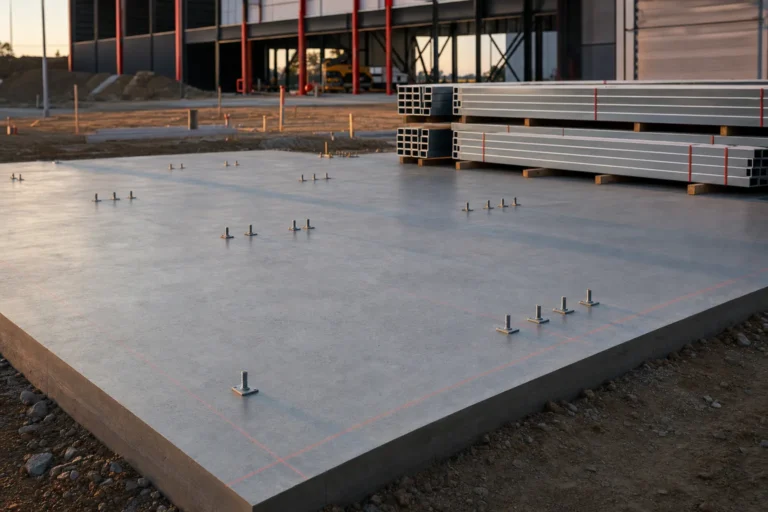
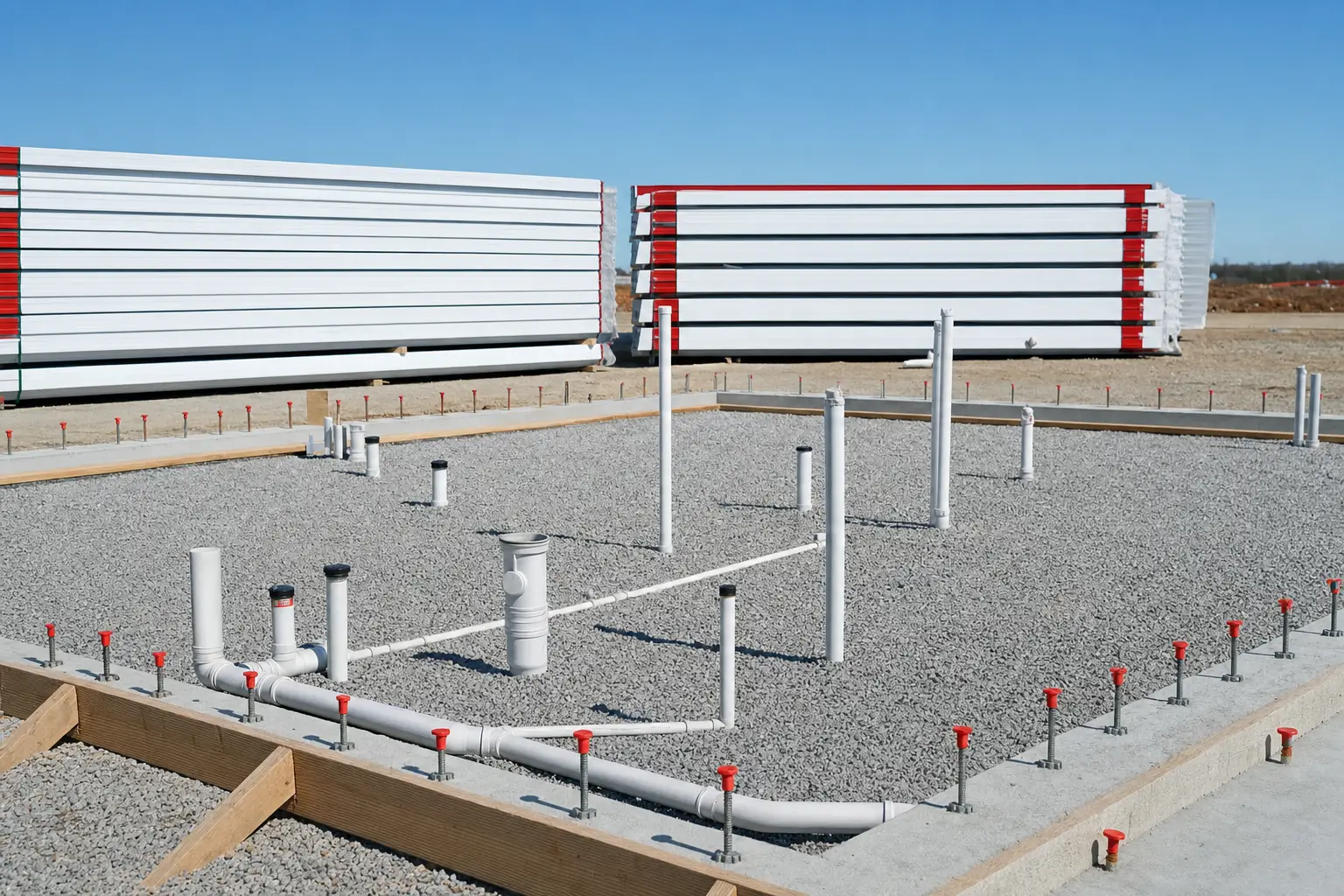
Everything in this category prices off one question: is the concrete poured yet? Before the pour, a plumber lays drain lines, vents, and supply stubs in open ground for $1,500-$4,000. After the pour, the same layout means saw-cutting concrete, excavating under a finished floor, re-pouring, and patching: $5,000 and up before any fixture is bought, with the mess spread across a working building.
So the planning rule is simple: if there is any realistic future in which this building has a toilet, a sink, or a floor drain, rough it in now and cap it. A stubbed-and-capped bathroom rough-in costs a few thousand dollars and sits invisibly under the slab until you are ready; the fixtures and walls can follow next year or next decade at normal prices. Coordinate the plumber and the concrete crew the same week, and make sure the slab plan shows every drain before the trucks roll; our concrete slab cost guide covers what else belongs on that drawing.
The 40×60 shop plumbing worksheet
Here is a typical working-shop scope: a half bath, two floor drains, and a wash-up corner in a 40×60. Every line scales with your layout and your distance to sewer or septic.
| Line item | Typical range modeled | Notes |
|---|---|---|
| Under-slab rough-in, half bath + drains | $2,000 – $3,500 | Laid before the pour |
| Two floor drains with slab slope | $1,000 – $3,000 | Slope planned with the concrete crew |
| Half bath fixtures and finish | $3,000 – $6,500 | Toilet, sink, walls, door, exhaust |
| Utility sink and small water heater | $1,200 – $3,000 | Point-of-use or 40-gal tank |
| Sewer or septic connection | $1,500 – $5,000 | The wildcard line; distance driven |
| Working shop total | $8,700 – $21,000 | Half bath, drains, wash-up, connection |
Worked example at national mid-range rates: a $2,700 rough-in, $1,800 for two floor drains, $4,500 of half-bath finish, $2,000 for the sink and water heater, and $2,500 of sewer connection comes to $13,500. A drains-only shop that skips the bathroom models closer to $4,500-$6,000. The steel building cost calculator lets you carry a plumbing allowance alongside the building itself so this scope is in the budget from day one.
Configuration levers and what they cost
| Option | Typical impact modeled | Worth it when |
|---|---|---|
| Full bath over half bath | +$2,000 – $4,500 | Anyone showers after dirty work |
| Each additional floor drain | +$500 – $1,500 at pour | Wash bays, wet vehicles, humid climates |
| Stub-and-cap rough-in only | $1,500 – $4,000 now, fixtures later | Budget is tight but the future is not |
| Tankless over tank water heater | +$500 – $1,200 | Occasional hot water, no space for a tank |
| Shared utility trench with electrical | Saves $500 – $1,500 | Both trades scheduled the same week |
Floor drains, done right
Floor drains are the most shop-friendly plumbing money you can spend, and the least retrofittable: the slab has to slope toward them, and slope is set the day the concrete is finished. Price them at $500-$1,500 each installed at pour time, and put one anywhere vehicles drip, snow melts, or wash water runs. Two code notes to settle before pour day: many jurisdictions require shop floor drains to run through an oil and sand interceptor rather than straight to the sewer, and some rural counties restrict where they can discharge at all. A ten-minute call to the building department settles it while the answer is still cheap.
How your location moves these numbers
Location works on plumbing through the ground. Frost depth sets how deep supply lines bury, and northern trenches priced below the frost line cost more than shallow southern ones. Rural sites trade sewer taps for septic: if the building adds fixtures to an existing system, confirm its capacity; if it needs its own, a perc test and small septic system is a separate five-figure conversation. Permits for the overall project run $150-$4,000 by county, with plumbing inspections riding along, and metro plumber rates run 30-50% above rural ones, worth $1,000-$3,000 of swing on the full scope here. And the same slab-timing logic that governs this guide gets stricter in cold counties, where winter pours compress schedules; getting the rough-in sequenced right matters most exactly where re-mobilizing crews costs most.
The plumbing quote checklist
- Every drain, vent, and supply stub shown on the slab drawing before pour day
- Rough-in and fixture phases priced separately, so stub-and-cap is a real option
- Floor drain locations and slab slope coordinated with the concrete contractor in writing
- Interceptor or oil-separator requirements confirmed with the local building department
- Sewer or septic connection priced by measured distance, not allowance
- Water heater type, size, and location named, with its circuit or gas line assigned to a trade
- Supply lines specified below local frost depth
- Permit and inspection responsibility stated on the quote
The same line-by-line pricing continues in electrical cost and in interior buildout cost.
Metal building plumbing FAQs
How much does it cost to plumb a metal building?
The under-slab rough-in runs $1,500-$4,000 before the pour; a complete bathroom lands at $5,000-$12,000 with fixtures and finish; floor drains cost $500-$1,500 each at pour time (modeled July 2026). A working shop with a half bath, drains, and a wash-up corner typically totals $9,000-$21,000 including the sewer or septic connection.
Can you add a bathroom to a metal building after the slab is poured?
Yes, at a premium: saw-cutting and re-pouring the slab starts at $5,000 before fixtures, against $1,500-$4,000 for the same rough-in done before the pour. If a bathroom is even possible in your future, stub and cap the lines now; capped rough-in waits under the concrete indefinitely.
Are floor drains worth it in a shop?
Almost always. At $500-$1,500 each installed at pour time, they handle vehicle drip, snow melt, and wash-down water that otherwise sits on the slab. They cannot be added later without cutting concrete and re-sloping the floor, so decide at the drawing stage. Check whether your county requires an oil and sand interceptor.
Does a metal building bathroom need special construction?
No; it frames, plumbs, and finishes like any bathroom, typically as an insulated interior room. The metal building specific parts are timing (drains under the slab) and freeze protection (supply lines below frost depth and heat or insulation for the wet wall in cold climates). Budget $5,000-$12,000 complete, modeled July 2026.
What about water to a building far from the house or main?
Distance is the budget. A water line rides the same utility trench as power for small money when planned together, which saves $500-$1,500 in shared digging. A long solo run, or a septic system of its own, prices by the foot and by the perc test; get that number before you finalize the site, not after.
Ready to price this building for real? Compare verified metal building companies for this project type, with real reviews and track records.
Sources and methodology: published supplier price lists and advertised plumbing contractor pricing (June-July 2026); component cost benchmarks for ready-mix concrete, erection labor, and freight; IBC and ASCE 7 for load context. All figures are modeled national estimates, labeled as modeled, and reviewed quarterly; see the full Cost Index methodology. This guide links to our independent company directory; listings never change published numbers.
Written by the Steel Building Editorial Team | Last updated July 10, 2026