

SteelBuildingKit Cost Index · Updated July 10, 2026 · Pricing collected June-July 2026
A soil test for a metal building costs $300 to $1,500 for a standard bearing investigation, and a full geotechnical report runs $1,500 to $3,500 when the ground is suspect (modeled national ranges, July 2026). Many small buildings on known, undisturbed ground never need one. But on fill dirt, expansive clay, slopes, or any commercial project, this is the cheapest insurance on the entire budget, because it protects the one component you cannot redo: the foundation.
This guide, part of our component costs hub, prices the test itself, explains exactly when counties and engineers require it, and shows what a few hundred dollars of borings prevent further down the budget.
| Option | Typical cost modeled | When it fits |
|---|---|---|
| No test (presumptive soil values) | $0 | Small buildings on known, undisturbed ground, where the county allows it |
| Standard soil test (borings + bearing report) | $300 – $1,500 | Engineer or lender asks; ground history unknown |
| Full geotechnical report | $1,500 – $3,500 | Fill, expansive clay, slopes, high water table, commercial plan review |
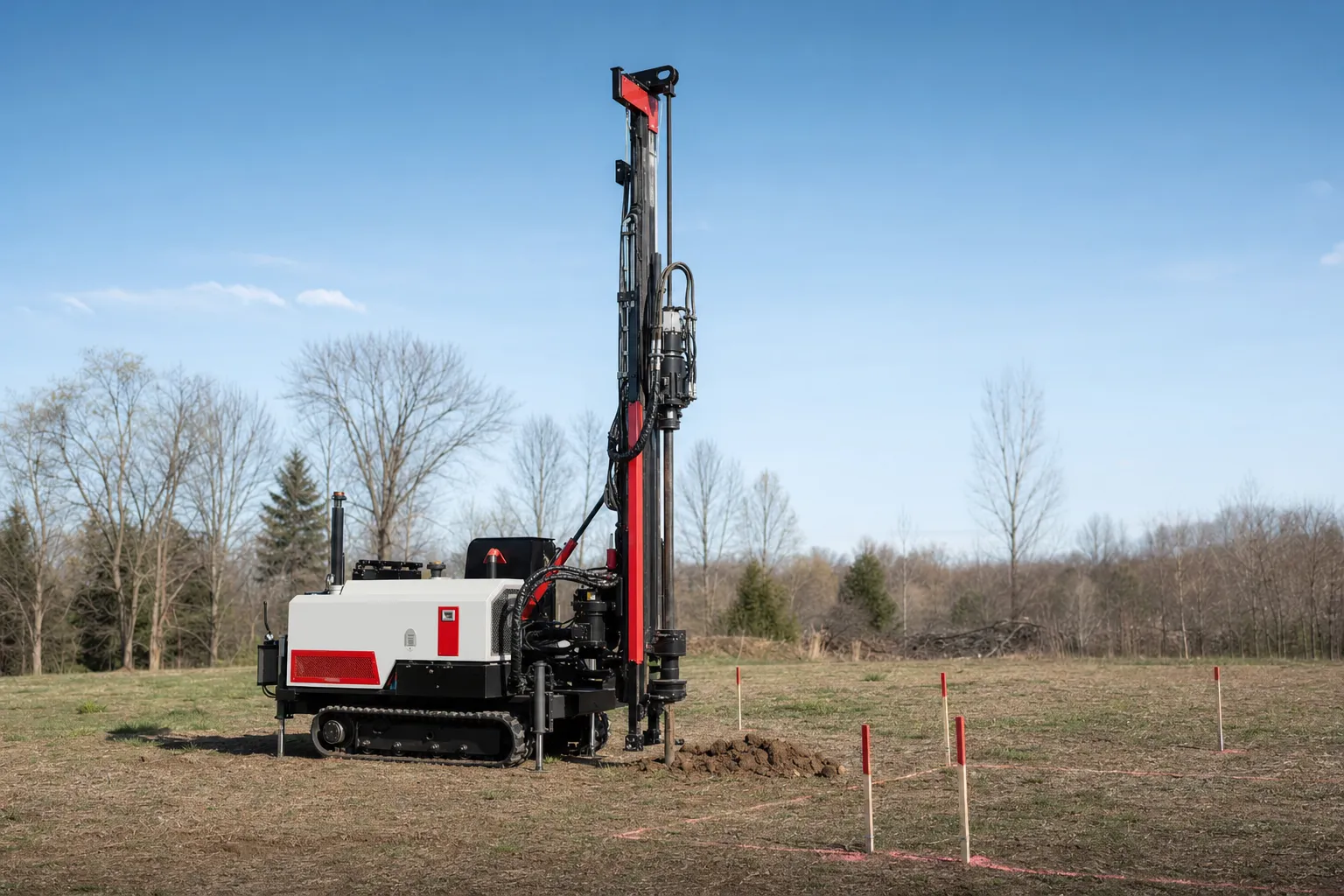
A standard test typically means one to three borings with a stamped letter stating allowable bearing pressure. A full geotechnical report adds lab work and foundation recommendations. Modeled national ranges, July 2026.
Ranges are modeled national estimates built from published geotechnical service rates collected June-July 2026, cross-checked against the component benchmarks we track for foundations, engineering, and permits, since soil findings drive all three. Testing prices vary with boring count, depth, and mobilization distance, so figures are labeled modeled and quoted as ranges. Full methodology lives in the SteelBuildingKit Cost Index.
When a soil test is actually required
Nobody orders borings for fun, so here is the honest trigger list. First, the permit office: many counties require soils data for commercial occupancies and larger buildings during plan review, full stop. Second, the engineer: the foundation designer must assume a bearing capacity, and if the site gives any reason for doubt, a stamped letter beats a guess they have to defend. Third, the lender: construction loans on larger projects often require geotechnical documentation. And fourth, the ground itself. Five red flags reliably justify the $300-$1,500: the lot contains fill dirt of unknown history, the region is known for expansive clay, the pad sits on or near a slope, water stands after rain or the water table is high, and any past use suggests buried debris. If none of those apply and the county is satisfied with presumptive values, a small garage or shop routinely proceeds without a test.
Where the test sits in the pre-construction budget
Soil testing belongs to the paper phase of the project, the money spent before anything visible happens. Here is that whole phase in one view, with the test in context.
| Line item | Typical range modeled | Notes |
|---|---|---|
| Soil test (if triggered) | $300 – $1,500 | Full geotech $1,500 – $3,500 on suspect ground |
| Stamped engineering | $800 – $2,500 | Often bundled into the kit price |
| Permits and plan review | $150 – $4,000 | County-dependent; ag exemptions $0 – $300 |
| Site preparation | $0.50 – $2.00 /sqft flat | $2 – $5 /sqft on sloped lots |
Worked example at national mid-range rates: a 40×60 shop on a lot with old fill runs a $600 soil test, $1,500 of engineering, a $900 permit, and $2,600 of site prep: $5,600 spent before a yard of concrete arrives. That sequence is correct, because the soil letter feeds the foundation design, and the foundation design feeds the permit set. The steel building cost calculator shows how this paper phase sits inside the full project number.
What moves the price inside the range
| Factor | Typical effect modeled | Notes |
|---|---|---|
| Number and depth of borings | Sets your position in the $300 – $1,500 band | One shallow boring vs three deep ones |
| Mobilization distance | Rural sites price toward the top | The rig drives to you; distance is billed |
| Lab testing for expansive soils | Pushes toward the $1,500 – $3,500 report tier | Clay country standard practice |
| Stamped letter vs full report | Letter sits low in band; report tier above | Ask the engineer which one plan review needs |
| Combining trips (soil + perc test) | Saves a mobilization fee | Worth asking on rural land with septic plans |
What a soil test prevents
The value of the test is everything it stops from happening. A foundation designed for soil that is not there fails in slow motion: differential settlement cracks the slab, racks door frames, and opens panel seams, and repairs on an occupied steel building start where whole foundations end. Short of failure, bad soil discovered mid-project forces a redesign, at $300-$800 per engineering revision (modeled, July 2026) plus schedule slip while the county re-reviews. Water problems that a boring log would have flagged become $3,000-$10,000 drainage retrofits. And the quiet cost runs the other way too: without data, engineers assume conservatively, and an over-built foundation on ground that tested fine can waste more concrete money than the test would have cost. Our guides to concrete slab cost and slabs and frost footings show exactly which foundation dollars the soil letter is steering.
How your location moves the answer
Geography largely decides whether this line exists on your budget. Expansive clay belts across Texas, the Gulf states, and the mountain West make testing near-standard practice, because clay that swells and shrinks with moisture is the single biggest slab-killer in the country. Coastal and river-bottom ground raises water table questions; glacial till and shallow rock in the North change excavation more than bearing; and stable, well-drained inland soils are where counties happily accept presumptive values. Mobilization is the other locational lever: metro sites see rigs at the bottom of the $300-$1,500 band, while a remote rural parcel pays the drive time (modeled, July 2026). Local knowledge is real here; a foundation contractor who has poured in your area for a decade usually knows what the borings will say before the rig arrives.
The soil test checklist
- Ask the county FIRST whether plan review requires soils data for your building class
- Give the tester the building footprint and column loads so borings land where columns will
- Confirm the deliverable: stamped bearing letter or full report, matched to what the engineer needs
- Disclose everything you know about the lot’s history, especially fill and old structures
- Schedule the test before final foundation design, never after concrete is priced
- Combine mobilizations with perc or septic testing on rural land
- Send the results to both the building engineer and the concrete contractor
For the adjacent questions, site preparation cost and engineering cost run the same modeled worksheet on their own scope.
Soil test FAQs
How much does a soil test cost for a metal building?
$300-$1,500 for a standard investigation with one to three borings and a stamped bearing letter; $1,500-$3,500 for a full geotechnical report with lab work (modeled, July 2026). Boring count, depth, and how far the rig drives set where you land.
Do I need a soil test for a small metal garage?
Often no. Small buildings on known, undisturbed ground typically proceed on presumptive soil values the code allows. The test becomes worth its $300-$1,500 when the lot has fill, expansive clay, slopes, or standing water, or when the county, engineer, or lender asks for data.
Who performs a soil test and how long does it take?
A geotechnical engineering firm: a drill rig takes borings in a few hours on site, and the stamped letter or report follows in about one to three weeks. Build that window into the paper phase of the schedule, since foundation design and permits wait on the result.
What happens if a soil test finds bad ground?
The foundation gets designed for reality: deeper footings, piers, more reinforcement, or soil replacement, and yes, that costs more than the standard slab. Finding it now costs a redesign on paper; finding it after the pour costs $300-$800 per revision plus remediation, and settlement repairs can dwarf the whole foundation budget (modeled, July 2026).
Is a soil test the same as a perc test?
No. A perc test measures how fast water drains for septic design; a soil test measures bearing capacity for foundations. Rural builds often need both, and scheduling them as one mobilization saves a trip fee. Neither substitutes for the other on a permit application.
Can I skip the soil test to save money?
If nothing triggers it, legitimately yes. But skipping a triggered test is a bad trade: you are risking the foundation, the one component with no cheap redo, to save $300-$1,500. Against a $3,000-$10,000 drainage retrofit or a settlement repair, the boring rig is the bargain of the whole project (modeled, July 2026).
Ready to price this building for real? Compare verified metal building companies for this project type, with real reviews and track records.
Sources and methodology: published supplier price lists and advertised kit pricing (June-July 2026); component cost benchmarks for ready-mix concrete, erection labor, and freight; IBC and ASCE 7 for load context. All figures are modeled national estimates, labeled as modeled, and reviewed quarterly; see the full Cost Index methodology. This guide links to our independent company directory; listings never change published numbers.
Written by the Steel Building Editorial Team | Last updated July 10, 2026