


SteelBuildingKit Cost Index · Updated July 10, 2026 · Pricing collected June-July 2026
Site preparation for a metal building costs $0.50 to $2.00 per square foot on a flat, accessible lot and $2.00 to $5.00 per square foot on a sloped site that needs real cut and fill (modeled national ranges, July 2026). That is $1,200-$4,800 for a flat 40×60 pad and $4,800-$12,000 for the same pad on a slope. Poor access adds $1,000-$3,000, and drainage problems ignored now cost $3,000-$10,000 to fix after the building is up.
Site prep is the least glamorous line on a metal building budget and the one that decides how every other line behaves. The slab is only as good as the pad under it, the delivery truck needs somewhere to stand, and water that is not managed before the pour will find the building afterward. This guide, part of our component costs hub, prices clearing, grading, base, drainage, and access so the dirt work stops being a mystery allowance on the quote.
| Site condition | Typical cost modeled | On a 40×60 pad (2,400 sqft) |
|---|---|---|
| Flat, cleared, good access | $0.50 – $2.00 /sqft | $1,200 – $4,800 |
| Sloped, cut-and-fill required | $2.00 – $5.00 /sqft | $4,800 – $12,000 |
| Tight or soft access | Add $1,000 – $3,000 | Mats, smaller trucks, extra trips |
| Drainage fixed after the build | $3,000 – $10,000 retrofit | The bill this guide helps you avoid |
Costs cover clearing, stripping, grading, compacted base, and basic drainage shaping for the building pad itself. Long driveways, wells, septic, and utility trenching are separate site-development lines. Modeled national ranges, July 2026.
Ranges are modeled national estimates built from published excavation and grading rates collected June-July 2026, cross-checked against component benchmarks for turnkey metal building packages, where site work typically appears as a $0.50-$2.00 per square foot allowance on flat lots. Dirt work is the most site-specific line in construction, so every figure here is labeled modeled and quoted as a range. Full methodology lives in the SteelBuildingKit Cost Index.
What site prep actually includes
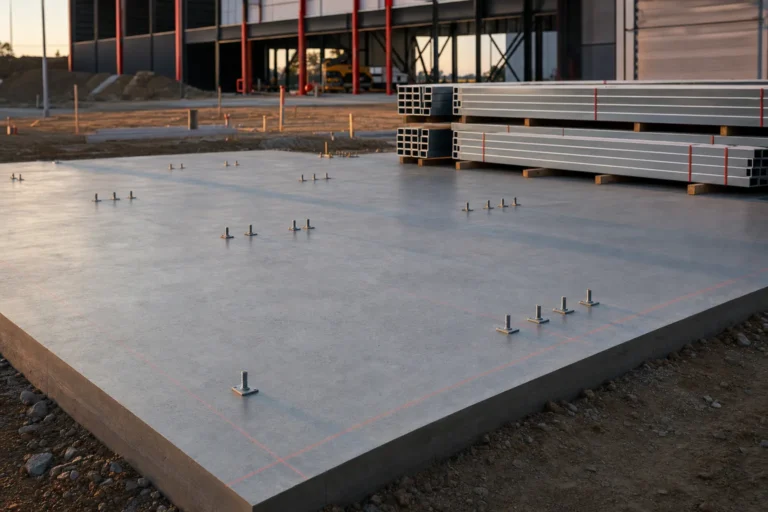
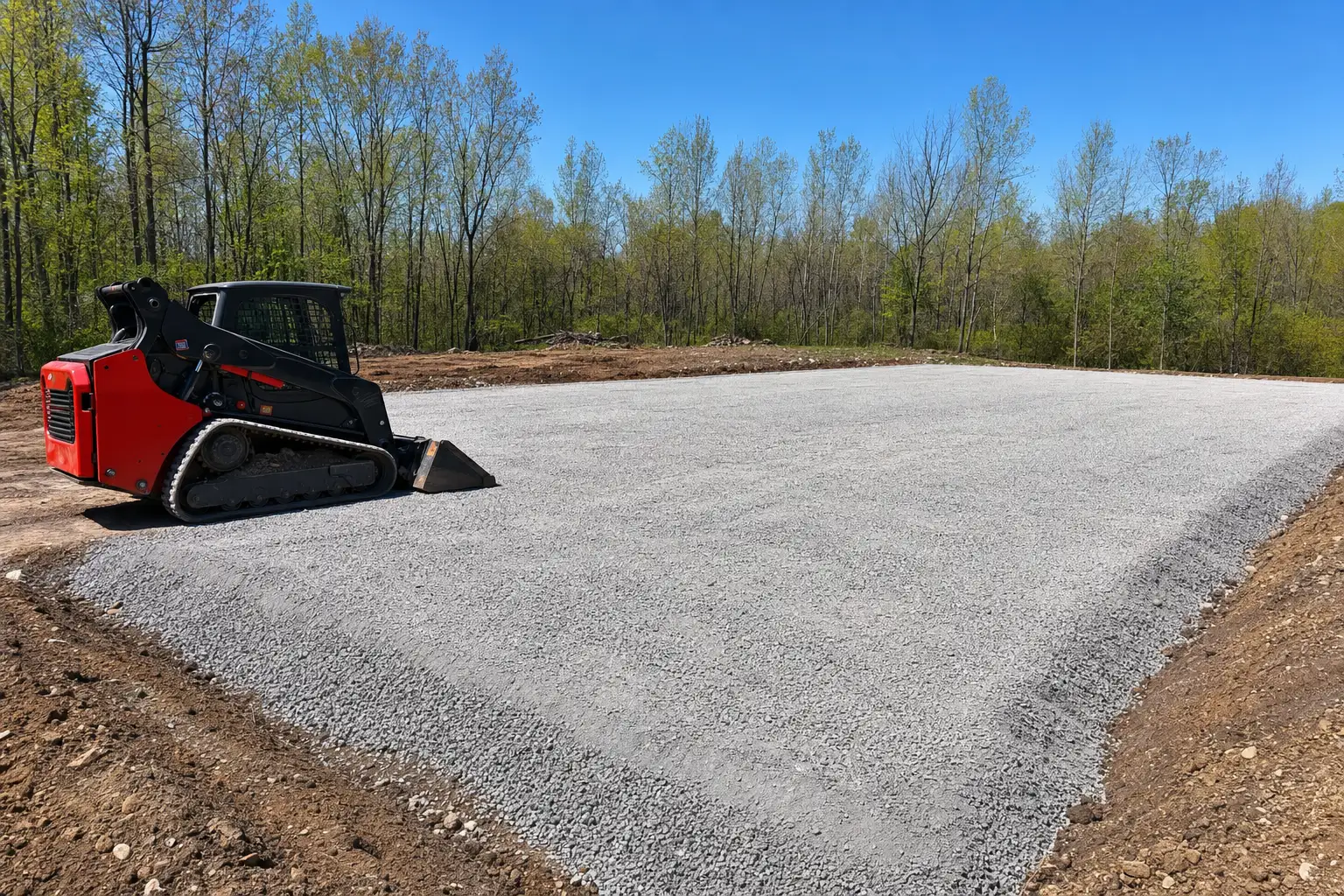
A proper building pad is four jobs in sequence. Clearing removes vegetation and strips the topsoil, because organic soil compresses and no slab should sit on it. Grading cuts and fills to a level plane, then compacts it in lifts so the pad will not settle. The base course adds crushed gravel, spread and compacted, as the immediate bed for the slab. And drainage shaping crowns the pad and cuts swales so water moves away from the building instead of under it. On a flat lot all four together land in the $0.50-$2.00 per square foot band (modeled, July 2026); slope, trees, and soft ground push individual lines up from there.
Watch how this line appears on quotes, because it is the most commonly fudged number in the package. Turnkey proposals tend to carry site work as an allowance (“site prep by owner” or a flat $1,500 placeholder) that assumes a lot the estimator has never seen. That is not dishonesty, it is distance; nobody can price dirt from a spreadsheet. Treat any allowance as a question, not an answer, and get a local grading contractor to walk the lot before the number goes in your project budget.
| Line item | Typical range modeled | Notes |
|---|---|---|
| Clearing and topsoil strip | $300 – $1,200 | Light vegetation; wooded lots run higher |
| Rough and finish grading | $400 – $1,600 | Cut, fill, and compaction in lifts |
| Gravel base, spread and compacted | $400 – $1,400 | The slab’s immediate bed |
| Drainage shaping (crown and swales) | $100 – $600 | The cheapest insurance on this list |
| Flat-site total | $1,200 – $4,800 | $0.50 – $2.00 per pad square foot |
Worked example at national mid-range rates: a flat rural 40×60 pad at roughly $1.10 per square foot comes to about $2,600, with $500 of that in gravel and $300 in drainage shaping. Slope the same lot and the grading line alone can triple. The steel building cost calculator carries a site prep line so you can see how your lot’s condition moves the whole project number.
Configuration choices that move the dirt work
| Factor | Typical impact modeled | Worth it when |
|---|---|---|
| Sloped site, real cut and fill | $2.00 – $5.00 /sqft instead of $0.50 – $2.00 | Not optional; the lot is the lot |
| Access improvements (culvert, rock drive) | +$1,000 – $3,000 | Soft ground, ditches, tight gates |
| Extra pad apron for staging and parking | Same $/sqft rate on the added area | Delivery staging, drainage, working room |
| Heavy tree clearing | Moves you to the top of the band | Wooded lots price per tree; get it itemized |
| Drainage done now vs later | $100 – $600 now vs $3,000 – $10,000 retrofit | Always; this is the whole game |
Drainage first: the rule that saves five figures
If you take one thing from this guide, take the sequence: water is managed before concrete, always. A pad crowned a few inches above surrounding grade, with swales carrying roof runoff away, costs $100-$600 in shaping while the equipment is already on site (modeled, July 2026). The same problem solved after the building is up means trenching around an occupied structure, French drains, regrading against finished walls, and sometimes gutter and downspout rework on top: $3,000-$10,000, and that is when the fix is straightforward.
The failure pattern is predictable because steel buildings shed enormous sheets of water. A 40×60 roof drops roughly 1,500 gallons per inch of rain at the drip line, and if the pad sits flush with grade, that water stands against the slab edge, soaks the base, and eventually finds the floor. Ask the grading contractor one question: “Where does the roof water go?” A contractor who points at swales and daylight has done this before. Budget gutters separately at $6-$12 per linear foot (modeled, July 2026) and give the downspouts somewhere to discharge.
Access: the line the delivery truck votes on
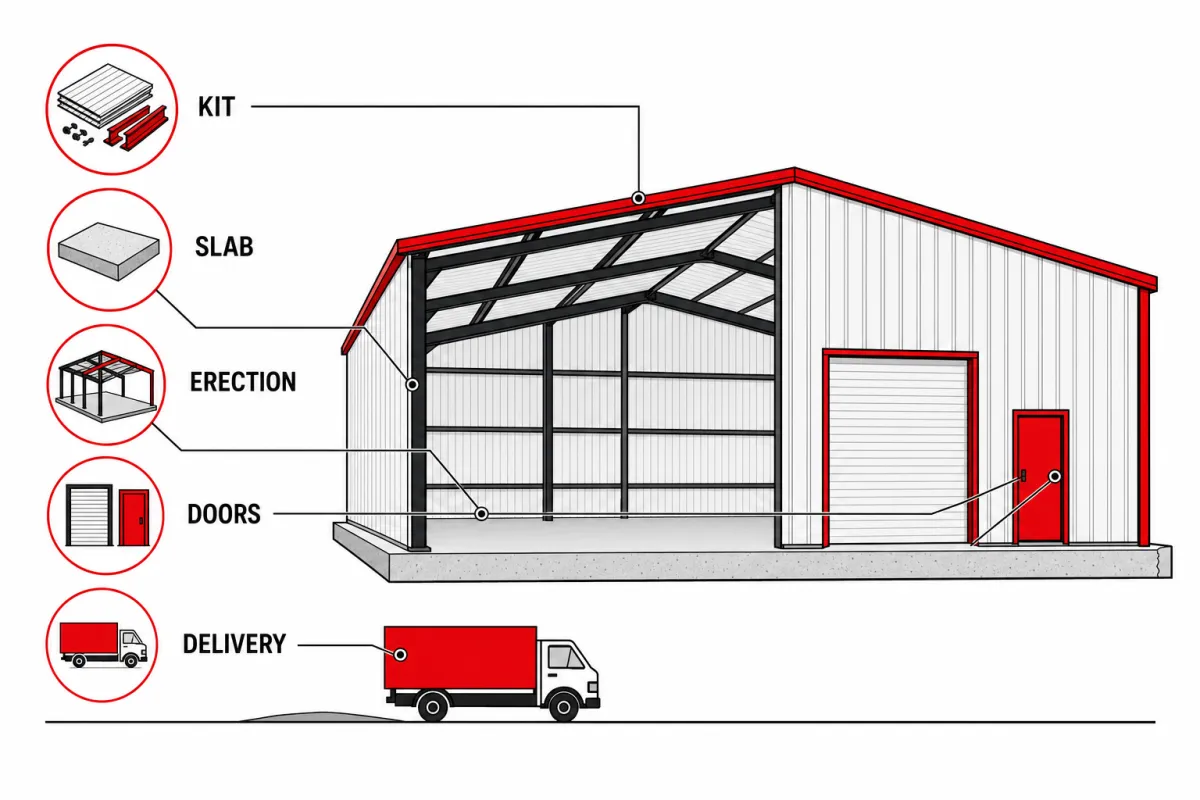
Site prep is also where delivery and erection quietly succeed or fail. The kit arrives on a full-size flatbed that needs a firm surface, reasonable turning room, and no soft ground between the road and the pad. If the truck cannot reach the site, bundles get offloaded at the road and moved twice, and every extra handling step is money. A temporary rock drive and a culvert at the ditch line run $1,000-$3,000 (modeled, July 2026) and pay for themselves the first wet week. The same firm access serves the concrete trucks, and later the erection crew’s equipment; our metal building erection cost guide covers what crews charge when a site fights them. Plan a staging area beside the pad big enough for the steel bundles to sit on blocking, close to where each piece gets used.
Who does the dirt work, and in what order
Site prep sits at an awkward seam: the building supplier will not do it, the concrete contractor needs it done, and the excavation contractor needs numbers from both. The sequence that works is simple. Final building drawings first, because they set the pad’s exact size and finished elevation. Then the grading contractor builds the pad to the slab contractor’s written spec: base depth, material, and compaction. Then the slab crew takes over a pad they specified themselves, which removes the classic finger-pointing when a slab cracks. On small flat lots one contractor sometimes handles both dirt and concrete, and that single point of responsibility is worth a modest premium. Either way, get the pad spec in writing and make it part of both contracts, so “the pad was wrong” can never become your problem.
How your location moves site prep costs
Region moves dirt work through soil, water, and rock rather than through markets. Clay-heavy ground compacts slowly and may need imported fill; sandy southern soils grade cheaply and drain themselves. Shallow rock turns a $1,600 grading line into hammer time at multiples of the estimate, which is one reason a soil and frost review before buying a sloped lot is money well spent. Wet climates justify more gravel and more aggressive swales; arid ones let you spend less on both. Frost country effectively deepens the excavation for footings at the pad’s edge, and local equipment rates swing 20-30% between rural and metro markets (modeled, July 2026). The pattern to remember: the flatter, drier, and firmer the lot, the closer you sit to $0.50 per square foot.
The site prep quote checklist
Dirt work is where vague quotes hide. Get each of these in writing before equipment shows up.
- Pad dimensions stated, including apron beyond the building footprint
- Topsoil strip included, with a stated destination for the spoil
- Compaction method and lift thickness named, not just “graded and compacted”
- Gravel base depth and material type specified by the slab contractor’s requirement
- Finish grade elevation set relative to the road or a fixed benchmark
- Drainage plan stated: crown height, swale routes, and where water daylights
- Access improvements itemized separately from pad work
- Rock clause read: what happens to the price if the excavator hits ledge
- Pad handoff timed against the concrete crew’s schedule, not “when it’s done”
Two related guides in this series take the next step: foundation cost breaks down its side of the decision, and soil test cost covers the other.
Site preparation FAQs
How much does site preparation cost for a metal building?
$0.50-$2.00 per square foot on a flat, cleared, accessible lot and $2.00-$5.00 on a sloped site (modeled, July 2026). That is $1,200-$4,800 for a flat 40×60 pad. Poor access adds $1,000-$3,000, and heavy tree clearing or shallow rock pushes totals past the band.
Can I skip site prep if my lot looks flat?
No. Looking flat and being a compacted, drained building pad are different things. Topsoil must come off because it compresses, the base must be compacted in lifts, and the pad needs to shed water. Skipping this to save $2,000 risks a settled slab and a $3,000-$10,000 drainage retrofit later.
Who does site prep, the building company or a local contractor?
Almost always a local excavation or grading contractor; building suppliers sell steel, and even turnkey packages usually carry site work as an allowance or exclusion. Get the grading bid separately, give the contractor the slab spec, and make sure pad handoff timing matches the concrete crew’s schedule.
How much does it cost to level a sloped lot for a metal building?
Plan on $2.00-$5.00 per square foot of pad (modeled, July 2026), so $4,800-$12,000 for a 40×60, depending on how much cut and fill the slope demands. Heavy slopes needing retaining or imported fill can exceed the band; get an on-site bid before buying steel for a sloped lot.
What does a gravel pad cost under a metal building?
The compacted gravel base runs $400-$1,400 on a 40×60 pad as part of the $1,200-$4,800 flat-site total (modeled, July 2026). For pier-foundation buildings using gravel as the finished floor, budget the same base work; the gravel is doing the same structural job either way.
When should site prep happen in the project timeline?
After the final building drawings exist and before concrete is scheduled. Drawings set the exact pad size and elevation; the pad then needs to be finished and inspected (where required) before the slab crew arrives. Grading a week early is fine; grading before drawings means guessing at dimensions.
Does site prep include the driveway and utilities?
Usually not. The $0.50-$2.00 per square foot band covers the building pad: clearing, grading, base, and drainage shaping. Long driveways, trenching for power and water, wells, and septic are separate site-development lines that vary too much by lot to carry a useful national range.
Ready to price this building for real? Compare verified metal building companies for this project type, with real reviews and track records.
Sources and methodology: published supplier price lists and advertised kit pricing (June-July 2026); component cost benchmarks for ready-mix concrete, erection labor, and freight; IBC and ASCE 7 for load context. All figures are modeled national estimates, labeled as modeled, and reviewed quarterly; see the full Cost Index methodology. This guide links to our independent company directory; listings never change published numbers.
Written by the Steel Building Editorial Team | Last updated July 10, 2026