


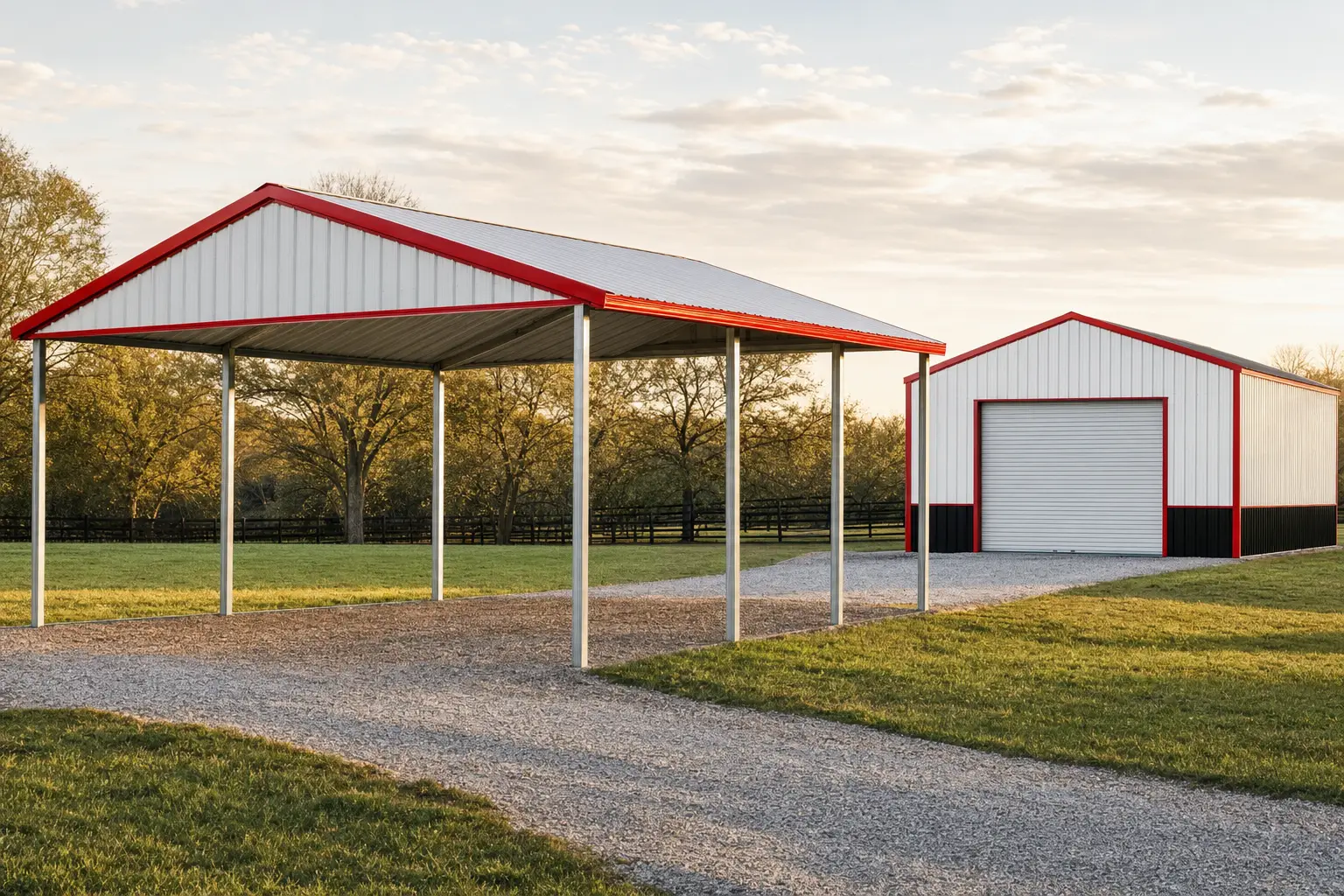
SteelBuildingKit Cost Index · Updated July 10, 2026 · Pricing collected June-July 2026
A two-car metal carport costs $2,400 to $4,800 installed; a two-car metal garage costs $18,000 to $38,000 turnkey with slab, erection, and delivery (modeled national ranges, July 2026). The third path, buying an enclosure-ready carport now and closing it in later, typically totals $9,000-$18,500 by the time the walls, doors, and pad are done. Three paths, a 10x price spread, and one honest question underneath: are you protecting vehicles from weather, or do you need a building?
That question does more work than any spreadsheet. Weather protection is a roof problem, and carports solve roof problems for pennies on the garage dollar. Security, storage, workspace, and resale presence are building problems, and no amount of carport solves them. This guide prices all three paths at the same two-car scale so the trade is visible; the full carport side of the family lives in our carport cost hub.
| Path | Cost modeled | What you end up with |
|---|---|---|
| Carport now | $2,400 – $4,800 installed | Engineered roof, open sides, anchored, done in a day |
| Garage upfront | $18,000 – $38,000 turnkey | Enclosed, on a slab, lockable, insulable, permitted |
| Carport, enclosed later | $9,000 – $18,500 total, staged | Carport-grade building; spend spread over years |
Two-car scale throughout: 18×21-20×20 carport, 20×20-24×30 garage. Carport prices include delivery and installation; garage prices are full turnkey scope. National mid-ranges, July 2026.
Ranges are modeled national estimates built from advertised carport package pricing and metal garage kit and turnkey pricing collected June-July 2026, cross-checked against component benchmarks for concrete at $6-$12/sqft, erection labor, and enclosure kits. The three paths carry different scopes by nature (installed structure versus turnkey building versus staged project), so each line above states its own. Full methodology in the SteelBuildingKit Cost Index.
What each dollar actually buys
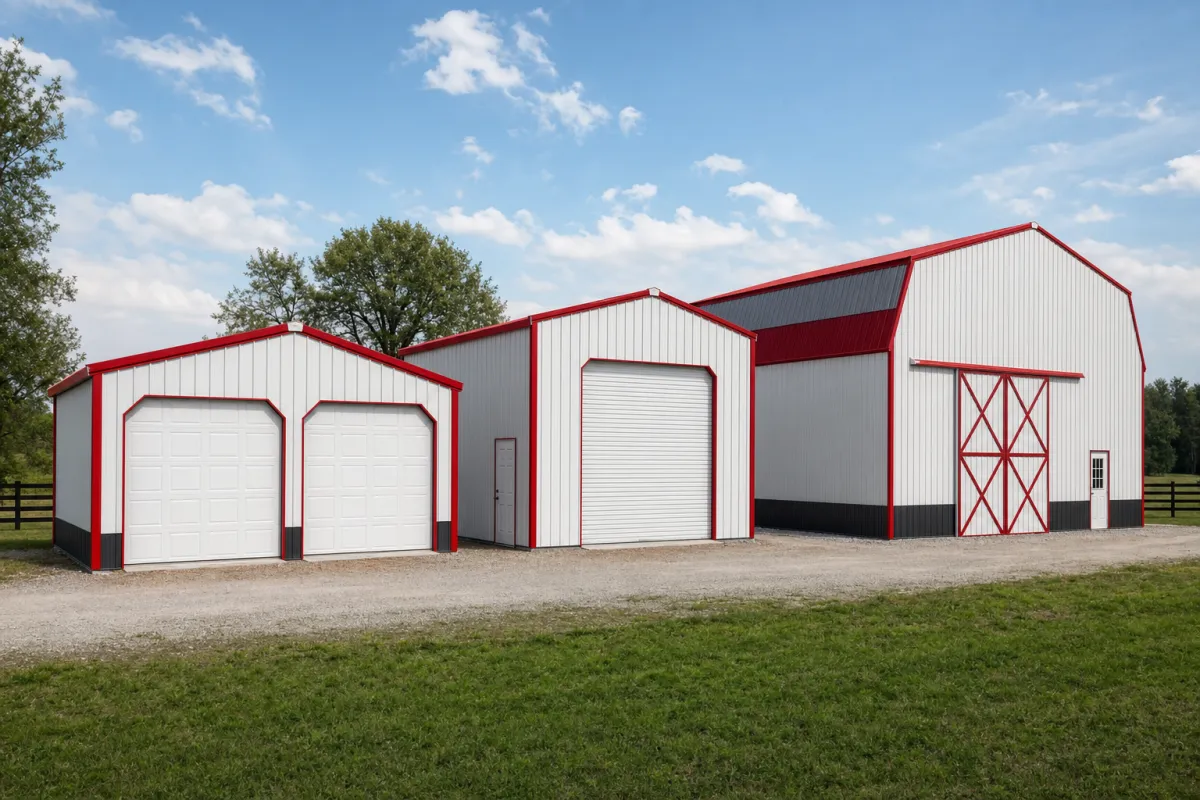
The carport dollar buys weather physics: UV off the paint, hail off the hood, snow off the windshield, and most of the daily-degradation problem solved for $2,400-$4,800. It does not buy a lockable door, a dry floor in blowing rain, a place to keep tools, or a wall to hang anything on. The garage dollar buys all of that plus things people forget to price: a concrete floor you can work on year-round, a structure insurers treat as a building, and square footage that shows up in an appraisal. The gap between the paths is not waste; it is a list of features. Write down which features you would actually use within five years, and the decision usually makes itself. The complete carport guide and the metal garage cost guide hold the deep pricing for each side.
The three paths, priced on one driveway
Here is the same two-vehicle household run down each path at national mid-range rates, so the totals compare honestly.
| Line item | Carport now | Garage upfront | Enclose later |
|---|---|---|---|
| Structure, installed | $3,700 (20×20 vertical) | included in turnkey | $4,400 (enclosure-ready spec) |
| Concrete | $0 (anchored to gravel) | included in turnkey | $3,600 pad, poured to anchor plan |
| Enclosure: panels, doors, labor | n/a | included in turnkey | $6,500, done in year three |
| Permits | $0 – $300 | included in turnkey | $450 at enclosure time |
| Total | ~$3,900 | ~$27,000 (20×20-24×30 turnkey) | ~$15,000 staged |
All figures modeled, July 2026. Two things jump out of that table every time we run it. First, the enclose-later path lands at roughly half a real garage, but delivers a carport-grade building: tube frame, thinner panels, and a structure that started life as a roof. Second, the garage number is turnkey scope, engineered as a building from the first bolt, which is what the extra money is. The steel building cost calculator prices your own version of each column in a few minutes.
Which path fits which buyer
| Your situation | Best path | Why |
|---|---|---|
| Vehicles outside, budget under $5K | Carport now | Solves 80% of the weather problem for 15% of the money |
| Tools, storage, or a workshop in the plan | Garage upfront | Enclosure features are the mission, not an add-on |
| Sure about enclosure, short on cash today | Enclose later | Stages the spend; order the enclosure-ready spec |
| Harsh winters, daily vehicle use | Garage upfront | A dry floor and a door beat a roof in January |
| Rental or short-hold property | Carport now | Fast, cheap, removable, no permit drama in most counties |
| Resale value on the mind | Garage upfront | Appraisers count buildings; carports read as equipment |
The enclose-later path, honestly
Enclosing works, but only when the first purchase was made for it. The carport must have a vertical roof, a certified frame, ideally 12-gauge steel, and a concrete pad poured to the anchor plan, which pushes the day-one price to the top of the carport range. The enclosure itself adds $4,000-$9,000 (modeled, July 2026) for wall panels, a roll-up door, a walk door, and labor, plus the pad if you skipped it. Buy the cheap regular-roof special instead and the path closes: the frame is not rated for wall loads, and the county will not paper it as a building. The step-by-step enclosure budget lives in the carport hub. The honest summary: enclose-later is a financing strategy, not a discount, and it works best when “later” has a date on it.
How your location tilts the decision
Location moves the two paths differently, which can flip the answer. Garages carry the location costs of real construction: frost footings add $800-$2,000 in northern counties, permits run $150-$1,500+ with plan review, and local slab and labor rates swing the turnkey total 20-30%. Carports mostly dodge all of that with anchors instead of foundations and exemptions instead of permits, but pay their own toll in wind country, where certified ratings add 10-20%. The practical tilt: in a mild-climate rural county, the carport’s cost advantage is at its widest; in a snow-belt suburb with plan review, the garage’s premium shrinks relative to what the finished building delivers, and staged enclosure gets less attractive because the permit office treats it as new construction anyway.
The decision checklist
- List what the structure must do in five years, not this summer: parking only, or storage and work?
- Price all three paths at YOUR size before comparing; the spread changes with footprint
- If enclosure is plausible, get the enclosure-ready spec quoted on day one: vertical roof, certified, 12-gauge
- Ask the county two questions: is an open carport exempt, and what does enclosing one trigger?
- Compare the garage quote at identical scope: slab, erection, delivery, and doors all included
- Check insurance treatment of each: enclosed buildings and open structures are rated differently
- Weigh resale: a permitted garage appraises; a carport usually conveys like equipment
- If staging the spend, put a date on “later”; undated plans become never at full price
Readers comparing options usually open 20×20 carport cost and cost to enclose a carport next; both follow the same July 2026 cost model.
Carport vs garage FAQs
Is a carport cheaper than a garage?
By roughly 5-10x at the same vehicle count: a two-car carport runs $2,400-$4,800 installed versus $18,000-$38,000 turnkey for a two-car metal garage (modeled July 2026). The gap is the walls, slab, doors, engineering, and permits that make the garage a building.
Is it cheaper to enclose a carport than build a garage?
Usually in total dollars, yes: an enclosure-ready carport plus pad plus enclosure totals about $9,000-$18,500 versus $18,000-$38,000 for a garage (modeled July 2026). But you end with a converted carport, not a garage-grade building. It wins when staging the spend matters more than the finished product.
Does a carport add property value like a garage does?
Not really. A permitted garage on a slab counts as building square footage to appraisers and buyers; a carport typically reads as removable equipment. If resale contribution is part of the math, the garage is the only path that scores it, and the $18,000-$38,000 turnkey spend recovers part of itself at sale.
Which protects vehicles better?
Against UV, hail, and snow load: nearly a tie, and those drive most weather damage. Against wind-driven rain, theft, vandalism, and rodents: the garage, decisively. A carport with side panels added for $300-$700 per side (modeled July 2026) closes some of the rain gap for little money.
Can I start with a carport and upgrade to a garage later?
Two real versions of that: enclose the carport (order vertical roof, certified, 12-gauge, pad to the anchor plan, then spend $4,000-$9,000 later), or run the carport as cheap cover while saving for a separate garage build. Both work; the mistake is buying the $1,800 special and expecting it to become a building.
Do carports and garages need the same permits?
No, and it matters. Open freestanding carports are exempt or cheap ($0-$300) in many counties; a garage is real construction with permits at $150-$1,500+, inspections, and frost footings up north. Enclosing a carport later usually re-triggers the full building conversation, so ask the county about both endpoints upfront.
Ready to price this building for real? Compare verified metal building companies for this project type, with real reviews and track records.
Sources and methodology: published supplier price lists and advertised carport and garage package pricing (June-July 2026); component cost benchmarks for ready-mix concrete, erection labor, and freight; IBC and ASCE 7 for load context. All figures are modeled national estimates, labeled as modeled, and reviewed quarterly; see the full Cost Index methodology. This guide links to our independent company directory; listings never change published numbers.
Written by the Steel Building Editorial Team | Last updated July 10, 2026