

SteelBuildingKit Cost Index · Updated July 10, 2026 · Pricing collected June-July 2026
Where you build moves a metal building budget by 20-30 percent in either direction before you change a single spec (modeled July 2026). Six levers do all of it: county snow and wind loads (+8-15% on the kit), frost depth ($800-$2,000+ in footings), freight ($500-$3,000+), local erection labor (a $4-$10 per square foot market), permits ($150-$4,000), and local concrete prices ($6-$12 per square foot installed). This guide prices each lever and shows the same building on three very different sites.
Notice what is not on that list: your state. Every one of these levers is set at the county or even ZIP-code level, which is why we publish location as levers and archetypes instead of pretending a state price list could be honest. This article anchors that method for the whole cost fundamentals hub; the table below is the summary, and everything after it goes lever by lever.
| Lever | Typical swing modeled | Who sets it |
|---|---|---|
| Snow / wind / seismic loads | +8-15% on the kit price | Your county building department |
| Frost depth | +$800 – $2,000 small buildings; $2,000 – $6,000 large | Climate, enforced by local code |
| Freight from the plant | $500 – $3,000+ per delivery | Distance to the nearest roll-former |
| Erection labor market | $4 – $10/sqft, small buildings $6 – $10 | Local contractor supply and season |
| Permits and plan review | $150 – $4,000; ag exemptions $0 – $300 | County fee schedules and zoning |
| Concrete market | $6 – $12/sqft installed slab | Regional ready-mix and finishing rates |
Swings are relative to a national mid-range baseline: standard 20-40 psf snow, 115-140 mph wind, shallow footings, regional freight, typical county permitting. Modeled July 2026.
Lever ranges are modeled national estimates from published supplier price lists and advertised kit pricing collected June-July 2026, cross-checked against component benchmarks priced in their own markets: ready-mix concrete, erection labor, and freight lanes, with IBC and ASCE 7 as the load context. We model levers and site archetypes rather than states because every lever here is set locally. All figures are labeled modeled; the full framework is the SteelBuildingKit Cost Index.
Loads: the lever that changes the steel itself
Five of the six levers price around the building. This one reprices the building. Snow, wind, and seismic requirements determine how much steel your frames carry, so a kit engineered for 50 psf snow costs 8-15 percent more than the same footprint at a 20 psf baseline, with wide clear spans feeling it most. Two things follow. First, an advertised price that does not name its design loads is quoting somebody else’s county. Second, this money is not optional or negotiable; the requirement comes from the permit office, not the salesperson. How those requirements get set, and how to find yours, is covered in our guide to steel building codes by state; the number that matters is the one your county gives you in writing.
Frost depth: foundation money the slab price hides
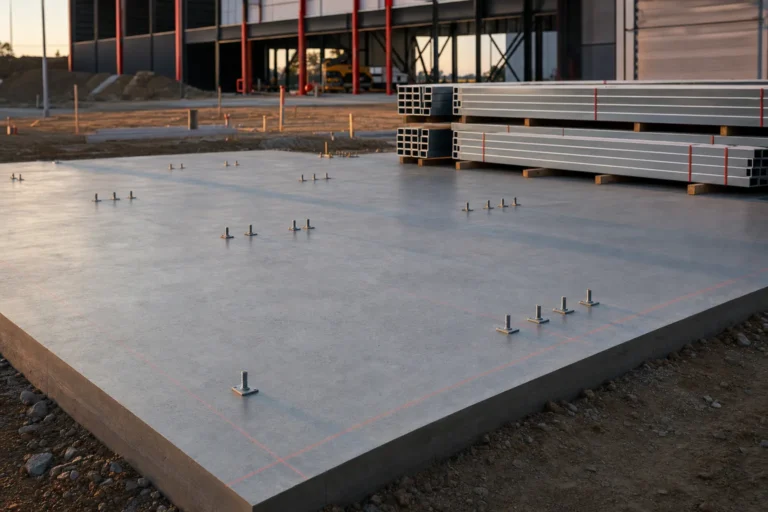
A 4-inch reinforced slab runs $6-$12 per square foot almost everywhere. What changes with latitude is what must happen at its edges. Cold-climate codes require footings below frost depth, sometimes 42 inches or more, and that thickened, deepened perimeter adds $800-$2,000 on a small building and $2,000-$6,000 on a large one against a shallow warm-climate slab. Quonset arches add their own wrinkle: thrust foundations run $2,000-$6,000 over a plain slab wherever they are built. The full engineering picture, including when piers and perimeter walls beat a slab, is in our guide to concrete slabs and frost footings. The short version for budgeting: the farther north the site, the more the foundation line grows, and no kit discount touches it.
Freight: the distance tax
Steel ships from regional roll-forming plants on flatbeds, and the meter is honest: within a couple hundred miles of a plant, delivery runs $500-$1,500; beyond roughly 250 miles, figure $2-$4 per mile on top; oversize loads that need escorts add $500-$1,500 more. A remote site can pay $3,000+ for the same steel a plant-adjacent buyer gets delivered for $600. Freight is also the most commonly omitted line in advertised pricing, quoted FOB factory and discovered later. Ask where your building would ship from before you fall in love with a quote; suppliers with plants near you carry a real, legitimate price advantage.
Local markets: labor, concrete, and the permit office
Erection labor prices like any trade: $4-$10 per square foot nationally, with small buildings at $6-$10 because mobilization dominates, and the same crew scope swinging thousands of dollars between a rural southern market and a tight metro one. Winter-rated erection in snow country costs more still. Concrete follows its own regional market inside the $6-$12 band. And permitting is the sleeper: a rural stamp can cost $150 while a commercial plan review with zoning conditions runs $4,000, with genuine agricultural projects sometimes exempt for $0-$300. Fee schedules are public; our permit requirements guide shows what offices actually ask for, and a ten-minute call to the county desk prices this lever exactly.
Season is the local lever nobody budgets. In snow country, the calendar splits the pricing in two: fabrication plants discount in winter when order books thin, while erection crews charge more or simply decline until the ground cooperates. A northern buyer who orders in January for an April slab pour can capture the discount and skip the premium; the same buyer ordering in May pays peak-season rates on both. Southern and mild-climate sites feel almost none of this. Wherever you build, steel quotes lock for only 7-30 days and lead times run 10-14 weeks ahead of erection, so the cheapest version of your building is usually the one ordered a season early.
The same 30×40, on three different sites
Here is how the levers stack on one building: a 30×40 turnkey workshop, identical spec, priced on three archetype sites (modeled July 2026). These archetypes are deliberately generic; your county will mix and match them.
| Line item | Mild southern site modeled | Snow-belt northern site modeled | Coastal high-wind site modeled |
|---|---|---|---|
| Steel kit (loads applied) | $18,500 | $21,000 | $22,500 |
| Slab + footings | $9,000 | $10,700 | $10,200 |
| Erection labor | $7,800 | $8,400 | $9,600 |
| Freight | $900 | $1,600 | $2,400 |
| Permits + engineering | $1,800 | $2,200 | $3,300 |
| Turnkey total | $38,000 | $43,900 | $48,000 |
Same drawings, same steel supplier, same doors. The southern archetype assumes shallow footings and short freight; the northern one adds 50 psf snow engineering, 42-inch footings, and winter-capable labor; the coastal one adds 150+ mph wind engineering and stricter plan review. All figures modeled, July 2026.
Worked out, the spread is $10,000 on a $38,000 building, about 26 percent, and every dollar of it traceable to a lever in Table 01. That is the number to internalize: identical buildings do not cost identical money, and neither archetype is being overcharged. The steel building cost calculator applies these same levers to your dimensions when you give it your county’s loads and ZIP.
Spec choices your location makes for you
| Choice | Typical impact modeled | Worth it when |
|---|---|---|
| Heavy-load engineering | +8-15% on the kit | Not optional; set by your county’s loads |
| Frost footings | +$800 – $2,000 small buildings | Required below the frost line; budget, don’t debate |
| 24-gauge panels over 26 | +8-12% on panel cost | Hail alley and coastal exposure |
| Blanket insulation | +$2.50 – $4.00/sqft | Any climate you will heat or cool against |
| Gutters and downspouts | +$6 – $12 per linear foot | Heavy-rain regions; protects slab edges |
| Winter-scheduled erection | Varies with local labor | Snow country; ask how weather delays are billed |
Placing your own site
You do not need a quote to place yourself on this map; you need four phone-friendly facts. Your county’s design loads and frost depth come from the building department in one call. Distance to the nearest roll-forming plant sets your freight expectation. Your permit office’s fee schedule is public. With those in hand, start from the national range for your size in the complete metal building cost guide, then shade toward the archetype you resemble: mild-climate sites land in the lower third of a turnkey range, snow-belt sites in the middle to upper third, and coastal high-wind or strict-review sites at the top. A site that mixes archetypes, say a snowy county far from any plant, stacks both adjustments. That shading exercise gets most buyers within a real quote’s neighborhood before a single salesperson is involved. It also changes how you shop: instead of asking suppliers what a building costs, you ask them to justify where their number sits against your archetype, which is a far stronger position to negotiate from.
The location questions to settle before quoting
- County snow, wind, and seismic design loads, in writing from the building department
- Frost depth requirement, and whether your foundation plan needs footings below it
- Distance from the supplier’s actual roll-forming plant to your site, and freight quoted to your address
- Local erection references: crews who have set steel in your county, not just your state
- Permit fee schedule and whether your use triggers plan review or an agricultural exemption
- Local concrete quote per square foot, with the footing detail your climate requires
- Seasonal timing: winter fabrication discounts against winter erection premiums
- Every quote’s design loads matched to YOUR county’s numbers before comparing prices
Readers comparing options usually open cost calculator methodology and prices by frame type next; both follow the same July 2026 cost model.
Metal building cost by location FAQs
How much does location change metal building cost?
About 20-30 percent in either direction from national mid-ranges (modeled July 2026). Loads add up to 15 percent to the kit, frost footings add $800-$2,000+, freight spans $500-$3,000+, and labor, permits, and concrete each swing thousands. The same 30×40 turnkey models at $38,000 on a mild site and $48,000 on a demanding one.
Which state is cheapest for a metal building?
The honest answer: pricing is set by county-level levers, not state lines. A mild-climate county near a roll-forming plant with light permitting is the cheap archetype wherever it sits, modeling 20-30 percent below a snow-belt or coastal county in the same region. Price your county’s loads, frost depth, and freight distance instead of shopping states.
How much do snow and wind loads add to a kit?
Heavy-load engineering adds 8-15 percent to the kit price versus a 20-40 psf baseline (modeled July 2026), and wide clear spans feel it most. The requirement comes from your county, not the seller, so any quote that doesn’t state its design loads is quoting a different county’s building.
Does location change the kit price or just the site costs?
Both. Loads reprice the steel itself (+8-15 percent), while frost depth, freight, labor, permits, and concrete move everything around the kit: $800-$2,000+ in footings, $500-$3,000+ in freight, $150-$4,000 in permits. That is why comparing bare kit prices across regions understates the real spread.
How much does delivery cost for a metal building?
Modeled July 2026: $500-$1,500 within a couple hundred miles of the plant, then roughly $2-$4 per mile beyond 250 miles, with oversize escorts adding $500-$1,500. Always get freight quoted to your address; FOB-factory pricing is where budgets quietly slip.
Why did my neighbor’s identical building cost less one county over?
Because at least one lever changed at the line: a different snow or wind designation (+8-15 percent on the kit), a different permit schedule ($150-$4,000 spread), or a different frost ruling. County borders are pricing borders in this industry, which is exactly why we model archetypes instead of publishing state price lists.
Ready to price this building for real? Compare verified metal building companies for this project type, with real reviews and track records.
Sources and methodology: published supplier price lists and advertised kit pricing (June-July 2026); component cost benchmarks for ready-mix concrete, erection labor, and freight; IBC and ASCE 7 for load context. All figures are modeled national estimates, labeled as modeled, and reviewed quarterly; see the full Cost Index methodology. This guide links to our independent company directory; listings never change published numbers.
Written by the Steel Building Editorial Team | Last updated July 10, 2026