

SteelBuildingKit Cost Index · Updated July 10, 2026 · Pricing collected June-July 2026
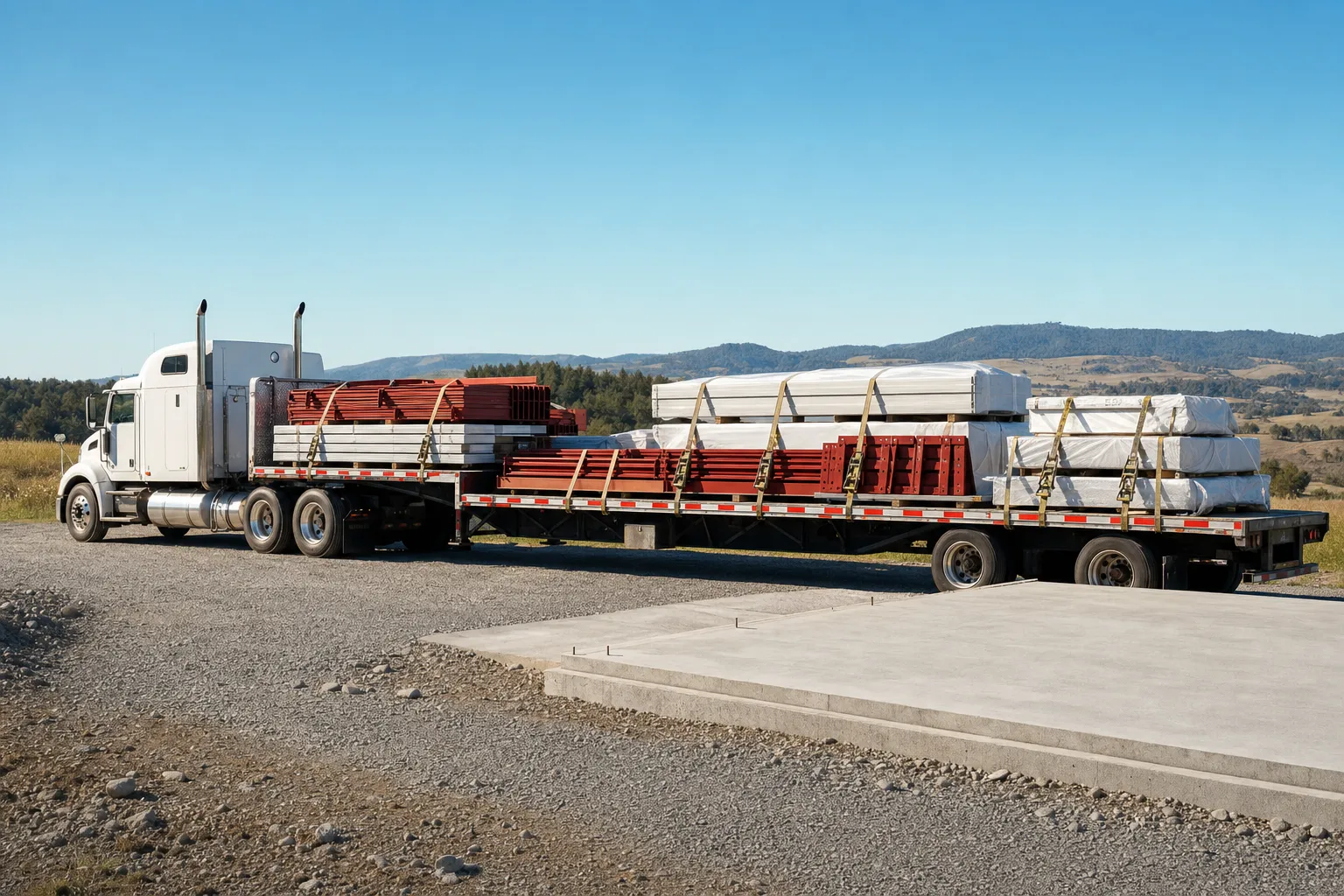
Metal building delivery costs $500 to $3,000+ depending on distance from the fabrication plant (modeled national ranges, July 2026). Within a regional lane of roughly 250 miles, most kits ship for $500 to $1,500 on a single flatbed; beyond that, figure $2 to $4 per additional mile. Oversize frame sections that need escort vehicles add $500 to $1,500. And the detail that surprises first-time buyers: offloading the truck is usually your job, not the driver’s.
Freight is the component quotes love to leave vague, with “FOB factory” doing a lot of quiet work in the fine print. This guide, part of our component costs hub, prices the line by distance, decodes the oversize rules, and gives you the offload plan that keeps delivery day from becoming an hourly-billed problem.
| Distance from plant | Typical cost modeled | Notes |
|---|---|---|
| Regional, under ~250 miles | $500 – $1,500 | Single flatbed; the most common case |
| 250 – 500 miles | $1,000 – $2,500 | Base plus $2 – $4 per mile beyond ~250 |
| 500+ miles / cross-country | $2,000 – $3,000+ | Ask whether a closer plant can fabricate |
| Oversize sections (escort required) | +$500 – $1,500 | Wide rigid frames, tall sections |
Assumes one full flatbed load, legal dimensions, and a site a semi can actually reach. Large buildings shipping on multiple trucks carry each load as its own freight line. Modeled national ranges, July 2026.
Ranges are modeled national estimates built from published supplier freight schedules and advertised delivery terms collected June-July 2026, cross-checked against flatbed lane benchmarks at $2-$4 per loaded mile beyond regional zones. Fuel surcharges and lane availability move real quotes week to week, so all figures are labeled modeled. Full methodology lives in the SteelBuildingKit Cost Index.
The delivery worksheet, line by line
| Line item | Typical range modeled | Notes |
|---|---|---|
| Base freight, regional lane | $500 – $1,500 | Confirmed to your address, not FOB factory |
| Mileage beyond ~250 miles | $2 – $4 per mile | The long-haul multiplier |
| Oversize escort (if triggered) | +$500 – $1,500 | Set by frame dimensions and state rules |
| Offload equipment rental | $400 – $900 per week | Telehandler or forklift; buyer’s side |
| Access improvements (if needed) | +$1,000 – $3,000 | Rock drive, culvert; soft or tight sites |
Worked example at national mid-range rates: a kit fabricated 420 miles out pays a $1,100 base plus 170 extra miles at $3, about $1,600 freight. Add a $600 telehandler rental week to unload and stage the bundles and delivery-day money totals around $2,200. The steel building cost calculator includes freight in its turnkey planning totals, and asking every bidder for delivered-to-address pricing is rule one in our guide to comparing metal building quotes.
What moves the freight number
| Factor | Typical effect modeled | Notes |
|---|---|---|
| Distance and plant choice | The dominant lever; $2 – $4/mile past ~250 | Multi-plant suppliers can quote closer fabrication |
| Order size (second truck) | Each truck is its own freight line | Common past the 50×100 class |
| Oversize frame sections | +$500 – $1,500 escort and permitting | Ask at quote stage, not delivery week |
| Site access quality | Extra handling if the semi cannot reach the pad | +$1,000 – $3,000 fixes beat double-moves |
| Delivery window flexibility | Rigid dates price high; storage has costs too | Coordinate with slab cure and crew dates |
The offload plan: your side of delivery day
Standard terms put the driver’s job at getting the trailer to your site and your job at getting the steel off it, and drivers bill detention by the hour when the buyer is not ready. A working offload plan has four parts. Equipment: a telehandler or forklift with fork extensions, rented at $400-$900 per week (modeled, July 2026), which usefully overlaps the erection week if you are building DIY. Ground: firm surface where the truck stops, because a flatbed on soft grass becomes an expensive tow. Staging: bundles set on blocking, panels slightly inclined so water cannot pond in the nesting, frames laid out near their erection sequence. And people: one spotter minimum, since frame sections are long, heavy, and unforgiving. Crews handle all of this when delivery lands inside a professional erection contract; our metal building erection cost guide covers how that scope is priced.
How your location moves delivery cost
Freight is geography made visible on the quote. Buyers within a regional lane of a fabrication plant, roughly 250 miles, sit in the $500-$1,500 band almost regardless of building size, while remote sites pay the $2-$4 per mile long-haul rate on every mile past the zone (modeled, July 2026). This is a genuinely useful supplier-selection filter: a big supplier with multiple plants can fabricate your building at whichever plant sits closest, and that choice alone can move freight by $1,000 or more on the same steel. Rural sites add the access question, since the last quarter mile of dirt road can cost more per foot than the first four hundred highway miles. Mountain routes, escort-rule differences between states, and seasonal road restrictions in northern spring thaw round out the locational swings.
The delivery checklist
- Freight quoted to your street address, in writing; “FOB factory” is not a delivered price
- Which plant fabricates your building, and whether a closer one is available
- Oversize status of your frame sections asked and answered at quote stage
- Number of trucks stated for larger buildings; each load is its own line
- Offload responsibility confirmed, and equipment rental booked for delivery week
- Truck path walked: firm ground, turning room, no low wires or soft spots
- Staging area planned with blocking laid out before the truck arrives
- Delivery date coordinated against slab cure and erection crew schedule
Readers comparing options usually open permit cost and crane and equipment cost next; both follow the same July 2026 cost model.
Delivery cost FAQs
How much does metal building delivery cost?
$500-$1,500 within a regional lane of roughly 250 miles, and $2-$4 per mile beyond that, with cross-country hauls reaching $3,000+ (modeled, July 2026). Oversize frame sections needing escorts add $500-$1,500. Always get freight quoted to your address, not FOB factory.
Is delivery included in a metal building kit price?
Sometimes within a regional zone, but never assume it. Advertised kit prices are commonly ex-factory, with freight quoted after your address is known. Make every bidder state delivered pricing in writing; a $1,500 surprise on delivery week is the classic quote-comparison error.
Who unloads the truck when a metal building kit is delivered?
You do, under standard terms. Plan a telehandler or forklift with fork extensions at $400-$900 for the rental week (modeled, July 2026), firm ground for the truck, and a staging area on blocking. Drivers bill detention by the hour when the site is not ready.
What makes a metal building load oversize?
Frame section dimensions, mainly width and height on the trailer. Wide-flange rigid frames for bigger clear spans are the usual trigger, adding $500-$1,500 for permits and escort vehicles, with rules varying by state (modeled, July 2026). Ask at quote stage; it is a known answer, not a surprise.
Can a delivery truck reach a rural or unfinished site?
Only if you make it true: a loaded flatbed needs firm ground, turning room, and clearance. A temporary rock drive and culvert run $1,000-$3,000 (modeled, July 2026) and beat offloading at the road and double-handling every bundle. Walk the truck path before delivery week, not during it.
When should delivery happen relative to the slab and erection?
After the slab has cured (7 days minimum) and as close to the erection start as scheduling allows. Steel stored on site for weeks invites panel staining and bundle damage; steel arriving before the concrete cures invites a crew standing around. The tight version is delivery a day or two ahead of the crew.
Ready to price this building for real? Compare verified metal building companies for this project type, with real reviews and track records.
Sources and methodology: published supplier price lists and advertised kit pricing (June-July 2026); component cost benchmarks for ready-mix concrete, erection labor, and freight; IBC and ASCE 7 for load context. All figures are modeled national estimates, labeled as modeled, and reviewed quarterly; see the full Cost Index methodology. This guide links to our independent company directory; listings never change published numbers.
Written by the Steel Building Editorial Team | Last updated July 10, 2026