

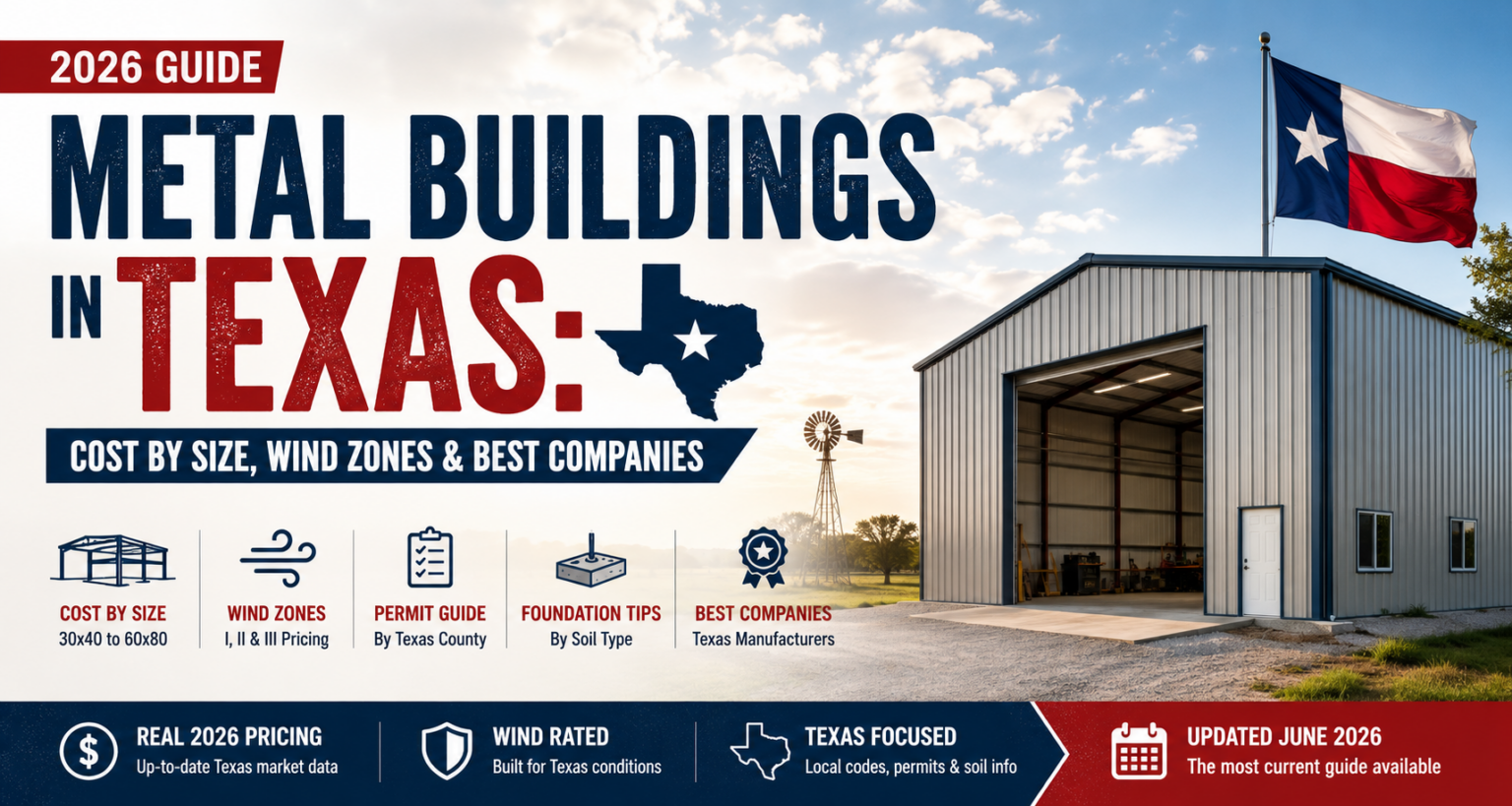
Metal Buildings in Texas: Cost by Size, Wind Zones & Best Companies (2026)
What You’ll Learn
– Real 2026 price ranges for metal buildings in Texas by size (30×40 through 60×80)
– How Texas wind zones affect your kit cost and which coastal areas pay the most
– Which Texas counties require permits and which rural areas have zero requirements
– How soil type in Dallas, Houston, and Hill Country changes your foundation cost
– A breakdown of the 30×40 metal building cost in Texas with total turnkey estimates
– The difference between actual Texas manufacturers and lead-gen brokers posing as them
– How 2026 steel tariffs are affecting Texas metal building prices right now
Metal buildings in Texas are one of the most cost-effective ways to add covered space on a property, whether you are building a shop in the Panhandle, a barndominium outside of Waco, or a commercial warehouse near the Port of Houston. A metal building Texas buyers purchase today will cost anywhere from $12,000 for a basic 30×40 kit to over $150,000 fully installed for a large 50×100 commercial structure, depending on your region, wind zone, and soil conditions.
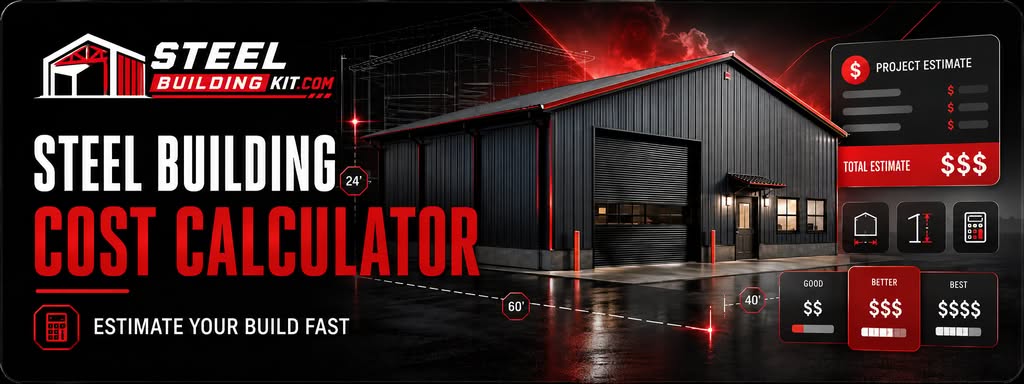
At SteelBuildingKit.com, we review manufacturers, compare kit pricing, and dig into the regional details that most generic guides skip. This article covers the Texas-specific factors that directly affect what you pay. If you want a faster estimate, use our steel building cost calculator first, then come back here for the fine print. For general pricing fundamentals, our guide on steel building cost per square foot covers the national baseline.
Quick Answer: What Does a Metal Building Cost in Texas in 2026?
Texas pricing generally runs within 5-10% of the national average for inland regions. The Gulf Coast is the exception. Here is a fast-reference table for 2026 kit and installed prices:
| Size | Kit-Only Price (Texas) | Installed Shell (Texas) | Notes |
|---|---|---|---|
| 30×40 | $12,000 – $20,000 | $26,000 – $44,000 | Wind zone has large impact |
| 40×60 | $24,000 – $40,000 | $50,000 – $85,000 | Most popular Texas size |
| 50×100 | $42,000 – $72,000 | $88,000 – $150,000 | Commercial grade typical |
| 60×80 | $40,000 – $68,000 | $84,000 – $142,000 | Large shop or ag use |
These ranges reflect Wind Zone I pricing for inland Texas. Gulf Coast buildings (Wind Zone III) run 15-30% higher on the kit cost alone. Foundation, permitting, and finish work are on top of these numbers.
Section 1: Metal Building Costs in Texas by Size (2026)
Texas pricing tracks the national market closely for most of the state. The exception is anything within the Texas Department of Insurance (TDI) windstorm zone along the Gulf Coast, where engineering upgrades and certification costs add a noticeable premium.
For detailed size-specific breakdowns, see:
– 30×40 metal building kit cost guide
– 40×60 steel building kit cost guide
– 50×100 steel building kit cost guide
The biggest variables driving price differences within Texas are wind zone engineering requirements, soil conditions that affect foundation design, and delivery distance from manufacturers. A buyer in Red Oak south of Dallas buying from Mueller Inc. will pay considerably less in freight than a buyer in Lubbock purchasing from a manufacturer in Georgia.
Section 2: Texas Wind Zones – The Biggest Factor in Your Building Price
Texas spans multiple wind design categories under ASCE 7, and the spread between the cheapest and most expensive zones is significant. Here is how the state breaks down:
Wind Zone I – North Texas, Panhandle, Inland Areas
Design wind speed: 90-100 mph. This covers cities like Amarillo, Lubbock, Abilene, and most rural West Texas. Buildings built to this standard use standard steel gauge and fastener patterns. Pricing is at or below the national baseline.
Wind Zone II – Central and East Texas
Design wind speed: 110-120 mph. This covers Austin, San Antonio, most of the Dallas-Fort Worth metro (DFW sits in a transition zone), and East Texas markets like Tyler and Lufkin. Expect 5-10% above Wind Zone I pricing on the kit cost.
Wind Zone III – Gulf Coast, Houston Area, Galveston
Design wind speed: 130-150 mph. This zone covers Houston, Corpus Christi, Galveston Island, Beaumont, Brownsville, and the entire coastal strip. Buildings here require heavier gauge steel, additional bracing, closer frame spacing, and TDI windstorm certification. Add 15-30% to kit cost before any other adjustments.
The real-dollar difference: A 40×60 building engineered for 90 mph winds in Amarillo costs $4,000-$8,000 less than the exact same building engineered for 140 mph winds in Corpus Christi. That is before you factor in the TDI certification process.
Buyer warning: Many online metal building quotes default to 90 mph wind rating regardless of where you are located. If you are in coastal Texas, confirm in writing that your building is engineered for your actual local design wind speed before signing any purchase agreement. Ask the manufacturer for the engineer’s wind speed assumption on the drawings.
Section 3: Texas Building Codes for Metal Buildings
Texas operates with a patchwork of code enforcement that confuses a lot of first-time buyers. Here is what you actually need to know:
Texas follows the International Building Code (IBC) at the state level for commercial structures. However, Texas does NOT have statewide residential building code enforcement. This means:
- Many rural Texas counties, particularly in West Texas and the Panhandle, have no building code at all. You can erect a structure with no permit and no inspections.
- Cities and incorporated suburban counties do require permits. If you are in a city limits or ETJ (extraterritorial jurisdiction), assume you need a permit.
- The IBC requires PE-stamped (Professional Engineer) drawings for commercial structures above a certain size and occupancy type.
- The Texas Department of Insurance windstorm certification is required for any structure in the TDI windstorm zone (roughly the coastal counties from Jefferson down to Cameron). This is a separate process from a standard building permit.
- Frost line depth is minimal in Texas compared to northern states. South Texas is effectively 0 inches. North Texas runs 6-8 inches. This is one area where Texas actually saves money on foundation design versus Colorado or the Midwest.
Section 4: Permit Requirements by Texas Region
Permit requirements vary significantly by where in Texas you are building. This table covers the major regions:
| Region | Permit Required? | PE Stamp? | Typical Permit Cost | Timeline |
|---|---|---|---|---|
| DFW metro | Yes | Yes (commercial) | $300 – $2,500 | 2-6 weeks |
| Houston metro | Yes | Yes | $400 – $3,500 | 4-8 weeks |
| Gulf Coast (TDI zone) | Yes + TDI cert | Yes | $800 – $5,000 | 6-12 weeks |
| Austin metro | Yes | Yes | $350 – $2,800 | 3-6 weeks |
| Rural unincorporated | Often no | Varies | $0 – $500 | Days to weeks |
The Gulf Coast timeline is the one that catches buyers off guard. If you are building in Brazoria County, Galveston County, or anywhere along the Coastal Bend, budget 6-12 weeks minimum for the TDI approval process on top of your local permit. Start this process before you order your kit.
For a complete breakdown of permit processes and what documentation manufacturers typically provide, see our metal building permit requirements guide.
Section 5: How Texas Soil Affects Foundation Cost
Foundation cost is one of the biggest variables in Texas that surprises out-of-state buyers. Texas has wildly different soil conditions by region, and each one has real cost implications.
Black clay soil – Dallas/Fort Worth and Central Texas
This is the most challenging soil type in Texas for slab construction. Black clay expands significantly when wet and contracts when dry, which causes cracking and heaving in standard slabs. A 40×60 slab in Parker County outside Fort Worth will typically require a thicker slab with deeper turn-down footings or post-tension design.
- Turn-down footings with 4″ slab: $6-$9 per square foot (higher than national average)
- Large buildings sometimes use pier-and-beam systems to isolate the structure from soil movement
- Geotechnical reports are often required by engineers before they will stamp drawings in DFW
Sandy soil – East Texas and Gulf Coast areas
East Texas counties like Nacogdoches, Henderson, and Rusk have sandy loam soil with good drainage. Standard slab construction works well here and costs run $4-$6 per square foot for most applications.
Caliche and limestone – Hill Country and West Texas
The Edwards Plateau, Hill Country areas around Fredericksburg and Kerrville, and much of West Texas sit on caliche or limestone bedrock. Hard rock makes for cheaper footings because you are not fighting soil movement, but it does require rock drilling for deep anchor bolts. Net cost is often at or below national average.
| Region | Soil Type | Foundation Recommendation | Cost Premium |
|---|---|---|---|
| DFW / Central TX | Expansive black clay | Thickened slab or post-tension | High (+15-25%) |
| East TX | Sandy loam | Standard 4″ slab | Low (at or below average) |
| Gulf Coast | Sandy / clay mix | Standard slab, check flood zone | Moderate |
| Hill Country / West TX | Caliche / limestone | Standard slab, rock drill anchors | Low to moderate |
For more on foundation types and what each costs, see our steel building foundation types guide.
Section 6: 30×40 Metal Building Cost in Texas
The 30×40 is the most common size for residential garages, small shops, and agricultural use in Texas. Here is a realistic cost breakdown for 2026:
Kit-only cost: $12,000 – $20,000 (delivered to Texas)
Installed shell costs by wind zone:
– Wind Zone I (Amarillo, Lubbock, Abilene area): $28,000 – $40,000
– Wind Zone II (Austin, San Antonio, DFW): $30,000 – $44,000
– Wind Zone III (Houston, Corpus Christi, Galveston): $34,000 – $52,000
TDI windstorm certification in Gulf Coast counties adds $2,000 – $4,000 to total project cost.
Foundation (4″ slab):
– Sandy/limestone soil: $4,500 – $7,500
– Dallas black clay (thickened slab): $7,000 – $12,000
Total turnkey estimate (kit, erection, slab, basic doors and windows):
– North/West Texas: $38,000 – $55,000
– DFW/Austin metro: $42,000 – $60,000
– Gulf Coast: $48,000 – $68,000
These are realistic ranges, not marketing numbers. For a full 30×40 cost breakdown including door and window options, see the 30×40 metal building kit cost guide.
Section 7: Metal Building Use Cases in Texas
Texas has one of the most diverse metal building markets in the country because the land area, climate, and economy create demand across multiple use types:
Agricultural buildings (barns, hay storage, equipment cover)
This is the bread-and-butter of rural Texas metal building sales. Farmers and ranchers in counties like Foard, Haskell, and Coleman often face zero permit requirements. A basic hay barn or equipment shed in an unincorporated area can be up in days without a single form filed.
Residential garages
The most popular urban and suburban use. A two-car or three-car metal garage in the suburbs of San Antonio or Pflugerville will need a city permit, but the process is straightforward for residential applications.
Commercial shop and light industrial
DFW and Houston metro areas have heavy demand for commercial metal buildings for contractor shops, auto repair, and light manufacturing. These require IBC compliance and PE-stamped drawings.
Barndominium
Texas is arguably the epicenter of the barndominium market in the United States. If this is your intended use, we cover the full procurement process in our barndominium kits complete buyers guide.
Oil field equipment storage
West Texas and the Permian Basin around Midland and Odessa generate significant demand for equipment storage and maintenance buildings. These are typically purchased as commercial structures with engineered drawings.
Section 8: Best Metal Building Companies for Texas
Not every metal building company that shows up in a Texas Google search is actually a metal building company. Here is what to know:
Mueller Inc. – Texas-based manufacturer headquartered in Red Oak, TX (south of Dallas). Mueller is one of the only major manufacturers actually located in Texas, which means lower delivery costs across most of the state. Strong reputation for agricultural and residential buildings throughout the Lone Star State. Read our Mueller Inc. steel buildings review for a full breakdown.
General Steel – Strong Texas presence with Gulf Coast-specific experience. Has engineered and delivered buildings in the TDI windstorm zone and understands the certification process.
Rhino Steel Buildings – Ships to all Texas regions. Solid warranty and standard Texas engineering packages available.
Nucor Building Systems – Commercial-grade manufacturer appropriate for large Houston and Dallas commercial projects. Not the right fit for a residential garage but competitive on larger structures.
Buyer warning: A large portion of Texas Google ads for metal buildings lead to lead-generation brokers who are not manufacturers. They collect your information and sell it to multiple dealers. Mueller Inc. and General Steel are actual manufacturers with their own fabrication facilities. When talking to any company, ask directly: “Do you manufacture the steel yourself or do you purchase from a third party and resell?” The answer tells you whether you are dealing with a manufacturer or a middleman.
For a broader comparison of companies, see our top 10 steel building kit companies in-depth review.
Section 9: Steel Tariffs and Texas Metal Building Prices in 2026
Steel tariffs hit 50% in 2025 and have been partially rolled back through 2026 negotiations. Texas buyers, particularly in the Houston port market, felt the initial impact before inland states because imported steel enters through Gulf Coast ports first.
The current 2026 pricing environment sits approximately 8-15% above pre-tariff levels from 2023-2024 even after the partial rollback. This is meaningful on a large kit. A 50×100 building that would have been $52,000 in 2023 is now running $57,000 – $60,000 for the same spec.
For buyers who are price-sensitive, the most effective strategy is to lock in your quote with a confirmed delivery date before any scheduled tariff policy changes. Manufacturers can hold pricing once a contract is signed with a delivery commitment. Get any tariff price-hold terms in writing.
For more detail on how tariffs are affecting 2026 kit prices nationally, see our steel tariffs 2026 impact on building kit prices article.
Section 10: Texas-Specific Tips for Buying a Metal Building
These are the practical things that experienced Texas buyers know that first-timers often learn the hard way:
Buy local when you can. Mueller Inc. in Red Oak, TX ships to most of the state at a freight advantage over out-of-state manufacturers. Depending on your delivery address, this saves $500 – $3,000 compared to a manufacturer in Indiana or Pennsylvania.
Check your county permit requirements before you order anything. Some rural Texas counties have zero permit requirements for non-commercial structures. If you are in an unincorporated area, a quick call to the county judge’s office or county clerk can confirm whether you need a permit at all. This can save you $500 – $2,000 in permitting fees and weeks of wait time.
Get your TDI windstorm certification process started early. If you are in a Gulf Coast county covered by the TDI windstorm program, the certification process is separate from your building permit and can add 6-12 weeks. Start it before you place your building order, not after.
Ask manufacturers specifically for a Texas engineering package. Some manufacturers include Texas-specific PE-stamped drawings as standard. Others charge $500 – $1,500 extra for it. Know which category your manufacturer falls into before you commit.
Schedule delivery in fall. August through October is peak construction season in Texas, which means erection crews are booked out and material deliveries get congested. If your timeline is flexible, a spring or early summer delivery date typically means faster erection scheduling and sometimes lower crew rates.
Common Metal Building Mistakes in Texas
| Mistake | Region Where It Hits Hardest | Cost Consequence |
|---|---|---|
| Ordering a 90 mph wind-rated building for a Gulf Coast site | Houston, Galveston, Corpus Christi | TDI rejection, full re-engineering required ($3,000-$8,000) |
| Not checking county permit status before ordering | Rural West and South Texas | Ordering engineering package you did not need |
| Skipping geotechnical soil report in DFW | Dallas, Fort Worth, Collin County | Foundation failure or cracking within 3-5 years |
| Buying from a broker assuming it is a manufacturer | Statewide | Markup of 10-20% over manufacturer direct pricing |
| Ignoring delivery timeline for large kits | Statewide | 6-14 week lead time on large kits; underestimating delays project completion |
| Not asking about TDI certification in advance | Gulf Coast counties | Project completion delayed 6-12 weeks while waiting for TDI approval |
Article Summary
- Metal building Texas pricing ranges from $12,000 (30×40 kit) to over $150,000 (50×100 installed) depending on size, wind zone, and region
- Texas has three wind zones: Wind Zone I (90-100 mph inland), Wind Zone II (110-120 mph central/east), and Wind Zone III (130-150 mph Gulf Coast)
- Gulf Coast buildings require TDI windstorm certification, which adds $2,000-$4,000 and 6-12 weeks to the project timeline
- Texas does not have statewide residential building code enforcement; many rural counties have no permit requirements at all
- Black clay soil in the Dallas-Fort Worth area makes foundation costs 15-25% higher than the national average
- Mueller Inc. in Red Oak, TX is the only major manufacturer actually based in Texas, which means lower freight costs for most in-state buyers
- Many Texas metal building ads lead to lead-generation brokers, not actual manufacturers; always ask if they fabricate their own steel
- 2026 steel pricing is 8-15% above pre-tariff levels; locking in pricing before policy changes is the best hedge
- Always confirm the engineer’s assumed wind speed matches your local design requirement before signing a purchase agreement
- Schedule delivery in fall to avoid peak Texas construction season congestion in August-September
- Total turnkey cost for a 30×40 in Texas ranges from $38,000 (rural North Texas) to $68,000+ (Gulf Coast with TDI cert)
- Foundation type should be matched to your soil: post-tension or thickened slabs for DFW clay, standard slab for sandy East Texas soils
Frequently Asked Questions
Q: How much does a 30×40 metal building cost in Texas in 2026?
A: A 30×40 metal building kit in Texas costs $12,000-$20,000 for the kit alone. Fully installed and including a concrete slab, total turnkey cost runs $38,000-$55,000 in North and West Texas, $42,000-$60,000 in the DFW and Austin metro areas, and $48,000-$68,000 in Gulf Coast locations where TDI windstorm certification is required.
Q: Do I need a permit for a metal building in rural Texas?
A: It depends on your county. Texas does not have statewide residential building code enforcement, and many rural and unincorporated Texas counties have no permit requirements for non-commercial structures. Before you order, call your county judge’s office or county clerk to confirm whether your specific location requires a permit. Cities and incorporated suburban areas almost always require permits regardless of county rules.
Q: What is the TDI windstorm certification and do I need it?
A: The Texas Department of Insurance windstorm certification is a required inspection and approval process for structures built in designated windstorm areas along the Texas Gulf Coast. It applies roughly to the coastal counties from Jefferson County down through Cameron County. If your building site is in this zone, you need TDI certification in addition to a standard building permit. The process adds $2,000-$4,000 in cost and typically 6-12 weeks in timeline. Start it before you order your building kit.
Q: Why is my metal building quote cheaper than what I see on this page?
A: The most common reason is wind rating. Many online quote tools default to a 90 mph wind speed regardless of your location. If you are in Central, East, or Coastal Texas, your actual required design wind speed is likely 110-150 mph, which means heavier steel, closer frame spacing, and more bracing. Get the engineer’s assumed wind speed in writing before signing any purchase agreement.
Q: Which Texas-based metal building manufacturer is most reputable?
A: Mueller Inc. in Red Oak, TX is the most established manufacturer actually located in Texas. They have a long track record with agricultural and residential buyers across the state and ship at lower freight cost than out-of-state manufacturers. For commercial projects in Houston or Dallas, Nucor Building Systems is a strong option. For full rankings and scores, see our top 10 steel building kit companies review.
Q: How does black clay soil in DFW affect my metal building foundation cost?
A: Expansive black clay soil in the Dallas-Fort Worth area and much of Central Texas requires special foundation design. Standard 4″ slabs without extra reinforcement tend to crack and shift as the soil expands and contracts with moisture. Most structural engineers in DFW recommend a thickened slab with turn-down footings or a post-tension slab design. This adds 15-25% to foundation cost compared to national averages, bringing a typical 40×60 slab in the DFW area to $18,000-$30,000 depending on soil conditions and slab specifications.