

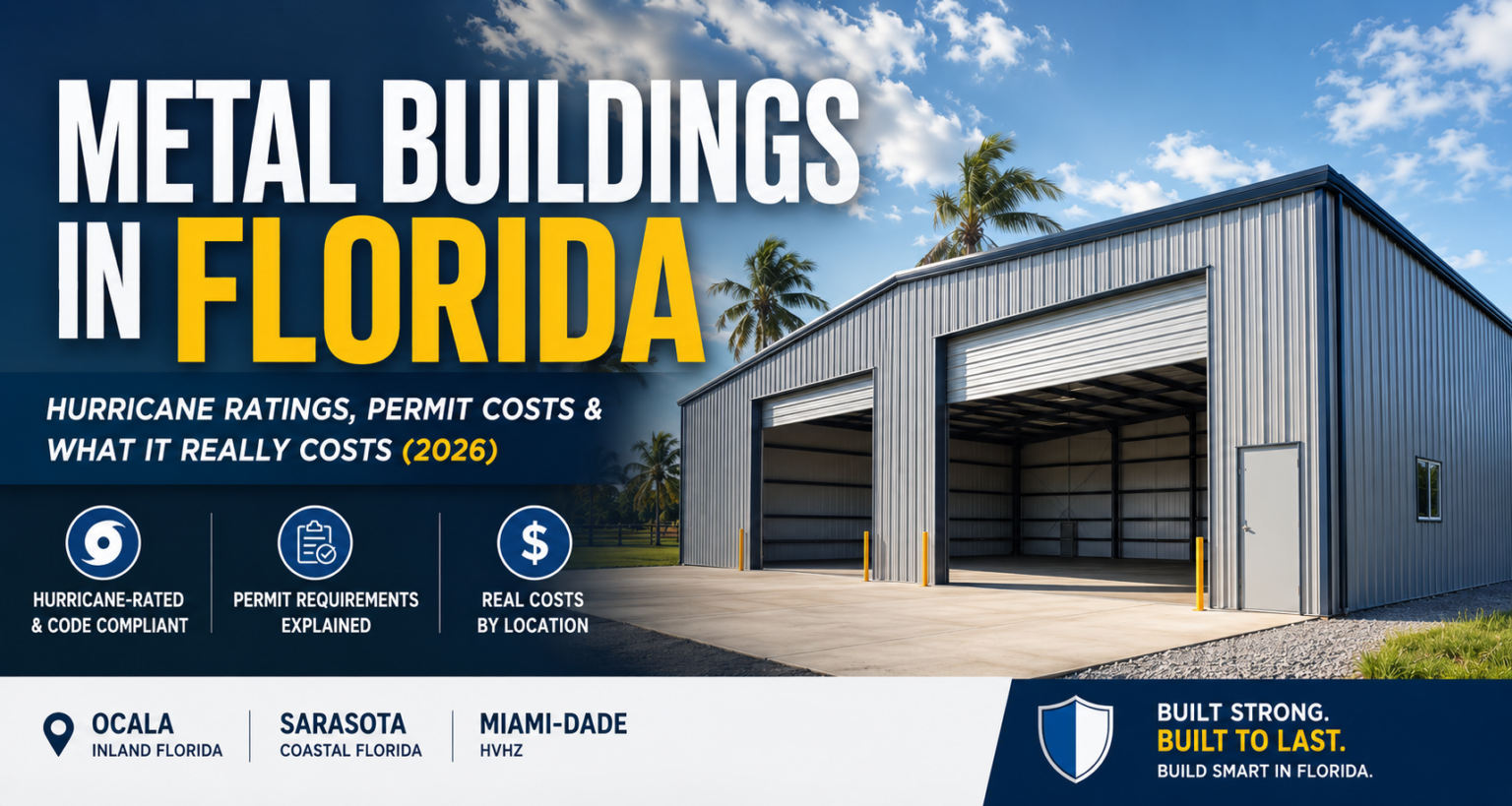
Metal Buildings in Florida: Hurricane Ratings, Permit Costs & What It Really Costs (2026)
What You’ll Learn
- Why a metal building Florida project costs 40-90% more than the same structure in Tennessee or Ohio
- How Florida’s three wind zones (Standard, Coastal, HVHZ) determine what you can build and what you’ll pay
- What NOA approval is and why skipping it gets your permit denied in Miami-Dade and Broward counties
- Real installed cost breakdowns for a 40×60 metal building in Ocala, Sarasota, and Miami-Dade
- What documents Florida requires for a building permit and how long the process actually takes
- Which metal building companies have genuine Florida experience vs. those that just say they do
- How to protect your investment with the right foundation, corrosion package, and insurance strategy
If you’re pricing a metal building Florida project, the first number you get from a national quote tool is going to be wrong. A metal building in Florida costs significantly more than anywhere else in the continental US, and the gap is not minor. Florida has the strictest wind resistance codes in the country, and those codes translate directly into higher material specs, heavier framing, third-party inspections, and a permit process that can take three months in South Florida.
This guide was put together for buyers who want the unfiltered picture before they sign anything. SteelBuildingKit.com does not sell buildings or earn referral commissions from manufacturers, which means you get cost data that reflects what buyers actually pay on the ground, not manufacturer marketing ranges. If you’re comparing options across the state, start with our steel building cost calculator to build a baseline before reading through the Florida-specific details below.
Quick Answer: Metal Building Costs in Florida vs. National Average
A 40×60 metal building installed nationally averages $46,000-$78,000 for a shell. In standard inland Florida, that same structure runs $72,000-$130,000. In Miami-Dade under HVHZ rules, you’re looking at $110,000-$200,000 or more.
That premium exists because of three mandatory cost drivers: NOA-certified or Florida Product Approved materials, heavier framing gauge requirements to meet higher design wind speeds, and third-party inspections that are not optional. The further south and the closer to the coast you build, the more each of those factors compounds.
Section 1: Why Florida Metal Buildings Cost More Than the Rest of the Country
Florida has the strictest statewide building codes in the US for wind resistance. After Hurricane Andrew flattened 28,000 homes in 1992 and caused $27 billion in damage, the state overhauled its entire building code framework. The Florida Building Code (FBC) that came out of that overhaul is updated on a three-year cycle and has no local opt-out provision. Every county, every structure, same minimum standard.
Hurricane codes add 20-45% to metal building costs compared to the national average, and that’s before you factor in South Florida’s HVHZ requirements. A 40×60 that installs for $52,000-$85,000 in Tennessee will run $91,000-$165,000 in standard inland Florida counties and $110,000-$200,000+ in Miami-Dade or Broward.
Three factors drive that cost difference:
NOA-certified or product-approved materials. Wall panels, roof panels, fasteners, doors, windows, and any penetrations all need individual Florida Product Approval (statewide) or NOA approval (HVHZ counties). Standard national kits don’t come with this documentation.
Heavier framing gauge. Design wind speeds of 130-185 mph require thicker primary and secondary framing than the 90-110 mph-rated buildings most national manufacturers quote as their standard product. The steel tonnage goes up, and so does the price.
Third-party inspections. Buildings over 30×40 in Florida typically require a third-party wind tunnel validation test costing around $4,200 on average. This fee almost never appears in online price quotes. If a national company quotes you a Florida project and the line item doesn’t appear, ask them directly where it’s included.
Section 2: Florida Wind Zones Explained
Florida is not one wind zone. Where you’re building determines your design wind speed, which determines your kit spec, which determines your total project cost.
| Wind Zone | Counties | Design Wind Speed | Code Level |
|---|---|---|---|
| Standard Florida (inland) | North/Central inland counties (Marion, Alachua, Polk interior) | 110-130 mph | Florida Building Code |
| Coastal | Most coastal counties (Sarasota, Charlotte, Volusia, Nassau, etc.) | 130-150 mph | Florida Building Code enhanced |
| HVHZ | Miami-Dade, Broward only | 175-185+ mph | HVHZ code |
Miami-Dade and Broward are the only counties in the US that enforce High Velocity Hurricane Zone (HVHZ) standards. These requirements are stricter than anything else in the nation, including coastal Louisiana, the Texas Gulf Coast, and the Carolinas. The HVHZ code originated in Miami-Dade after Andrew and has never been rolled back. If you’re building anywhere in those two counties, assume your project falls under HVHZ rules unless your contractor has confirmed otherwise in writing.
Your specific design wind speed comes from the Florida Building Code wind speed maps, and it can vary even within a county depending on distance from the coast and local terrain. A Florida-licensed PE will pull your exact site speed as part of the engineering package.
Section 3: What Is NOA Approval and Why You Need It
NOA stands for Notice of Acceptance. It is a product certification issued by Miami-Dade County specifically for construction products used in HVHZ buildings.
For a metal building, NOA approval applies to individual components, not the whole kit as a unit. Wall panels, roof panels, fasteners, doors, windows, and any penetrations all need their own NOA. If even one component lacks an NOA number, the inspector flags the whole project. In Miami-Dade and Broward, a building permit submitted without complete NOA documentation gets denied at intake. This is not a gray area.
An NOA-certified metal building kit costs $8,000-$18,000 more than a comparable standard kit from the same manufacturer. That premium reflects the testing cost, the documentation overhead, and the limited number of manufacturers who have gone through the process.
Here’s the buyer warning that needs to be front and center: most national metal building companies do not offer NOA-certified kits. They can design and fabricate a building, but they haven’t invested in testing their specific product line through Miami-Dade’s approval process. If you’re in Miami-Dade or Broward, you must verify NOA certification before you request a quote or pay a deposit. Ask the manufacturer specifically which components carry NOA numbers and request copies of the certificates. If they hesitate or deflect, that’s your answer.
For projects in other Florida counties, the equivalent is Florida Product Approval under the statewide system. This is less restrictive than NOA but still requires manufacturer documentation that not all national kit sellers can provide.
Section 4: Metal Building Costs in Florida by Size (2026)
These are installed shell prices. They include kit, delivery, concrete slab, and erection. They do not include interior finishing, insulation, HVAC, or plumbing.
| Size | National Average (installed shell) | Florida Standard | Florida HVHZ |
|---|---|---|---|
| 30×40 | $26,000-$42,000 | $38,000-$62,000 | $55,000-$90,000 |
| 40×60 | $46,000-$78,000 | $72,000-$130,000 | $110,000-$200,000 |
| 50×100 | $85,000-$145,000 | $130,000-$230,000 | $200,000-$380,000 |
| 60×80 | $80,000-$140,000 | $124,000-$218,000 | $190,000-$360,000 |
HVHZ prices assume NOA-certified kit, third-party wind validation, and the full HVHZ permit process. The range is wide because foundation costs vary substantially depending on FEMA flood zone classification. A site in an AE flood zone with a 12-foot base flood elevation requires a very different foundation than one in Zone X.
For a full breakdown of what’s driving price per square foot across different building sizes, see our steel building cost per square foot guide. If you’re looking at a 50×100 build specifically, the 50×100 steel building kit cost guide covers Florida-specific considerations for larger structures.
Section 5: Florida Permit Requirements for Metal Buildings
The Florida Building Code applies statewide and has no local opt-out. Every enclosed structure over 100 square feet requires a permit. This applies to metal buildings regardless of whether they’re on a residential lot, agricultural land, or a commercial parcel.
Required permit documents:
- Site plan showing property boundaries, setbacks, easements, and structure location
- PE-stamped engineering drawings from a Florida-licensed Professional Engineer (out-of-state PEs are not accepted)
- Wind product approval documentation: NOA certificates in HVHZ counties, Florida Product Approval numbers elsewhere
- Energy compliance documentation for any conditioned space
- Soil and geotechnical data if required by the AHJ (authority having jurisdiction) for larger structures
Permit costs:
- Standard Florida (inland): $1,200-$4,500
- Coastal counties: $1,800-$5,500
- HVHZ (Miami-Dade, Broward): $3,000-$8,000
Timeline:
- Standard Florida: 4-8 weeks
- HVHZ counties: 8-14 weeks
The HVHZ timeline is longer because Miami-Dade’s Building Department runs a more extensive review for wind load calculations and product approval documentation. Plan your project schedule around this, especially if you’re targeting a specific occupancy date.
For a complete breakdown of what goes into the permit package, see our metal building permit requirements guide.
Section 6: 40×60 Metal Building in Florida — Real Cost Breakdown
Here’s what a 40×60 actually costs in three different Florida scenarios in 2026.
Standard Florida: Ocala, Marion County (110 mph rated)
| Line Item | Cost Range |
|---|---|
| Kit (110 mph rated) | $28,000-$45,000 |
| Delivery | $1,500-$2,500 |
| Concrete slab (4-inch) | $10,000-$16,000 |
| Erection | $14,000-$22,000 |
| Permit | $1,200-$2,000 |
| Total | $54,700-$87,500 |
Coastal Florida: Sarasota County (140 mph rated)
| Line Item | Cost Range |
|---|---|
| Kit (140 mph rated) | $36,000-$58,000 |
| Delivery | $1,500-$2,500 |
| Foundation (deeper footings required) | $14,000-$24,000 |
| Erection | $15,000-$24,000 |
| Permit + engineering | $2,000-$4,000 |
| Coastal premium (corrosion package, etc.) | $3,500-$7,000 |
| Total | $72,000-$119,500 |
HVHZ: Miami-Dade County (185 mph rated)
| Line Item | Cost Range |
|---|---|
| NOA-certified kit | $52,000-$85,000 |
| Third-party wind validation | $4,200 |
| Permit (HVHZ) | $3,500-$8,000 |
| Foundation (elevated in flood zones) | $18,000-$40,000 |
| Erection | $22,000-$38,000 |
| Delivery | $2,500-$3,500 |
| Total | $102,200-$178,700+ |
For a full 40×60 guide that covers both Florida and national pricing scenarios, see our 40×60 steel building kit cost guide.
Section 7: Florida Foundation Requirements for Metal Buildings
Foundation requirements in Florida are driven by soil bearing capacity, flood zone classification, and wind uplift loads. Frost line is not a factor. Florida has no frost depth to worry about, but what it does have is expansive soils in some areas, high groundwater tables, and FEMA flood zones that can require elevated construction.
By location:
- Standard inland (Zone X, low flood risk): A 4-inch slab is sufficient for garages and basic storage. Commercial or shop use typically calls for a 6-inch slab with thicker edge beams.
- Coastal flood zones (Zone AE): May require an elevated slab or stem wall above the base flood elevation (BFE) shown on your FEMA Flood Insurance Rate Map. This adds $6,000-$15,000 to foundation cost depending on the required elevation.
- Miami-Dade (HVHZ): Anchor bolt requirements are stricter than elsewhere in Florida. Embedment depth, spacing, and diameter are all specified in the HVHZ code. Contractors who haven’t done HVHZ work before sometimes underestimate this scope, which causes change orders late in the project.
Check your property’s flood zone status at the FEMA Flood Map Service Center before you order anything. If you’re in an AE or VE zone, your foundation cost and timeline will be substantially higher than the base estimates. Our steel building foundation types guide covers the full range of options for different soil and flood zone conditions.
Section 8: Best Metal Building Companies for Florida
Florida-experienced manufacturers are not the same as national manufacturers who are willing to ship to Florida. The difference shows up in the engineering package, the product approval documentation, and what happens when the inspector shows up.
Probuilt Steel has Florida-specific experience and maintains a dedicated steel buildings Florida product line with Florida-rated engineering packages. If you’re in a standard or coastal Florida county, they’re worth getting a quote from.
Viking Steel Structures offers Florida hurricane-rated products and has experience processing permits in Florida’s coastal counties. Their wind rating documentation is generally in order, which matters a lot during permitting.
Husky Steel Buildings has done work along Florida’s Gulf Coast and has a track record with coastal county permit offices.
General Steel has experience with NOA documentation for South Florida projects, making them one of the few national companies that can realistically handle HVHZ builds.
The buyer warning for this section is more important than any company list: general national companies frequently sell standard 90-110 mph buildings and tell you “we can do Florida.” Sometimes they can, but sometimes they cannot produce the specific Florida engineering package, cannot provide wind product approval documentation, and have never navigated an HVHZ permit. Always ask directly: “Can you provide a Florida PE-stamped engineering package?” and “Are your wall panels and roof panels Florida Product Approved or NOA certified?” Get the answers in writing before you pay any deposit.
Our top 10 steel building kit companies review covers company-by-company strengths and weaknesses in more detail, including how each performs on hurricane-rated product lines.
Section 9: Florida-Specific Tips for Metal Building Buyers
These are the things that experienced Florida contractors know but first-time buyers often find out the hard way.
Hire a Florida-licensed PE. Out-of-state Professional Engineers are not accepted on Florida building permit applications. Your manufacturer may use their own in-house PE for the national engineering, but for Florida submissions you need a Florida PE to review and stamp the drawings. Some larger manufacturers have Florida-licensed PEs on staff. Others do not. Confirm this before signing a purchase agreement.
Check FEMA flood maps before ordering. Your flood zone determines your foundation type, your minimum floor elevation, and a significant portion of your total project cost. Go to the FEMA Flood Map Service Center, pull your property’s FIRM panel, and note the zone and base flood elevation. Do this before you talk to manufacturers so you’re quoting the right foundation scope from the start.
Ask about Florida Product Approval in writing. Get the specific Florida Product Approval numbers or NOA certificate numbers for wall panels, roof panels, and fasteners. A legitimate Florida-capable manufacturer will have these numbers immediately available. If they have to “check on that,” that’s a flag.
Specify your corrosion protection package for coastal locations. Salt air accelerates corrosion significantly faster than inland conditions. A standard Galvalume panel with no additional coating will show visible degradation within 10-15 years in a coastal environment. Get your coating system specified in writing in the purchase contract. Look for Galvalume plus a PVDF or SMP paint system on both the exterior and interior face of the panels.
Schedule delivery and erection for October through November. This is Florida’s dry season and sits just past the peak of hurricane season. You get better weather windows for concrete pours and erection work, and contractor availability tends to be higher than in the spring rush. Scheduling during hurricane season (June through September) is possible but introduces risk of weather delays that can push your project weeks.
Plan your insulation before you pour the slab. If you’re conditioning the space, Florida’s Energy Code requires a specific insulation system for the building envelope. This affects what you embed in the slab, what you specify on the walls, and what you put in the roof. Adding insulation after the fact costs significantly more than designing it in from the start. See our steel building insulation cost guide for what Florida’s energy code requires and what each option costs.
Section 10: Is a Metal Building Worth It in Florida?
For garages, shops, agricultural buildings, and commercial structures, yes. Metal buildings in Florida hold up better in major storms than wood-frame alternatives, they require less maintenance over time, and they frequently come with a better insurance picture.
A properly engineered steel building rated for 140 mph design wind speed performs better in a major hurricane than most wood-frame construction. The 2004 and 2005 hurricane seasons demonstrated this repeatedly: metal agricultural buildings and commercial structures that were correctly anchored and built to code sustained minimal damage while surrounding wood-frame structures were destroyed.
Insurance companies know this too. Hurricane-rated metal buildings often qualify for 15-25% better property insurance rates compared to wood-frame construction of equivalent value. Over a 40-year building life, those savings are significant. Ask your insurance agent for quotes on both construction types before you commit to a material.
The long-game math on a Florida metal building: 40-60 year building life with minimal maintenance beyond periodic coating touchups, versus 20-30 years for wood frame with regular repairs, pest treatments, and repainting cycles. In Florida’s climate, wood requires considerably more attention than it does in drier states.
If you’re financing the build, our steel building financing options guide covers what lenders want to see for Florida projects, including how insurance documentation and PE-stamped engineering affect loan approvals. For long-term ownership planning, the steel building maintenance guide covers what a Florida coastal metal building needs on a 1, 5, and 10-year maintenance schedule.
Common Mistakes Florida Metal Building Buyers Make
| Mistake | What Goes Wrong | How to Avoid It |
|---|---|---|
| Ordering a standard national kit without checking Florida Product Approval | Permit denied at intake, no refund on kit | Verify product approval numbers before deposit |
| Using an out-of-state PE for permit drawings | Permit application rejected | Confirm manufacturer uses a Florida-licensed PE |
| Skipping flood map check before ordering | Foundation cost doubles or triples vs. estimate | Pull FEMA FIRM panel before any site work or ordering |
| Accepting “we can do Florida” without NOA documentation | HVHZ permit denied, project stalled for months | Get NOA certificate numbers in writing for HVHZ projects |
| Not specifying corrosion package in coastal areas | Panel degradation within 10-15 years | Require PVDF/SMP coating on Galvalume in purchase contract |
| Forgetting the third-party wind validation fee | Budget comes up $4,200 short after kit is ordered | Include validation fee in your total budget from day one |
| Scheduling erection during peak hurricane season | Weather delays push project 4-8 weeks | Target October-November delivery and erection window |
| Conditioning the space without planning insulation | Energy code violation, expensive retrofit | Design insulation system before pouring the slab |
Article Summary
- A metal building Florida project costs 40-90% more than the national average due to hurricane code requirements, heavier framing specs, and third-party inspection mandates
- Florida has three wind zones: Standard inland (110-130 mph), Coastal (130-150 mph), and HVHZ in Miami-Dade and Broward (175-185+ mph)
- HVHZ is the strictest building standard in the US, stricter than coastal Louisiana, Texas, or the Carolinas
- NOA approval (Notice of Acceptance from Miami-Dade County) is required for all components in HVHZ projects; standard national kits do not include it
- A 40×60 metal building costs $54,700-$87,500 in inland Florida, $72,000-$128,000 on the Gulf Coast, and $102,000-$178,000+ in Miami-Dade under HVHZ rules
- Permits require Florida-licensed PE-stamped drawings, wind product approval documentation, and take 4-8 weeks inland, 8-14 weeks in HVHZ counties
- Permit costs run $1,200-$4,500 for standard Florida and $3,000-$8,000 in HVHZ counties
- A third-party wind tunnel validation test averaging $4,200 is required for structures over 30×40 and almost never appears in online quotes
- Florida-specific buyer steps: check FEMA flood map before ordering, require product approval numbers in writing, and confirm Florida PE on the manufacturer’s team
- Hurricane-rated metal buildings often earn 15-25% better insurance rates vs. wood frame construction and have a 40-60 year building life in Florida’s climate
Frequently Asked Questions
Q: How much does a metal building cost in Florida?
A: A basic installed shell runs $38,000-$62,000 for a 30×40 in standard inland counties, $72,000-$130,000 for a 40×60 on the Gulf Coast, and $110,000-$200,000 for a 40×60 in Miami-Dade under HVHZ rules. Those ranges cover kit, delivery, slab, and erection but not interior finishing, insulation, or MEP work. Use our steel building cost calculator to build a project-specific estimate.
Q: Do I need a permit for a metal building in Florida?
A: Yes. The Florida Building Code requires a permit for any enclosed structure over 100 square feet, statewide, with no local exceptions. You’ll need PE-stamped engineering drawings from a Florida-licensed engineer, product approval documentation, a site plan, and energy compliance documentation if the space is conditioned. Permit timelines run 4-8 weeks in most counties and 8-14 weeks in Miami-Dade and Broward.
Q: What is HVHZ and does it apply to my project?
A: HVHZ (High Velocity Hurricane Zone) is a special building code that applies exclusively to Miami-Dade and Broward counties. It requires higher design wind speeds (175-185+ mph), NOA-approved components, and a more extensive permit review process. If your project is anywhere in those two counties, HVHZ applies unless you have a written confirmation from a Florida-licensed PE that your site is exempt, which is rare.
Q: What is NOA approval and how do I verify it?
A: NOA (Notice of Acceptance) is product certification issued by Miami-Dade County for construction materials used in HVHZ buildings. Each component of a metal building needs its own NOA certificate. You can verify NOA status by asking the manufacturer for the specific NOA numbers for wall panels, roof panels, and fasteners, then confirming those numbers in Miami-Dade County’s product approval database. Never rely on verbal confirmation for HVHZ projects.
Q: Can I build a metal building in a Florida flood zone?
A: Yes, but the foundation requirements change significantly. In an AE flood zone, you may need to elevate the finished floor above the base flood elevation shown on your FEMA FIRM map, which typically means a stem wall or elevated slab rather than a standard on-grade pour. In VE zones (coastal high hazard), requirements are even more stringent. Check your flood zone status before you order anything, because foundation costs in flood zones can run $6,000-$20,000 higher than a standard slab.
Q: Are metal buildings hurricane-proof?
A: Not hurricane-proof, but hurricane-resistant when built to Florida code. A steel building engineered and constructed to Florida’s design wind speed requirements for its location will perform substantially better in a major hurricane than wood-frame construction of the same vintage. The key words are “engineered to Florida code for that specific location.” A generic national kit not rated for Florida wind loads provides no meaningful advantage over wood frame in a major storm. Get the right engineering for your wind zone.