


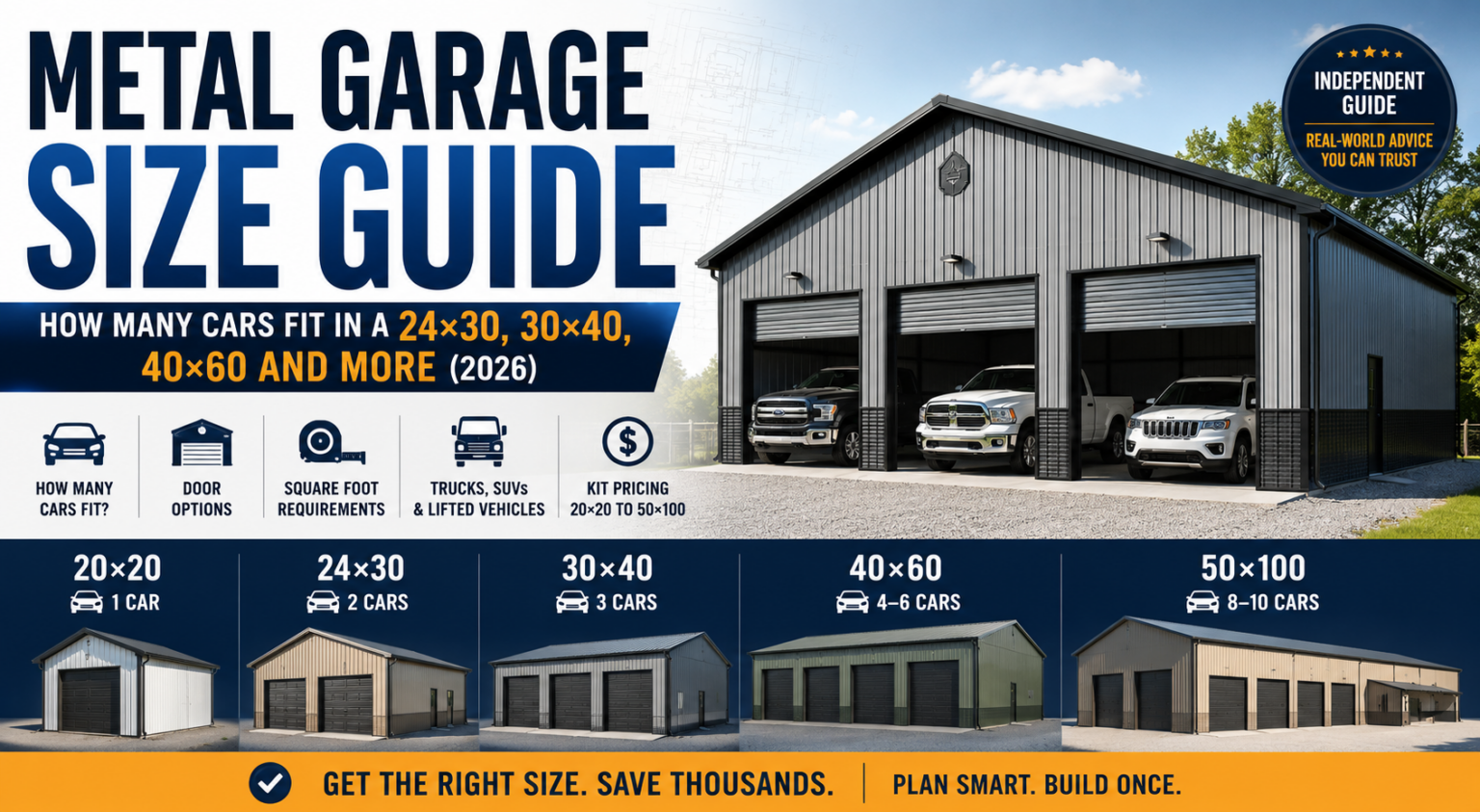
Metal Garage Size Guide: How Many Cars Fit in a 24×30, 30×40, 40×60 and More (2026)
What You’ll Learn
– Exactly how many cars fit in a 30×40 garage — with specific bay layouts and door configurations
– Whether a 30×40 is truly big enough for 3 cars (and when it is not)
– How many square feet you actually need for a 4-car garage
– Which sizes accommodate full-size trucks, SUVs, and lifted vehicles
– How eave height affects what fits — including car lifts and RVs
– Door configuration recommendations for every common garage size
– Real kit pricing ranges from 20×20 up to 50×100
– The 5 questions to ask before you order any metal garage kit
Knowing how many cars fit in a 30×40 garage is the first question most buyers get wrong — and it costs them money. Either they order too small and end up with a cramped two-car structure that barely fits their trucks, or they overbuild a 50×100 when a 40×60 would have served them just fine. The difference between those two decisions can be $30,000 to $80,000. Getting your sizing right before you call a supplier is the most valuable 10 minutes you will spend in this entire process.
SteelBuildingKit.com is an independent resource — we do not sell buildings, and we have no financial relationship with any manufacturer. That means the sizing guidance here is based on real-world layouts and buyer feedback, not upsell incentives. If you want to see how different sizes compare on total project cost, start with our metal garage kits complete buyer’s guide before diving into dimensions.
Quick Answer: How Many Cars Fit in a 30×40 Garage?
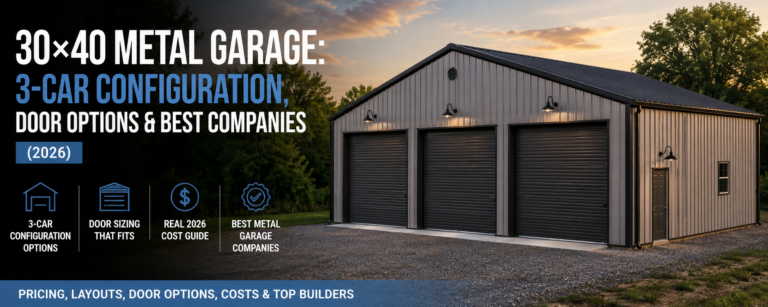
A 30×40 metal garage gives you 1,200 square feet of floor space. With three standard roll-up doors across the 40-foot wall, you can comfortably park three standard sedans or mid-size SUVs side by side. If you are parking full-size pickups — a Ford F-250, a Ram 3500, or a similarly wide truck — plan on two trucks comfortably, three if you are careful with door placement and mirrors. A 30×40 is the most popular size for a reason: it hits the sweet spot between footprint and functionality for most residential buyers.
Section 1: Standard Metal Garage Sizes at a Glance
Before you lock in a size, here is how the most common metal garage footprints stack up. The “cars” column assumes standard 10-foot-wide parking bays. The “trucks/SUVs” column uses 11-foot bays with room to open doors.
| Size | Sq Ft | Cars (standard) | Trucks/SUVs | Best Use |
|---|---|---|---|---|
| 20×20 | 400 | 1 | 1 (tight) | Single-car garage, workshop |
| 24×24 | 576 | 2 | 1 + storage | Standard 2-car residential |
| 24×30 | 720 | 2 + storage | 2 | 2-car family with storage needs |
| 30×30 | 900 | 2-3 | 2 | 3-car with compact vehicles |
| 30×40 | 1,200 | 3 | 2-3 | Most popular residential size |
| 30×50 | 1,500 | 3 + workshop | 3 | 3 cars with dedicated work area |
| 40×40 | 1,600 | 4 | 3-4 | 4-car or 2 cars + full shop |
| 40×60 | 2,400 | 4-6 | 4 | 4-car ideal, cars + RV, commercial |
| 50×100 | 5,000 | 8-10 | 6-8 | Commercial fleet, car collection |
KEY INSIGHT Square footage alone does not tell the full story. A 30×40 and a 40×30 have identical square footage but completely different usable layouts for vehicles. The longer wall is almost always your door wall — orientation matters as much as total area.
Section 2: How Many Cars Fit in a 30×40 Garage?
The 30×40 is the workhorse of the residential metal garage world, and for good reason. Let’s break down exactly what fits depending on how you configure it.
Three-Bay Standard Configuration:
Three 9×8 roll-up doors across the 40-foot front wall gives you three 9-foot-wide drive lanes with about a foot of clearance on each side of a standard passenger car. Add 2 feet of column/frame on each end and you are using about 30 feet of the 40-foot wall for doors, leaving 5 feet on each side for the structural frame. This works. It is tight, but it works for sedans and crossovers.
Two-Bay Truck Configuration:
If you are parking full-size trucks — think Chevy Silverado 2500, Ford Super Duty, or Ram 3500 — drop to two bays with 10×10 doors. Two trucks side by side with room to walk around and open doors comfortably, plus a 6-foot storage strip along one side wall.
Workshop Plus Two Cars:
One of the most popular 30×40 layouts: two 10×10 doors on the 40-foot wall (left and center), leaving the right-third of the building as a 12-foot-deep work area. You park two vehicles, have a full workbench setup along the back wall, and still have a pass door to outside. This is what most serious hobbyists build.
Door Options:
Standard 9×8 roll-up for sedans, 10×10 for full-size trucks and taller SUVs, 12×12 if you are parking lifted trucks or need clearance for a rooftop cargo carrier. For more detail on 30×40 kit pricing and what is included, see our 30×40 metal building kit cost guide.
BUYER WARNING Do not assume three doors means three comfortable parking spots. Always draw it out with the actual door widths and the vehicle widths on paper before ordering. A Chevy Suburban is 80 inches wide plus mirrors. Three Suburbans in a 30×40 is a door-ding nightmare.
Section 3: How Many Cars Fit in a 24×30 Garage?
A 24×30 gives you 720 square feet — enough for two standard cars comfortably, with room to spare for storage.
Standard Two-Car Layout:
Two 9×8 doors on the 30-foot wall (the short end, assuming the building runs 24 feet deep). Each car gets a 10-foot-wide bay with 3 feet left over for a side storage strip or a slop sink. The 24-foot depth gives you plenty of room to walk around the front of parked vehicles and still have a workbench area across the back.
What Does Not Fit Comfortably:
Two full-size crew cab pickups. You can physically get them in with 9×8 doors on the 24-foot wall, but opening doors fully becomes a problem. Bump up to a 30×40 if trucks are your primary vehicles.
Best Use Case:
A 2-car family with a sedan and an SUV or small crossover. Add overhead storage racks and a small storage room partition and you have a highly functional everyday garage. For pricing on the smaller 24×24, our 24×24 metal building kit cost guide covers what to expect per square foot.
Section 4: Is a 30×40 Big Enough for 3 Cars?
Yes — with the right door placement. Here is what that looks like in practice.
Three cars in a 30×40 requires three doors across the 40-foot wall. The standard approach:
– Three 9-foot-wide roll-up doors
– 1-foot gaps between doors and frame (standard column placement)
– 10-foot drive lanes per vehicle
– Vehicles should be compact to mid-size (sedan, crossover, small SUV)
Minimum Clearances Per Vehicle:
– Door width: 9 feet minimum, 10 feet preferred
– Bay width: 10 feet minimum, 11 feet preferred for comfortable entry/exit
– Depth: 22 feet minimum for a standard passenger vehicle, 24 feet for larger SUVs
The Problem with 3 Full-Size Trucks:
Three 8-foot-wide full-size trucks in a 30×40 means roughly 24 feet of width for vehicles with only 6 feet left over — roughly 2 feet per gap between trucks and walls. Doors open about 3 feet. The math does not work. Go to a 40×60 if you need three full-size trucks.
KEY INSIGHT Three compact to mid-size vehicles in a 30×40 = yes. Three full-size trucks or large SUVs in a 30×40 = no. The cutoff is roughly 76 inches of vehicle width per bay. Check your specific vehicles’ widths before you finalize the layout.
Section 5: How Many Square Feet for a 4-Car Garage?
This is where buyers consistently underestimate. Here are the three realistic options:
Minimum: 40×20 = 800 sq ft (not recommended)
Four 9-foot bays across a 40-foot wall, but only 20 feet deep. You can park four cars, but you cannot open rear doors without hitting the back wall, and there is zero workspace. This is a storage lot, not a garage.
Better: 40×40 = 1,600 sq ft
Four comfortable bays, enough depth to walk around vehicles, room for a workbench along the back wall. This is the realistic minimum for a proper 4-car garage. Budget $28,000 to $48,000 for a kit-only package from suppliers like General Steel or Rhino Steel Building Systems.
Ideal: 40×60 = 2,400 sq ft
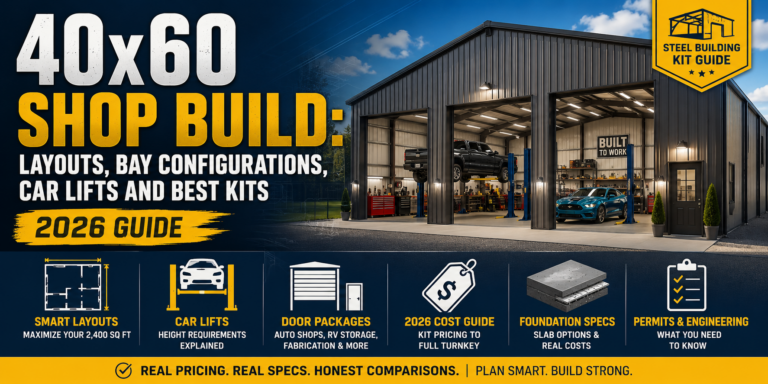
This is the real answer for a functional 4-car garage. Four bays on the 60-foot wall, 40 feet of depth, room for a dedicated workshop area in the back 15 feet, and space for tall vehicles or a car lift. Mueller Inc. and SteelMaster both offer strong 40×60 packages. See full pricing in our 40×60 steel building kit cost guide.
KEY INSIGHT If someone asks you how many square feet for a 4-car garage and you want a real working garage (not just parking), the answer is 1,600 square feet minimum, 2,400 square feet ideally.
Section 6: Can a 40×60 Metal Building Fit an RV and Cars?
Yes — but eave height is the critical variable, not floor space.
RV + 2 Cars Layout:
– 40×60 with 14-foot eave height
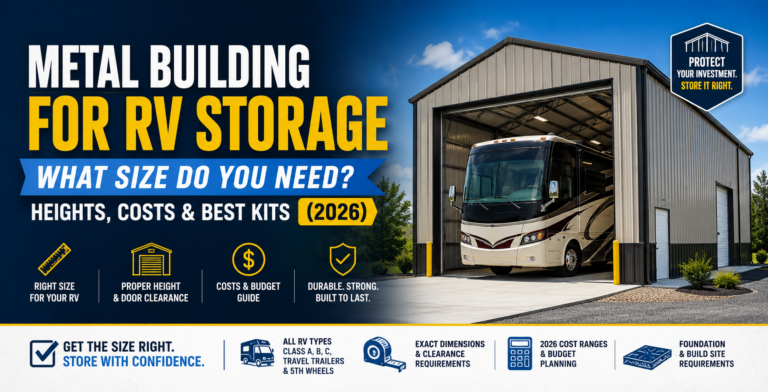
– One 14×14 door for the RV (Class A coach: 13 feet tall, 8.5 feet wide)
– Two 10×10 doors for passenger vehicles
– The RV takes roughly 20 feet of width and 40 feet of depth
– Two cars park in the remaining 20 feet of width, side by side
Door Height Requirements:
– Class A motorhome: 13 to 14 feet tall, need 14×14 door minimum
– Class B/C RV or travel trailer: 11 to 12 feet, 12×12 door works
– 5th wheel: 13+ feet, need 14-foot door
What Does Not Work:
A standard 40×60 with 10-foot eave height will not clear a Class A RV. You need to specify the eave height upgrade when you order. Most kit suppliers charge an additional $3,000 to $7,000 for the 14-foot eave option versus a standard 10-foot eave.
Section 7: Door Configurations by Garage Size
Ordering the wrong door configuration is the second most common mistake buyers make (the first is ordering the wrong size). Here is a reference table for the most practical setups.
| Size | Recommended Doors | Door Sizes | Configuration Notes |
|---|---|---|---|
| 20×20 | 1 | 9×8 or 10×10 | Single bay, centered |
| 24×24 | 2 | 9×8 each | Side by side, 20-foot opening span |
| 24×30 | 2 | 10×10 each | On 30-foot wall, 4-foot gap center |
| 30×30 | 2-3 | 9×8 or 10×10 | 2 large or 3 standard |
| 30×40 | 3 | 9×8 (standard) or 10×10 (trucks) | Across 40-foot wall |
| 30×50 | 3 | 10×10 | 2 vehicle doors + 1 shop door |
| 40×40 | 4 | 10×10 | Across 40-foot wall, 3-car + shop |
| 40×60 | 4-5 | 10×10 or 14×14 (RV) | Mix based on vehicle types |
| 50×100 | 6-8 | 12×14 | Commercial grade, sectional |
BUYER WARNING Always confirm door rough opening dimensions with your supplier. A “10×10 door” often has a 10’2″ x 10’2″ rough opening. If your building column is placed at exactly 10 feet, the door will not fit. Get the actual rough opening specs in writing before finalizing column placement.
Section 8: How Eave Height Affects What Fits
Eave height is the measurement from the ground to the top of the sidewall, not the peak of the roof. It is one of the most overlooked spec decisions in a metal garage order.
10-Foot Eave:
– Standard passenger cars and crossovers: yes
– Full-size SUVs and pickups: yes
– Lifted trucks (4-6 inch lift): usually yes, check your specific door height
– Car lifts (two-post, 10-12 foot raised height): no
– Class A RV: no
– Typical residential garage: this is the standard starting point
12-Foot Eave:
– All passenger vehicles including lifted trucks: yes
– Entry-level two-post car lift (cars raised 6 feet): yes
– RVs up to 11.5 feet tall: yes
– Class A motorhomes: usually no
– Cost premium over 10-foot eave: typically $1,500 to $3,500
14-Foot Eave:
– All vehicles including Class A RVs: yes
– Full two-post lift with full-size truck raised: yes
– Commercial equipment and tall trailers: yes
– Cost premium over 10-foot eave: typically $3,000 to $7,000
Suppliers like Rhino Steel Building Systems and General Steel both offer 10, 12, and 14-foot eave heights as standard options. SteelMaster’s arch-style buildings handle this differently — the curved roof gives more clearance at the center without a traditional eave height upgrade. See our full discussion of sizes and workshop configurations in the metal building workshop cost and sizes guide.
Section 9: Kit Cost by Garage Size
These are kit-only prices (steel components, hardware, fasteners) from major US suppliers as of mid-2026. Installed prices include concrete, labor, delivery, and permits — and vary significantly by region. Add 40-70% for full installation in most US markets.
| Size | Sq Ft | Kit Price Range | Installed Est. | Notes |
|---|---|---|---|---|
| 20×20 | 400 | $6,500 – $10,000 | $18,000 – $28,000 | Entry level |
| 24×24 | 576 | $9,000 – $14,000 | $22,000 – $35,000 | Most popular 2-car |
| 24×30 | 720 | $11,000 – $17,000 | $26,000 – $42,000 | 2-car + storage |
| 30×40 | 1,200 | $16,000 – $26,000 | $38,000 – $65,000 | 3-car sweet spot |
| 30×50 | 1,500 | $20,000 – $32,000 | $46,000 – $78,000 | 3 cars + workshop |
| 40×40 | 1,600 | $22,000 – $36,000 | $50,000 – $85,000 | 4-car min viable |
| 40×60 | 2,400 | $30,000 – $50,000 | $68,000 – $120,000 | 4-car ideal |
| 50×100 | 5,000 | $65,000 – $110,000 | $145,000 – $220,000 | Commercial |
Prices above reflect painted steel panels and standard gauge framing. Galvalume roofing, upgraded insulation packages, and engineer-stamped drawings add cost. Steel tariffs active in 2026 have pushed kit prices up roughly 12-18% versus 2024 levels — get multiple quotes and lock in pricing when you can.
Use our steel building cost calculator to get a customized estimate for your size, location, and configuration. For a detailed breakdown of 30×50 pricing, see the 30×50 metal building kit cost guide.
Section 10: Choosing the Right Garage Size: 5 Questions to Ask
Before you call a supplier or fill out a quote form, answer these five questions. They will cut through the confusion faster than any size chart.
1. What is your largest vehicle — now and in the next 10 years?
Size for your largest vehicle, not your average vehicle. If you have a standard sedan today but plan to buy a crew cab truck next year, size for the truck. A 9-foot door works for a sedan. It does not work for a Super Duty.
2. Do you need a workshop area?
A true workshop — workbench, tool storage, air compressor, welder — needs at least 10 to 12 feet of dedicated depth beyond your parking bays. A 30×40 with a workshop fits 2 cars. A 30×40 parking-only fits 3.
3. Will you add a car lift now or later?
A two-post lift needs at minimum 11 to 12 feet of eave height to safely raise most vehicles. A four-post alignment lift needs 14 feet. If there is any chance you add a lift in the next 5 years, order the taller eave now — retrofitting height is not possible.
4. Are you future-proofing for resale or additional vehicles?
Metal garages add real value to properties. A 40×60 on 5 acres increases resale value more than a 24×24. If the lot can handle it and the budget allows, go one size up. You will not regret extra space.
5. What does your foundation type support?
A larger building needs a properly engineered slab. A 40×60 on a 4-inch residential slab is an engineering problem waiting to happen. Get your foundation spec right before you size the building. Our steel building foundation types guide covers the differences between monolithic slabs, pier footings, and perimeter walls.
Section 11: Best Metal Garage Kit Companies by Size
Not every supplier is strong across all size ranges. Here is the short version:
- 20×20 to 24×30: Mueller Inc. and SteelMaster offer competitive pricing and strong DIY assembly support at smaller sizes. Both have good dealer networks.
- 30×40 to 30×50: Rhino Steel Building Systems is consistently competitive here. General Steel also performs well. Get quotes from both.
- 40×40 to 40×60: General Steel and Rhino are the two to beat at this size range. Mueller Inc. is worth a quote. SteelMaster’s arch design works well for RV storage at 40×60.
- 50×100 and up: This is commercial territory. General Steel, Rhino, and NCI Building Systems all have experience in this range.
For full scoring, reviews, and a side-by-side comparison of the top suppliers across all size ranges, see our top 10 metal garage kit companies in-depth reviews and buyer guide and our top 10 steel building kit companies steel building buying guide.
Common Sizing Mistakes Table
| Mistake | Why It Costs You | Fix |
|---|---|---|
| Sizing for today’s vehicles, not tomorrow’s | Order a 24×30 today, buy a truck next year, and you are stuck with a structure that barely fits | Add one car-width of extra space to your plan as a buffer |
| Ignoring eave height until after ordering | Can not add a lift, can not fit the RV you plan to buy, can not install overhead storage properly | Spec 12-foot eave minimum; go 14 feet if any doubt |
| Not accounting for door frame columns in layout | Three 9-foot door openings in a 40-foot wall sounds right until you realize columns take 2+ feet each | Get exact rough openings and column placement from supplier before finalizing |
| Underestimating installed cost | Kit price is 30-40% of total project cost; buyers go over budget on the foundation, labor, and permits | Budget 2.5x to 3x the kit price for a complete installed project |
| Skipping engineered drawings to save money | Un-engineered buildings fail permit inspections; some counties reject them outright | Always include PE-stamped drawings — it is $500 to $1,500 well spent |
| Buying from a single quote | Steel building pricing varies 20-35% between suppliers for identical specs | Get at least 3 competitive quotes |
Article Summary
- A 30×40 garage (1,200 sq ft) fits 3 standard cars or 2 full-size trucks comfortably with proper door placement.
- A 24×30 garage (720 sq ft) is best suited for 2 vehicles plus storage — it is not a 3-car garage.
- Yes, a 30×40 is big enough for 3 cars — if they are standard to mid-size vehicles and you spec three 9-foot doors across the 40-foot wall.
- A proper 4-car garage needs at minimum 1,600 sq ft (40×40); the ideal is 2,400 sq ft (40×60) for usable space.
- A 40×60 with 14-foot eave height can accommodate one Class A RV plus 2 cars with proper door sizing.
- Eave height is a separate decision from footprint — get it wrong and lifts, RVs, and overhead systems will not work.
- Kit-only prices range from roughly $6,500 (20×20) to $50,000+ (40×60) — installed costs are 2.5x to 3x higher.
- Door configuration, not just door count, determines whether your layout actually works.
- Always size for your largest planned vehicle and include at least one size upgrade for workshop space.
- Get PE-stamped engineered drawings; skip them and you risk permit rejection and structural liability.
- Steel tariffs in 2026 have raised kit prices 12-18% — locking in quotes is more important than in prior years.
- Use the steel building cost calculator and get 3+ quotes before committing to any supplier or size.
Frequently Asked Questions
Q: How many cars fit in a 30×40 garage with a workshop?
A: With a 12-foot-deep workshop along the back wall, a 30×40 metal garage comfortably fits 2 vehicles in the remaining space. You would use two 10×10 roll-up doors on the 40-foot wall. If you skip the workshop and use all floor space for parking, you can fit 3 standard cars with three 9-foot doors.
Q: Is a 30×40 big enough for 3 cars?
A: Yes, for 3 standard passenger cars or mid-size SUVs. Three 9-foot-wide doors across the 40-foot wall gives each vehicle a 10-foot bay with minimal but workable clearance. It is not the right choice for 3 full-size pickup trucks — go to a 40×60 for that.
Q: How many square feet do I need for a 4-car garage?
A: The practical minimum is 1,600 square feet (40×40). The comfortable, functional answer for 4 cars with door-opening room and modest storage is 2,400 square feet (40×60). Anything less than 1,600 square feet means tight quarters and no room for anything beyond parking.
Q: How many cars can fit in a 40×60 metal garage?
A: Four to six standard vehicles, depending on configuration. Four is comfortable with wide bays and walking room. Six is achievable if you are stacking small cars tightly. Realistically, most buyers use a 40×60 for four cars plus a workshop area, or for three cars plus an RV or large trailer.
Q: What size metal garage do I need for 2 trucks and a workshop?
A: A 30×50 gives you the best balance: 1,500 square feet with room to park two full-size trucks using 10×10 doors and still have 12 to 15 feet of depth for a proper workshop. A 30×40 works but the workshop will be smaller. Go 40×50 or 40×60 if the trucks are heavy-duty crew cabs with wide mirrors.
Q: What is the best metal garage size for a home with 3 cars?
A: The 30×40 is the most popular answer for most 3-car families. It fits 3 cars, costs significantly less than a 40×60, and works well on most residential lots. If one or more of the vehicles is a full-size truck or large SUV, go to a 30×50 for more working depth and door flexibility.