

SteelBuildingKit Cost Index · Updated July 10, 2026 · Pricing collected June-July 2026
Online metal building estimates are accurate to within 10-20 percent at best and off by 30-40 percent at worst, depending on which rung of the ladder the number came from (modeled July 2026). Advertised prices miss by 30-40 percent, good calculators hold 10-20 percent at matching scope, a written quote narrows to 5-10 percent, and only a locked contract gets inside 5 percent. Used correctly, an online estimate is a genuinely useful planning band; used as a promise, it is how budgets break. On a $40,500 turnkey 30×40, that spread is the difference between a $4,000 planning cushion and a $14,000 surprise.
The ladder below is the whole answer in one table. The rest of this page covers what online tools structurally cannot see, and the short routine that makes their output reliable anyway. It is part of our cost fundamentals hub, where pricing gets decoded before money moves.
| Source of the number | Typical accuracy modeled | Why it drifts |
|---|---|---|
| Advertised / teaser price | ±30-40% | Stripped spec, light-load county, freight omitted |
| Online calculator, matched scope | ±10-20% | Can’t see your site, exact freight, or local labor |
| Written quote on your county’s loads | ±5-10% | Site conditions and change orders remain |
| Locked contract, stamped drawings | ±0-5% | Steel surcharge clauses are the last wiggle |
Accuracy is measured against the final project cost at the same scope. A kit estimate compared to a turnkey invoice will always look wildly wrong; that is a scope mismatch, not an estimating error. Modeled July 2026.
The accuracy bands are modeled from the spread between advertised kit pricing and published supplier price lists collected June-July 2026, cross-checked against component benchmarks for concrete, erection labor, and freight, the lines where online numbers most often diverge from invoices. All figures are modeled national estimates, labeled as modeled and reviewed quarterly, under the SteelBuildingKit Cost Index methodology.
What online estimates structurally miss
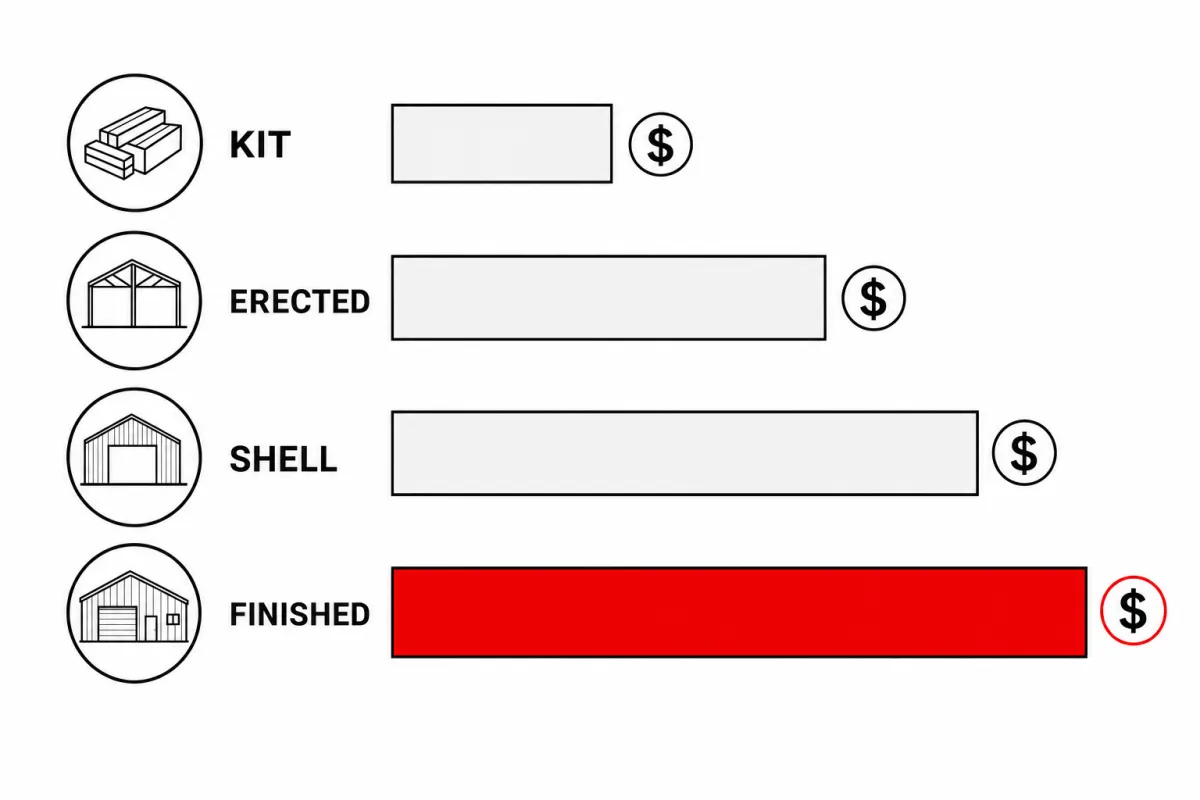
No tool is dishonest for missing these; they are unknowable from dimensions alone. But each one is real money, and together they explain nearly every gap between a screen and an invoice.
| What tools can’t see | Typical cost modeled | Why it hides |
|---|---|---|
| Your county’s design loads | +8-15% on the kit | Tools assume a light-load baseline unless told |
| Real freight to your address | $500 – $3,000+ | Advertised prices quote FOB factory |
| Site prep and access | $0.50 – $2.00/sqft; sloped sites $2 – $5 | No calculator sees the ground |
| Permits and plan review | $150 – $4,000 | County fee schedules vary 25-fold |
| Crane or offload equipment | $1,200 – $4,000 per project | Assumed into erection, then billed separately |
| Doors beyond the base spec | $1,500 – $4,500 each installed | Teaser specs include one door or none |
A worked example of honest drift
Take a 30×40 turnkey workshop. A calibrated calculator, fed the right scope, returns about $40,500: a $19,200 kit, $10,200 slab, $7,800 erection, $1,800 freight, $1,500 permits (modeled mid-range rates, July 2026). The written quote then lands at $43,800, because the county’s 50 psf snow load added $1,900 to the kit, real freight came in $600 over the assumed lane, and plan review cost $800 more than typical. That is 8 percent of drift, every dollar explainable, and exactly what the ladder predicts: the calculator was inside its 10-20 percent band, and the quote will hold inside 5-10 percent through to the invoice. Run your own inputs through the steel building cost calculator and expect this shape of gap, not a miracle of precision.
Drift you choose versus drift you don’t
One more distinction keeps comparisons fair: some of the gap between estimate and invoice is your own upgrades arriving. These are the levers buyers most often add after estimating:
| Lever | Typical impact modeled | Worth it when |
|---|---|---|
| Eave height +2 ft | +6-9% on the kit | Lifts, tall doors, mezzanine plans |
| 24-gauge panels over 26 | +8-12% on panel cost | Hail country, longer warranties |
| Second roll-up door | +$1,500 – $4,500 installed | Drive-through or split-bay layouts |
| Blanket insulation | +$2.50 – $4.00/sqft | Any conditioned or workshop use |
| +10 ft of length | Cheapest square footage available | Storage always grows; add it at order time |
How to use online estimates correctly
The routine is short. First, match the scope: decide kit, erected, or turnkey before collecting numbers, and discard any figure that will not state which it is. Second, feed real inputs: your county’s loads and your ZIP, not the defaults. Third, convert everything to total dollars; per-square-foot shorthand hides fixed costs on small buildings. Fourth, treat the output as a band and hold a 10 percent contingency against the unknowables above. Then use the band as a filter: quotes far outside it owe you a line-by-line explanation before they get another minute of your attention. Our guides to reading a metal building estimate and comparing quotes pick up from there.
One habit separates buyers who get burned from buyers who don’t: they collect three numbers from three rungs of the ladder and watch the spread. When the calculator band, the advertised price, and the first written quote all point at the same neighborhood, the budget is real. When one of them sits alone, that outlier is where the missing scope is hiding.
Where you live moves the error band
Location is the biggest single reason identical estimates resolve into different invoices. County loads add 8-15 percent to the kit before anything else changes. Frost-depth footings add $800-$2,000 on small buildings against shallow southern slabs. Freight spans $500 near a plant to $3,000+ far from one, local labor swings erection by thousands inside its $4-$10 per square foot market, and permits run $150 to $4,000. A national tool that has not asked for your county is averaging across all of that, which is precisely the 20-30 percent spread between mild-site and demanding-site versions of the same building. Give any estimator your real loads and ZIP and you reclaim most of its accuracy; withhold them and you are reading a national average with your name on it.
The sanity-check list for any online number
- Scope named in writing: kit only, kit plus erection, or turnkey, before you compare anything
- Design loads stated, and matched to YOUR county’s requirements, not a generic baseline
- Concrete confirmed in or out; the slab is $6-$12 per square foot all by itself
- Freight quoted to your address, not FOB factory
- Door and window schedule itemized against what you actually plan to order
- The number converted to total dollars, not just per-square-foot shorthand
- Price-lock window asked about; steel quotes hold 7-30 days
- A 10 percent contingency held until the building is delivered and standing
Readers comparing options usually open kit vs installed vs finished price and cost overruns buyers miss next; both follow the same July 2026 cost model.
Online estimate accuracy FAQs
How accurate are online metal building estimates?
Good calculators hold within 10-20 percent of the final cost at matching scope; advertised prices miss by 30-40 percent (modeled July 2026). Written quotes narrow to 5-10 percent and locked contracts to 0-5 percent. The rung the number came from matters more than the brand on the website.
Why are advertised metal building prices so much lower?
Teaser prices quote a stripped spec: light-load engineering, minimal openings, no freight, no concrete, no permits. Those omissions are worth 30-40 percent of a real project. An advertised price is a starting flag, not an estimate; the honest comparison starts when scope and loads are stated.
Why is my written quote higher than the online estimate?
Usually three lines: county loads the tool didn’t know (+8-15 percent on the kit), real freight versus an assumed lane ($500-$3,000+), and permits or plan review ($150-$4,000). A gap under 20 percent at matched scope is normal drift; a bigger gap deserves a line-by-line explanation.
When can I trust a number enough to budget on it?
Plan on bands, commit on paper. Use a calculator band for feasibility, budget seriously on a written quote against your county’s loads (±5-10 percent), and release money on a locked contract with stamped drawings (±0-5 percent). Hold 10 percent contingency until steel is standing regardless.
Do online estimates include concrete, permits, and delivery?
Assume no until stated. Concrete runs $6-$12 per square foot, permits $150-$4,000, and freight $500-$3,000+; together they can equal half a kit’s price. Any tool or ad that won’t say what its number includes has answered your accuracy question already.
How long is an online or written estimate good for?
Steel pricing moves, so written quotes typically lock for 7-30 days; online estimates carry no lock at all. If your timeline is longer, ask how repricing works and read the surcharge clause before signing. Ordering 10-14 weeks ahead of need keeps you out of panic pricing.
Ready to price this building for real? Compare verified metal building companies for this project type, with real reviews and track records.
Sources and methodology: published supplier price lists and advertised kit pricing (June-July 2026); component cost benchmarks for ready-mix concrete, erection labor, and freight; IBC and ASCE 7 for load context. All figures are modeled national estimates, labeled as modeled, and reviewed quarterly; see the full Cost Index methodology. This guide links to our independent company directory; listings never change published numbers.
Written by the Steel Building Editorial Team | Last updated July 10, 2026