




Barndominium financing starts with the finished property
Barndominium financing is a coordination problem involving the borrower, the completed property and the construction payment schedule. Before paying a shell deposit, ask a lender whether it can finance the actual residential design, shop activities, site and builder arrangement. Then test whether the proposed loan can fund the supplier and contractor milestones when payment is due. A favorable conversation about the word barndominium is not the same as approval of a documented project.
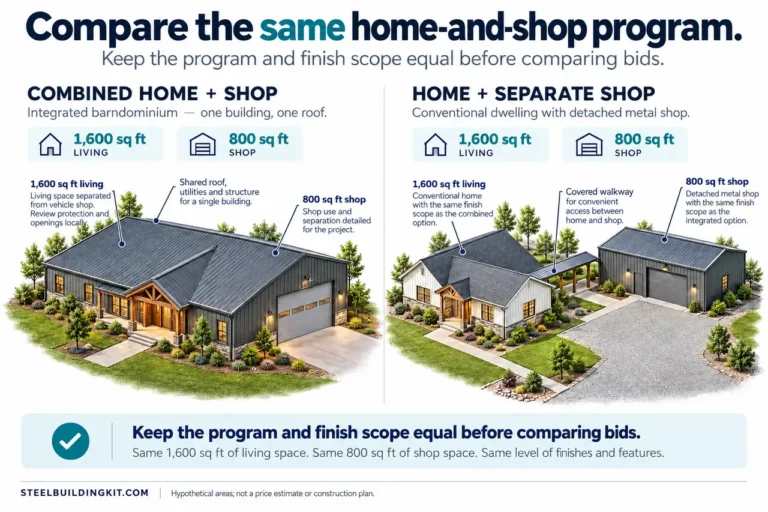
Describe the finished home rather than sending only a photograph of a metal shell. A lender needs a consistent picture of what will exist at completion. Prepare the proposed plans, living and shop area descriptions, site information, construction scope and responsibility for finishing each part. State whether the shop is personal storage, a hobby space or part of an income-producing activity. Do not relabel the space to make an application sound simpler; the intended use belongs in the eligibility discussion.
The Consumer Financial Protection Bureau explains construction loans as generally short-term financing advanced as building progresses. It also notes that repayment or conversion arrangements depend on the loan, and that a separate mortgage application may be necessary when conversion is not automatic. This establishes why the permanent financing route belongs in the first lender conversation, before the construction contract makes payment commitments.
Use three separate status labels in your project file: borrower review, property review and construction review. One may be further along than the others. A lender might still need plans for the property review after discussing the borrower finances, or may need a builder agreement before accepting the construction process. Ask what has actually been evaluated, what remains conditional and which document closes each gap. That produces a more useful answer than asking whether barndominiums are generally financeable.
Compare one closing and separate construction and permanent closings
Start by comparing the structure of the agreements, not their marketing names. Identify the construction advance terms, the permanent mortgage terms and the event that connects them. Ask whether one set of closing documents covers both phases, whether a new closing is required after construction, and which terms can change before the permanent phase begins. A short label such as one-time close is a starting point for questions rather than a complete description of the obligation.
In its May 6, 2026 single-closing construction-to-permanent Selling Guide topic, Fannie Mae describes a transaction that closes the construction and permanent financing together, with the lender managing disbursement to authorized project parties. It states that Fannie Mae cannot purchase the combined loan until construction is completed and the construction terms have converted to permanent financing. These are program delivery rules for lenders; they do not promise that a particular lender will offer the structure or accept a particular barndominium.
A separate construction loan and permanent mortgage can create a different decision sequence. Ask how the construction balance will be repaid, who is expected to provide the permanent mortgage and whether that later loan needs a new qualification and appraisal review. Compare the written conditions rather than assuming a second loan will be available when needed. If a permanent lender has not committed, record that dependency visibly instead of treating the hoped-for mortgage as cash already secured.
| Decision | Single combined arrangement | Separate arrangements |
|---|---|---|
| Connection between phases | What conditions trigger conversion under the signed documents? | What must happen to obtain and close the permanent loan? |
| Terms | Which construction and permanent terms are fixed or may change? | Which later terms remain unknown until the next application or lock? |
| Completion | What evidence is required to convert? | What evidence is required to fund the payoff mortgage? |
| Delay | What extension process and charges apply? | What happens if the construction loan matures before the mortgage closes? |
Request a side-by-side written explanation from the lenders being considered. Compare fees, timing, conditions, required cash and available remedies for delays within the actual offers. There is no need to assume one structure is universally cheaper or safer. The better fit is the one whose documented conditions work with the project and the household finances.
Prepare for appraisal without confusing cost with market value
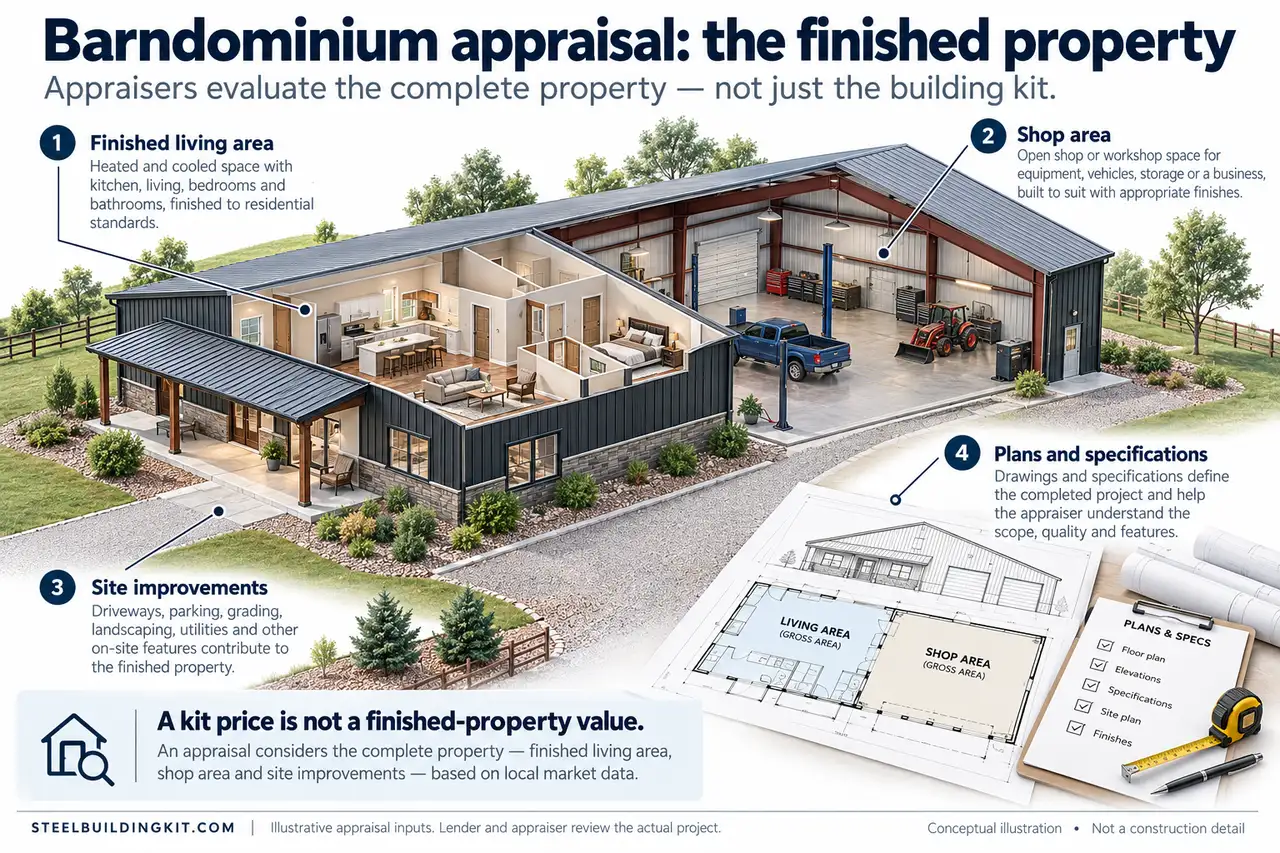
A construction budget describes spending. An appraisal addresses the property and market-value question within its assignment. Keep those concepts separate when planning barndominium financing. An expensive feature can be important to the owner without contributing the same amount to the market value conclusion. Likewise, a completed residential property is not adequately described by the price of its steel package. Give the lender and appraiser a clear, consistent finished-project description.
Freddie Mac's guide discussion of unique properties includes barndominiums and explains that traditional homes may be used as comparable sales when the appraiser identifies differences, supports adjustments and justifies their use. This is not a guarantee that appropriate market evidence exists for every location. It does show why the appraisal question is more specific than finding a recently sold building with the same nickname. Ask the lender what documentation its appraisal process will require.
Prepare plans and specifications that distinguish finished living space from shop, storage and unfinished areas. Describe heating and cooling boundaries, bathrooms, kitchen, access and the permanent improvements included in the construction contract. Use the same area categories throughout the project file. If the builder's budget, plan schedule and lender application contain different area totals, reconcile them before they become conflicting descriptions of the collateral.
Do not select comparable sales yourself and present a preferred value as established. You can supply factual property information requested through the lender's process, while leaving the appraisal conclusions to the qualified appraiser. If the project has unusual features, ask early how they will be evaluated and what happens if the value conclusion does not support the proposed loan. A possible response may involve changing scope, contributing more eligible cash or reconsidering the project, but the actual alternatives depend on the lender and borrower.
Maintain a revision log. Moving from an ordinary storage shop to a large finished commercial work area, adding a second dwelling or changing the residential footprint can alter what is being evaluated. Ask whether the proposed change needs updated plans, budget approval or appraisal consideration before authorizing it. Consistency is useful because everyone is then assessing the same future property rather than different versions of the idea.
Match draws to supplier and contractor payment milestones
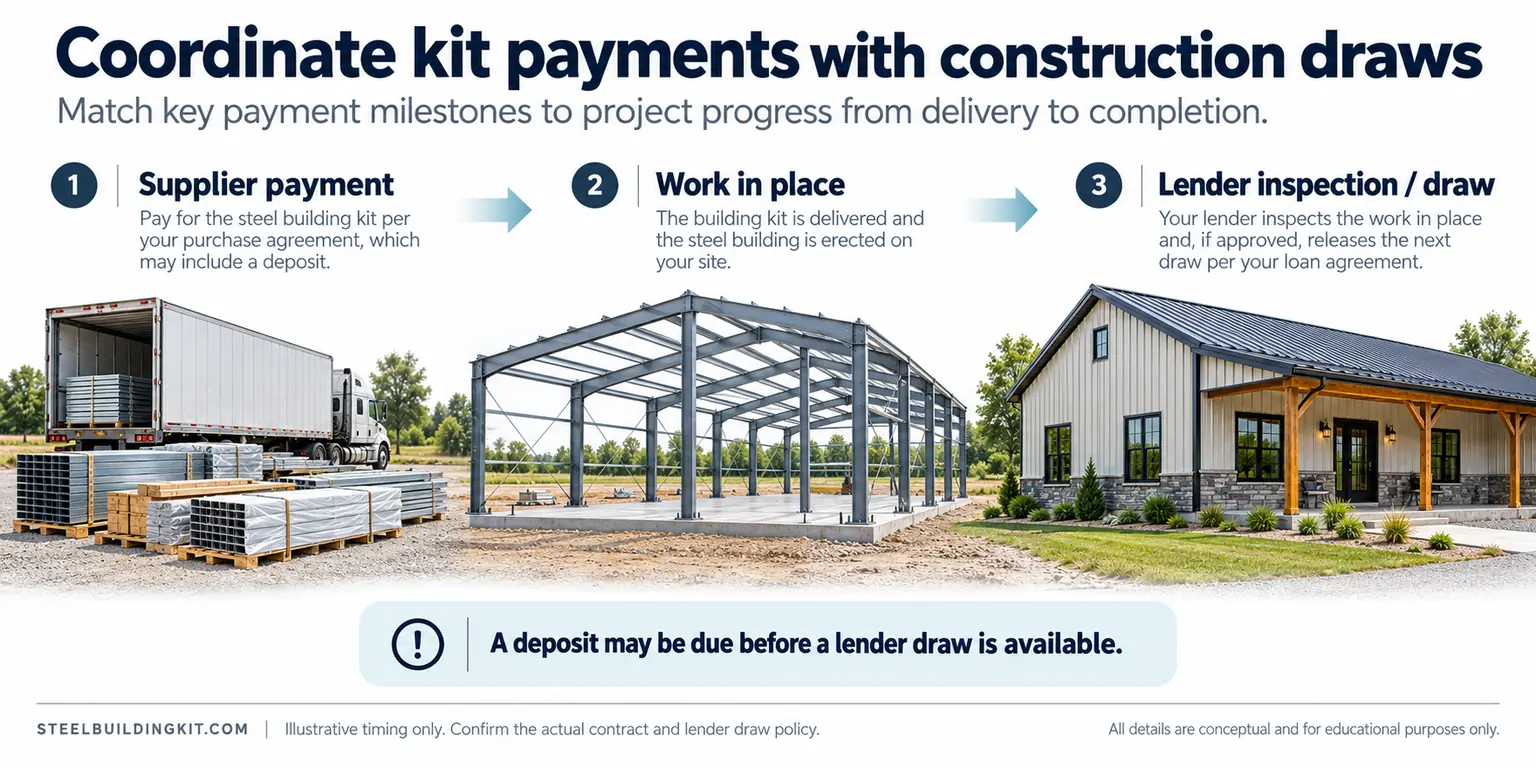
Build a cash-timing ledger before signing a contract. Put every expected payment in chronological order: design work, site preparation, shell deposit, delivery, erection, trade rough-ins, finishes and completion. Record the payee, the contractual trigger and the supporting document. In a separate column, record when the lender has said an advance can occur and what evidence it requires. A cost included in the approved budget may still create a timing problem if it must be paid before the lender will disburse.
Ask the lender specifically about deposits, offsite materials, delivered but uninstalled materials and owner-purchased items. Ask what inspections, invoices, lien documents or other verification apply to each requested advance. These are questions about the particular loan process; there is no universal draw percentage or nationwide supplier-deposit rule to substitute for the answer. Obtain written clarification while the contract milestones can still be negotiated.
Coordinate with the builder and supplier using the same ledger. If a supplier requires payment before releasing material and the lender funds only at a later milestone, someone must bridge the interval or the arrangement must change. Identify who is legally responsible for the payment and which funds are genuinely available. Do not solve the spreadsheet by entering an expected advance on a date the lender has not accepted.
- Contract milestone: the exact event that makes an invoice payable, including any deposit or delivery condition.
- Loan milestone: the evidence needed for the lender to approve and release the associated advance.
- Timing interval: the period between the contractual obligation and available loan funds, including processing time discussed with the lender.
- Resolution: a documented change in payment terms, accepted funding method or project sequence that closes the interval.
Keep the ledger distinct from the construction schedule. Work can be physically ready to proceed while funding documentation is incomplete, and paperwork can be ready while work fails the relevant review. The useful question is not simply whether a draw is scheduled, but what must be true before it can be released. Confirm the expected processing steps so a contractor does not treat a requested advance as a payment already received.
Stress test unfinished work, changes and conversion conditions
Read the completion requirements before deciding to leave work for later. Ask which items must be complete for an advance, occupancy, loan conversion and permanent mortgage closing. These are different checkpoints and may involve different reviewers. Do not assume a local occupancy document automatically satisfies all lender requirements, or that a lender's completion review grants permission to occupy. Identify the evidence each party needs and include the work in the construction scope.
Fannie Mae's June 4, 2025 construction-to-permanent overview says construction work and relevant construction lien obligations must be completed and satisfied before delivery of the mortgage to Fannie Mae. It also identifies retained completion documentation. This is a program-specific lender requirement, not a rule defining the borrower's rights under every loan. Use it to frame a practical question: what documents and unpaid obligations would prevent this lender from completing the permanent financing process?
Run a modest change-order scenario through the financing plan. Suppose a different shop door requires a structural revision and moves the delivery date. Ask who approves the new scope, how the budget changes and whether the lender needs revised information before funding the extra work. The important lesson is sequencing. A change agreed between owner and contractor may still need lender review; do not assume an accepted construction change automatically increases the loan.
Ask about delays separately from overruns. A project can remain within its construction budget and still face a loan maturity or conversion deadline. Conversely, an on-time project may need cash for work outside the approved financing. Record the extension procedure, decision maker, documentation and possible charges from the actual loan documents. Avoid relying on a verbal assurance that extensions are routine.
Protect the household budget by keeping project cash needs visible alongside normal obligations. Identify money allocated to deposits, contingency, unfinanced work and closing requirements without counting the same funds twice. The lender determines what sources and documentation it accepts. This planning exercise does not replace qualification; it helps the borrower ask precise questions before making payments that reduce available reserves.
Worked example: a deposit occurs before the expected advance
Consider a hypothetical owner who has discussed a residential barndominium with a lender and obtained a shell proposal. The supplier requires a deposit when the order is placed. The owner initially lists that deposit as covered by a construction advance because the package appears in the budget. On closer review, the owner discovers that the lender has not confirmed an advance for that particular deposit milestone. The budget might add up while the payment sequence remains unresolved.
The first step is to identify facts rather than infer a lender rule. Ask the supplier for the precise payment obligation, cancellation terms and release conditions. Ask the lender how it treats that payment and what documentation is necessary. Ask the builder how the shell purchase fits the overall construction agreement. The owner should not characterize an unanswered question as a rejection, but should not commit on the assumption that the eventual answer will be favorable.
Compare three possible paths as questions, not presumed solutions. Could the supplier accept a different milestone? Could the lender approve a documented funding method compatible with the contract? Could the owner use an accepted source of cash without undermining other financing requirements? Each path needs agreement from the relevant parties. The exercise deliberately avoids invented deposit percentages, approval thresholds and interest rates because those figures would conceal the operational issue.
Now add a delay. Suppose delivery moves later while a contractor invoice and another project obligation remain due. Update the ledger with the revised dates and confirm whether the earlier resolution still works. If cash allocated to the deposit is also the contingency for delayed site work, the original plan counted one pool twice. Separate those commitments. A workable financing plan survives a realistic sequence of obligations rather than depending on every payment arriving at its most convenient moment.
The decision rule is simple: no unresolved interval between a binding payment promise and its documented funding source. That is an owner's planning standard, not an underwriting guarantee. If the interval remains open, the next task is to resolve the contract or loan arrangement before placing the order. An apparent bargain on the shell does not answer the question of how its payment terms will be funded.
A lender question package that produces useful answers
Organize the first serious lender conversation around one consistent project package. Include the parcel, site and access description, proposed residential plans, shop-use statement, construction scope, builder information and payment ledger. Identify what is preliminary. A lender can then explain which decisions need to be finalized, rather than receiving a mixture of a shell quote, a different inspiration plan and an estimated finished area that nobody has reconciled.
Can barndominiums qualify for conventional financing? Do not treat the label as either a universal obstacle or universal acceptance. The lender must evaluate its program, borrower, property and construction requirements. The useful request is a written explanation of the lender's process for your actual project. Program guidance about unique housing is background for that conversation; it does not establish a borrower's eligibility or compel a lender to make the loan.
Can you act as your own builder? Ask the lender directly before organizing the project around that assumption. Explain the proposed responsibilities, subcontracting and experience accurately. Some financing questions are about who is responsible for completion and how the lender will verify work. Do not assume that a construction budget alone resolves them, and do not invent a universal owner-builder restriction based on one lender's response.
Before choosing an offer, request clear answers on property eligibility review, appraisal scope, required borrower funds, deposit funding, draw evidence, change orders, insurance, completion and conversion. Ask which answers are preliminary and which are represented in the actual documents. Keep the written record with the version of plans and contracts it concerns so later changes cannot silently invalidate the assumptions.
The steel building buyers guide can help keep supplier scope and buying decisions organized alongside this financing work. The next step is to reconcile the proposed construction contract with the lender's written conditions. When the finished-property description, appraisal assumptions and payment sequence agree, the borrower has a concrete basis for deciding whether to proceed with the financing process.