


Buy a documented system that fits the new project
Used metal buildings should be evaluated as complete, traceable systems rather than piles of reusable steel. Before buying, establish what the seller has, which drawings identify it, whether the components are complete and sound, and whether a qualified project team can adapt it to the intended site and use. A low asking price does not establish engineering suitability, a complete kit or a low completed-project cost.
Start with three separate tests: identity, condition and fit. Identity links the material to drawings and component records. Condition addresses what happened during service, removal and storage. Fit concerns the new site's requirements and the intended layout. Passing one test does not pass the others. A well-kept frame can still have missing components or an unsuitable design basis.
The MBMA Common Industry Practices describes a metal-building package as part of a larger construction project and ties its contents and design responsibilities to project documents. That framework is useful here: a used shell is not automatically a complete permitted building, foundation, service package or installation scope.
This article provides a staged proceed, hold or decline review. It helps a buyer spend investigation effort in a sensible order before committing to transport and construction. It does not provide structural acceptance tolerances, a repair recipe or a guarantee that an undocumented kit can be certified.
Identify exactly what is being sold
An erected building available for removal, a dismantled used kit, an unopened surplus order and a mixed collection of parts present different evidence problems. Ask the seller to state which one is offered and identify its manufacturer, order number, original site and known service history. Do not let the phrase never erected substitute for documentation of what was ordered and delivered.
For an erected building, arrange an appropriate condition and documentation review before removal obscures the original arrangement. For a dismantled kit, establish how pieces were marked, inventoried and protected. For surplus material, compare the packing records with what remains on site. For mixed material, expect a more difficult identity and suitability question rather than assuming similar-looking members belong together.
Clarify ownership and included items through the purchase documents. Record which panels, fasteners, bracing, trims, doors and accessories are included and which remain with the property. Define who is responsible for disassembly, loading, packaging and loss or damage during those stages. These are practical scope questions to resolve with the relevant contract professionals, not assumptions to leave until pickup.
Photograph identification marks, labels, bundles and the overall arrangement. Keep a date and location with the record. If a seller provides drawings from a similar model, label them as unconfirmed rather than treating them as the actual building record. Matching width and length is not enough to establish that the drawing describes the material offered.
Request engineering and alteration records
Ask for final shell drawings, certification, erection information, original load criteria and records of later changes. Foundation information can help explain the old installation, but it is not a template for a new site. Keep manufacturer and project identifiers together so a design professional can determine what information is relevant.
Prepare the proposed new-site brief before asking whether the kit can be reused. Include location, intended use, geometry, openings and major equipment. The new design team needs to compare actual requirements with the available system. Do not assume an old approval or a sealed drawing automatically authorizes relocation to another jurisdiction or a different use.
Investigate alterations. New doors, removed bracing, added roof equipment, member repairs and field-welded attachments may not appear in the original package. Ask what was changed, when and under whose review. A clean original drawing set remains useful, but its value depends on reconciling it with the construction that actually exists.
Treat missing documents as a decision gate. Ask the appropriate engineer and manufacturer what can be reconstructed, inspected or tested, and obtain a defined scope before relying on that possibility. Sometimes further investigation can close the gap; sometimes uncertainty makes the purchase impractical. Do not assume that paying for a later stamp is a guaranteed administrative step.
Inventory members, connections and enclosure parts
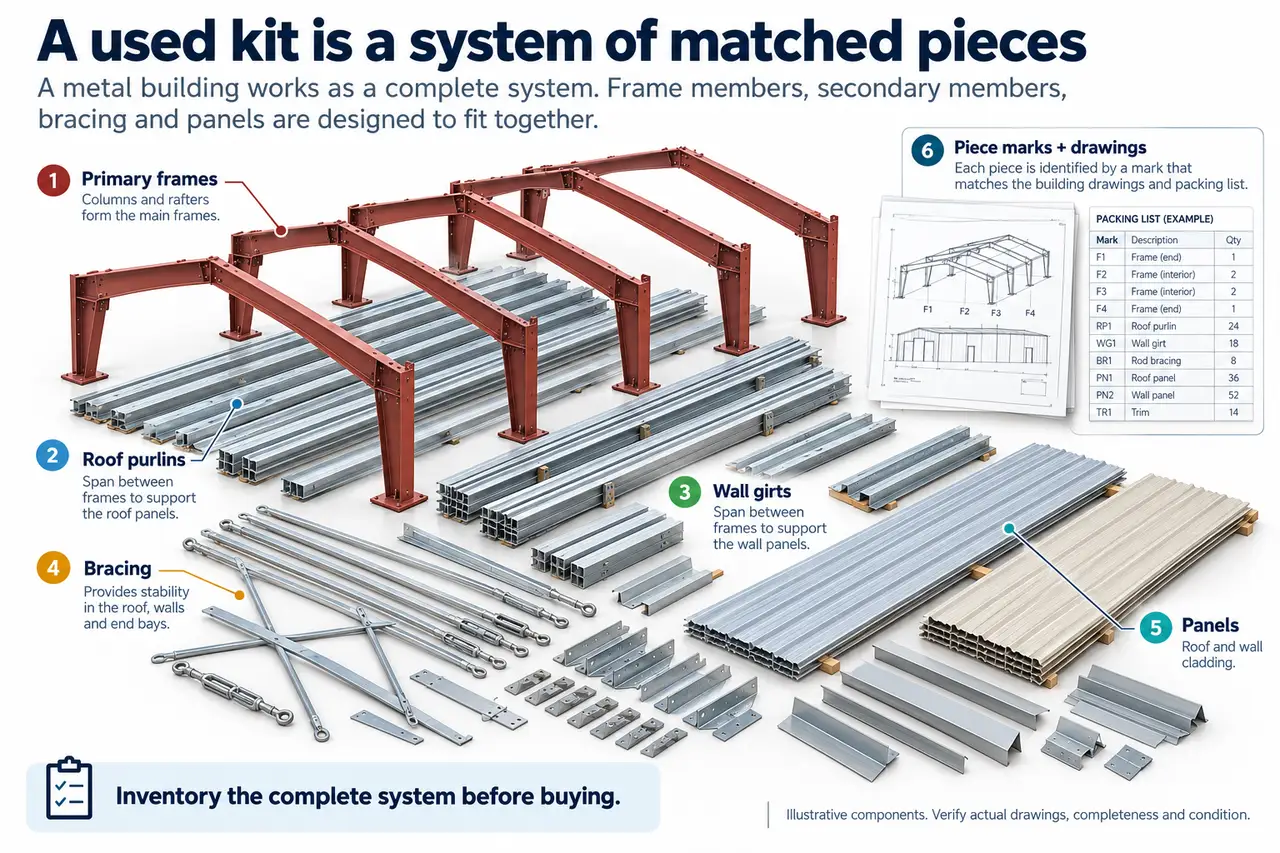
Use the actual drawings and packing information to build an inventory. Record piece mark, description, quantity, location, condition and photograph reference. Count complete connection and bracing arrangements as well as large frames. A stack can look substantial while lacking the smaller components necessary to assemble the intended system.
Keep component identity separate from apparent interchangeability. Similar-looking purlins, girts or clips may occupy different positions or have different properties. Do not combine bundles or remove labels during transport preparation. If a mark is unreadable, record the uncertainty and preserve the piece for qualified identification rather than assigning a convenient label.
Include roof and wall materials in the scope. Panels, closures, trims, sealants and opening details may require replacement or redesign even where framing reuse is feasible. Establish what the engineer, supplier and erector expect to reuse and what must be newly supplied. A frame-only inventory should not be described as a complete building kit.
Decide how the inventory will be reconciled at handover. Agree on a final list and a method for recording discrepancies before loading. Photograph bundles and packaging, and retain the relationship between marks and records. This protects information as well as material: losing the identification system can make a complete set much harder to evaluate and erect.
Give each bundle a transport identifier separate from the structural piece mark. The bundle identifier helps track packaging; the piece mark links a member to its intended role. Record which pieces are inside each bundle and photograph the label where it can be read. If a bundle is split for loading, update the list. This simple distinction prevents a shipping convenience from becoming a misleading structural identity and lets the receiving crew reconcile the delivery without guessing which group was opened.
Separate visible condition from engineering acceptance
AISC's announcement of its existing-steel assessment and repair guide identifies initial assessment, detailed inspection, evaluation and nondestructive examination as professional assessment topics. The announcement is not an acceptance standard. Its relevant lesson is that evaluating damage involves more than deciding whether a member looks reusable.
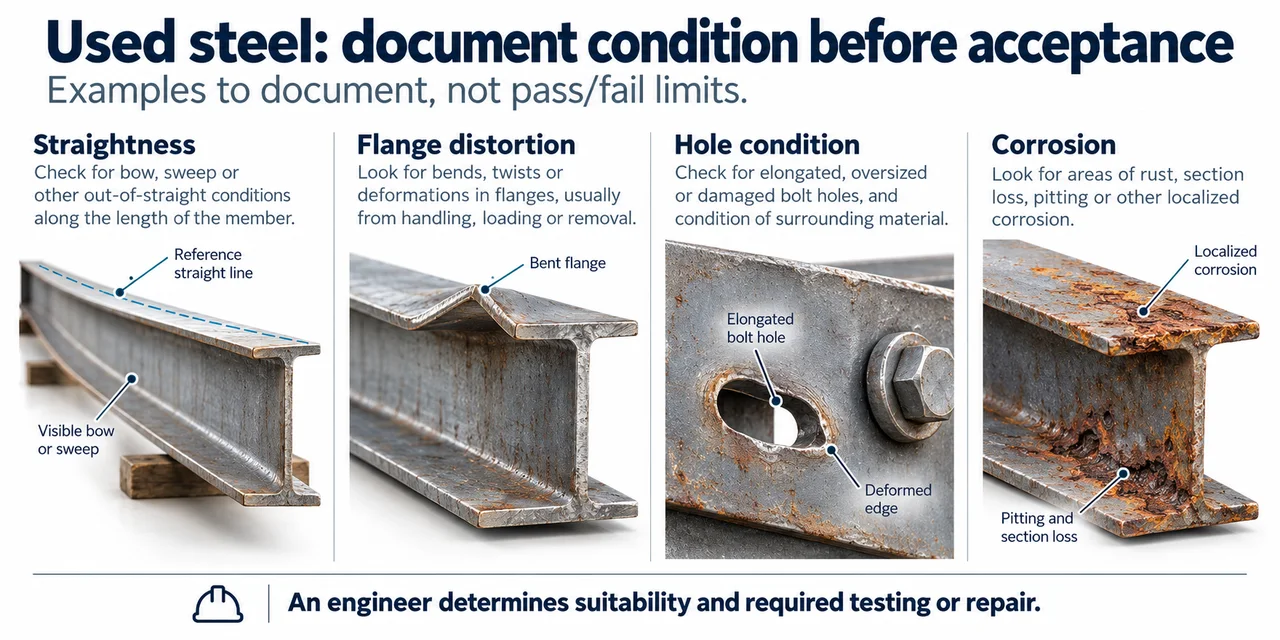
Record corrosion, distortion, damaged holes, damaged coatings and evidence of previous repairs without assigning a safe threshold yourself. Include both context and close photographs. A local defect may affect a connection differently from a similar-looking mark elsewhere. The responsible engineer determines what further measurement, testing or repair assessment is appropriate.
Storage history matters to the investigation. Ask whether material was exposed to standing water, salt, chemicals or repeated handling, and how bundles were supported. Document the answer and observed condition separately. A seller's assurance that material was kept dry should not erase visible evidence that needs examination.
Do not straighten, weld, cut, enlarge holes or remove material simply to make a used component appear acceptable before review. Such work can change the evidence and the component itself. Obtain the required assessment and an approved repair scope where applicable. The buyer needs traceable suitability, not cosmetic improvement that makes the original condition harder to understand.
Plan removal, transport and reassembly as project work
Disassembly is a construction operation with its own sequence and safety requirements. Use appropriately qualified contractors and resolve responsibilities before work begins. An owner should not treat the original erection drawing as a complete removal plan or assume that reversing an observed assembly order is safe.
Agree on how members, connections and panels will be labeled and protected. Packaging should preserve identification through lifting, transport and storage. Record damage or missing parts as it is discovered rather than waiting for reassembly. The value of a careful initial inventory is lost if the handover turns it into unidentified mixed bundles.
Ask the proposed erector to review access, handling and the available information before committing to the construction plan. If special equipment or replacement components are needed, identify them in the scope. Do not infer a short erection schedule merely because the building stood successfully somewhere else.
Reassembly also needs current project documents and site readiness. Foundation design, anchor coordination, permits, services and enclosure restoration remain part of the new construction project. Separate these deliverables from the used material purchase so each has a named owner. A seller's willingness to load the steel does not establish responsibility for the completed building.
A hypothetical kit with good frames but missing identity
Imagine a dismantled workshop kit offered with attractive photographs and a count of major frames. Some secondary-member marks are unreadable, the seller has no final drawing set and the bracing inventory is incomplete. This is an illustrative purchasing scenario, not an actual listing or customer case. The correct first decision is whether the missing evidence can be resolved, not whether the visible steel looks inexpensive.
Create three lists. Confirmed items are directly tied to reliable records. Unconfirmed items need identification or condition assessment. Missing items are absent or excluded from the offer. Avoid putting an unknown item in the missing list merely to price a replacement; its role may not yet be understood well enough to specify one.
Ask a qualified team for a bounded preliminary review. Provide the available identification, photographs, inventory and new-site brief. The deliverable should state what additional evidence is needed and whether the investigation appears feasible. It should not be represented as final structural approval unless that is actually the completed scope.
Use a hold decision while material gaps remain unresolved. Proceed only when the accepted scope identifies what can be reused, what must be supplied and what design and approval tasks remain. Decline if the seller cannot provide necessary access or evidence and the remaining uncertainty is incompatible with the project. This is a decision framework, not a universal rule that undocumented material can never be reused.
The example shows why transport should not become the first irreversible commitment. Moving unidentified components does not solve their identity or suitability. Close the material decision gates before the project becomes an expensive storage problem, and retain the evidence that supported each conclusion.
For this hypothetical purchase, define concrete stop points before negotiations progress. Stop the material decision if the offered pieces cannot be tied to the available records. Stop the new-site decision if the proposed use or location has not been evaluated. Stop the logistics decision if no qualified removal contractor has accepted the actual scope. These gates do not require every construction detail to be complete before a preliminary discussion. They prevent a partially answered question from being treated as approval of a different stage.
Compare the completed scope with a new-kit alternative
| Project item | Used-system question | Evidence for the comparison |
|---|---|---|
| Design and approval | Can the actual material be evaluated for the new site and use? | Defined engineering and permit scope |
| Missing or unsuitable parts | What must be replaced or newly designed? | Reconciled inventory and accepted findings |
| Removal and transport | Who handles sequence, labeling, packaging and damage? | Written contractor scope and handover record |
| Foundation and anchorage | What does the new site require? | Project-specific foundation and interface documents |
| Roof and enclosure | Which materials and details remain serviceable? | Condition assessment and complete installation scope |
| Erection and services | What work is outside the material purchase? | Comparable trade scopes for both alternatives |
Request written scopes rather than applying a generic discount percentage to the asking price. The purpose is not to prove that used is always cheaper or always risky. It is to compare two complete ways of achieving the same usable building. If one alternative excludes a major task, record it before interpreting the totals.
Keep contingency decisions tied to identified uncertainties. A missing drawing set, uncertain member identity and a known replacement panel are different kinds of issues. One may require investigation, another design and another a supplier quotation. Treating them all as one vague allowance hides the decisions that could change feasibility.
The steel building buyer's guide can organize the new-project scope after material feasibility is established. Add the used-system identity and condition records to it. The final decision should be supported by a documented path from offered material to approved construction, with remaining dependencies stated plainly.
Compare timing dependencies as well as monetary scope. Identify when the seller requires removal, when the new site can accept delivery and where protected storage is available if those dates differ. Ask who preserves labels and condition during that interval. A feasible structural reuse plan can still be impractical if the material must move before it can be assessed or safely stored. Put those dependencies on the same comparison sheet as the engineering and construction tasks.
Questions before buying a used metal building
Can I copy the original foundation? No assumption should be made from the old installation alone. The new foundation must address the actual site, loads and current project design. Original records are useful evidence, not a universal footing detail.
Are purlins with the same depth interchangeable? Do not assume so. Identification, properties, location and connection requirements matter. Preserve piece marks and have uncertain members evaluated rather than sorting them by appearance alone.
Does a sealed drawing transfer with the kit? It can be relevant documentation, but it does not automatically establish suitability or approval for a new location and use. Have the actual proposed project reviewed through the responsible design and approval process.
Should I replace every bolt? Follow the qualified team's requirements for the particular connections and applicable documents. Do not make a blanket reuse or replacement rule from a general buying article. The inventory should identify what hardware exists and what the accepted erection scope requires.
What should make the purchase conditional? Resolve the contract wording with appropriate advice, but the practical evidence gates include identity, access for assessment, completeness, condition, new-site feasibility and responsibility for removal and delivery. Do not let a deposit schedule replace those investigations.