


Read coverage as several separate promises
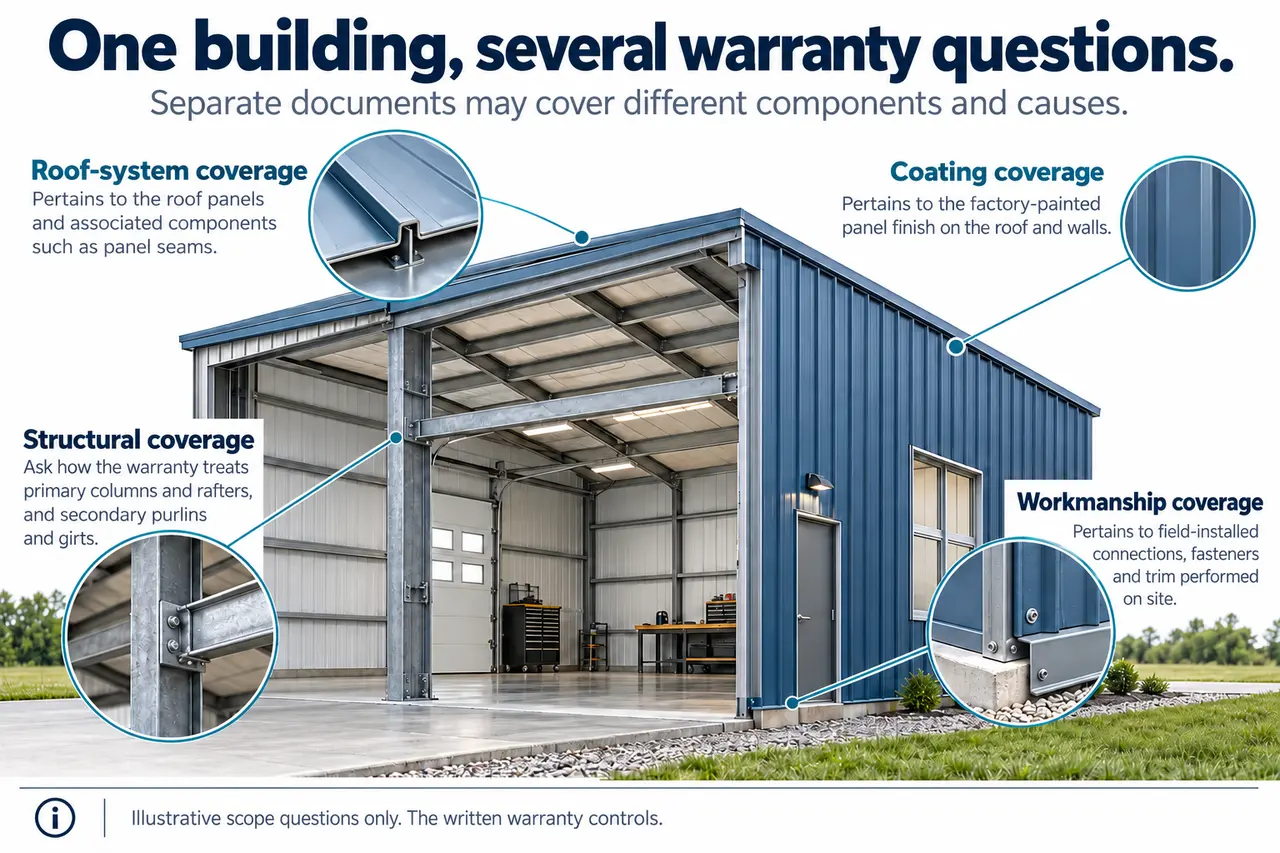
Metal building warranties can cover different products, causes and remedies. A structural-component warranty, a painted-finish warranty, a roof weathertightness warranty and an installer's workmanship agreement may be separate documents issued by different parties. A long term printed beside one category does not establish coverage for the entire completed building. Compare what is promised, by whom, under which conditions and with which remedy.
The MBCI warranty resource page lists separate weathertightness, paint, metallic-coated product and fabricated-component warranties. It also describes prerequisites for its roof warranties. This is a manufacturer example showing why categories differ; it does not state the coverage of a SteelBuildingKit purchase or any other supplier's agreement.
Begin with a coverage map rather than a headline term. Put the frame, panels, surface finish, roof system, openings and field installation on one list. Beside each, identify the actual document and issuer or mark the item unconfirmed. The purpose is to discover gaps and overlaps before a symptom occurs, not to assume every physical part must have a separate warranty.
This guide is a document-comparison method, not a legal interpretation of an unseen contract. Use the actual issued agreements and appropriate advice for disputed or material terms. Do not substitute a salesperson's general description, another manufacturer's sample or this article for the documents that govern the project.
Identify the issuer, beneficiary and covered product
Record the full name of the party making each promise and the person or entity entitled to use it. A supplier, manufacturer, coating provider, roofer and general contractor may have different roles. If a sales representative says the building has a warranty, ask which written agreement establishes that statement and whether it will be issued to the owner.
Match the covered product to the delivered material. Keep the order number, product description, panel or coating identification and relevant invoices together. A sample warranty for one finish or roof system may not apply to another. Where the contract promises a warranty to be issued later, track issuance as an outstanding deliverable rather than treating a brochure as the final document.
Read the start event and term separately. Shipment, installation, completion and acceptance are different possible milestones; use the event the agreement actually specifies. Record the date with its evidence. Do not assume all agreements begin when the owner first occupies the building, and do not transfer the longest term from one product to the rest of the project.
Also record transfer requirements and any beneficiary limitations. A used-building buyer or future property owner should not assume that possession of a warranty certificate establishes transferability. Ask the issuer to identify the applicable process and obtain the relevant written confirmation. Keep the response with the transaction records rather than relying on the previous owner's recollection.
Use three status labels in the register: sample received, issuance requirements confirmed and final agreement received. A sample is useful for early comparison, but it does not establish that the project completed the required steps or that the final wording is identical. At handover, reconcile the final agreement against the purchase requirement and record any difference for resolution. This avoids closing the project with a folder of attractive samples while the actual owner-facing documents remain outstanding.
Paint appearance, corrosion and roof leaks are different questions
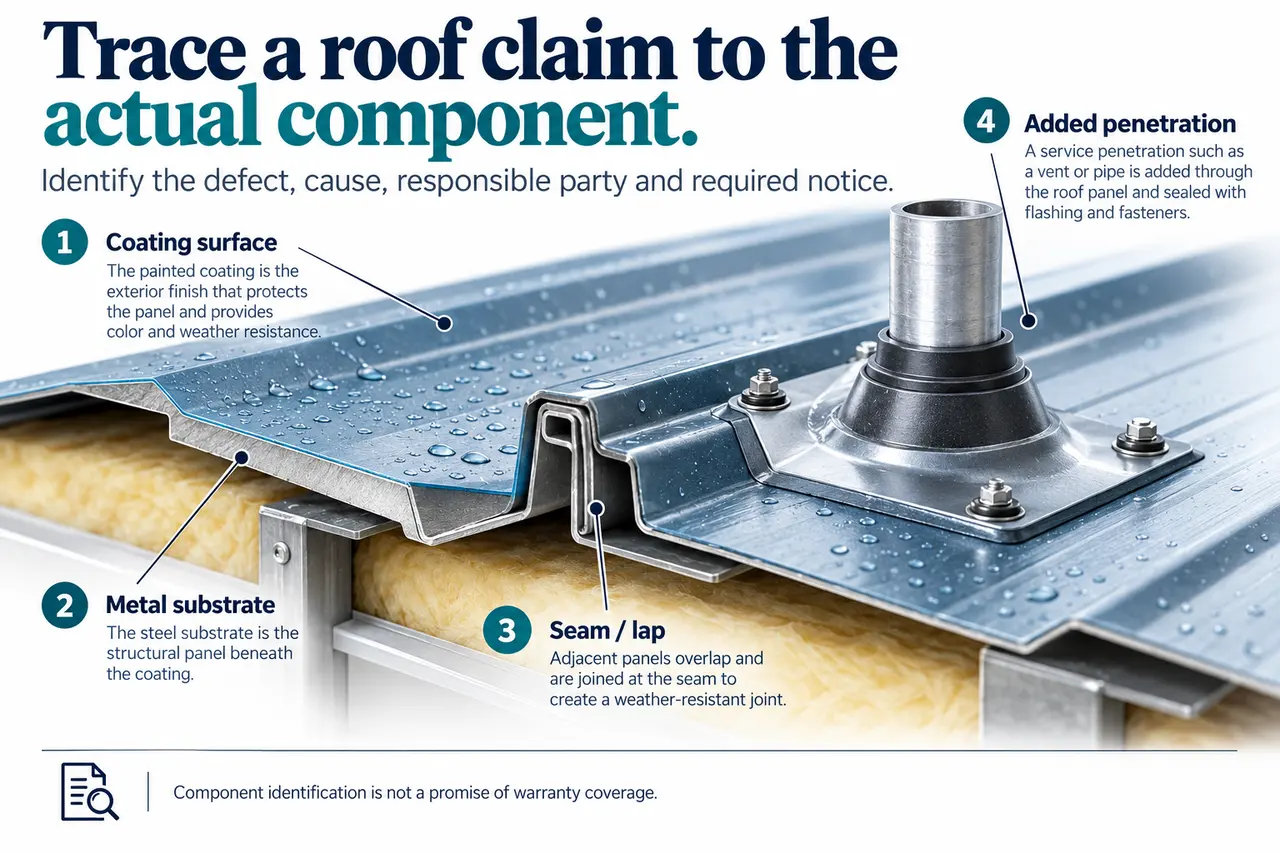
A painted-finish promise can concern a different outcome from a roof-system weathertightness promise. A faded panel, a corroded area and water entering at a seam may involve different products, causes and agreements. Begin by describing the observed condition accurately; do not choose the warranty category solely because its term is longest.
Separate the surface finish from the metal substrate in the coverage map. Identify whether the agreement addresses the coating, the metallic-coated sheet, the fabricated panel or some combination. Read the actual criteria and exclusions rather than assuming a statement about paint appearance covers every type of corrosion or every environmental exposure.
Roof leaks also need a cause investigation. Water observed inside a building does not by itself establish a defect covered by a roof warranty. Exterior entry, a later penetration and condensation can require different assessments. Preserve the symptom record and have the appropriate professional investigate while following the agreement's notice and authorization procedures.
Do not translate 'maintenance-free' language into an operating rule. Determine what maintenance, inspection and reporting the actual agreements require, and keep those tasks in the building file. A roof, finish and workmanship agreement can have different obligations. The owner needs a practical schedule based on those documents and product instructions rather than a generic interval from another building.
Understand roof-system warranty prerequisites
Before ordering a roof system for which a particular warranty is required, confirm the issuer's process. Ask which systems qualify, which installers or details are acceptable, what reviews or inspections are involved and what must be submitted before purchase. Do not assume a warranty can always be added after the roof is built.
MBCI's published example states that its weathertightness warranties concern roof systems and require approval before materials are ordered. Its listed options distinguish standard and single-source arrangements. Use that example as a prompt to obtain your issuer's actual requirements; it does not establish that another manufacturer's program follows the same process. See the MBCI warranty requirements for that manufacturer example.
Clarify what an inspection means. A warranty inspection, an installation quality check and a building-code inspection may have different scopes and purposes. Obtain the relevant reports and understand what each establishes. Do not treat the existence of one visit as proof that every component or condition was reviewed.
Make the issuance path visible in the contract schedule. Identify who requests approval, who submits details, who arranges inspections and who obtains the final certificate. If a prerequisite is missed, ask the issuer what options remain instead of assuming the promised term still applies. A useful warranty requirement is a deliverable with an owner, not an untracked sentence in a sales email.
Read exclusions and alterations before changing the building
Create an alterations log for proposed solar, spray foam, roof penetrations, new equipment and repairs. For each change, identify which issuer or contractor should review its effect on the applicable agreement. The correct question is not whether all solar always voids warranties; it is what the specific warranty and proposed mounting arrangement require.
Get written responses that identify the proposed work. A general statement that modifications are acceptable may not describe the actual attachment, product or detail. Attach drawings or a clear scope where necessary and preserve the response. If several agreements are involved, one issuer's consent should not be assumed to resolve another party's requirements.
Read exposure and maintenance provisions with the actual site in mind. Coastal conditions, chemical exposure, retained debris or contact with incompatible materials may be relevant depending on the agreement and product. Do not infer a universal exclusion from this list. Use it to check whether the site and intended operations have been accurately disclosed.
Coordinate urgent damage response with the written procedures and immediate safety needs. Preserve photographs and records, and seek appropriate professional direction. Before authorizing permanent third-party repairs, understand any notice or approval requirements that may affect the claim. The goal is to prevent further damage while retaining useful evidence and following the applicable process.
For a proposed solar installation, for example, keep one change packet containing the roof identification, array layout, mounting description and requested issuer decision. Record which party answered and the particular drawing revision reviewed. If the installer later changes the attachment, return that revision for the necessary review instead of assuming the earlier response applies. The same record can support maintenance and future roof work without claiming that approval under one agreement establishes every other design or contractual requirement.
Compare remedies and the claim process
| Document field | What to record | Why it changes the comparison |
|---|---|---|
| Covered outcome | The defect or performance criterion actually promised | A long term may cover a narrow condition |
| Remedy | Repair, replacement or other stated response | Material supply may differ from a complete installed repair |
| Included expenses | Labor, access, removal and related costs as stated | An owner needs to understand remaining project work |
| Limits and conditions | Caps, exclusions and prerequisites in the actual wording | A headline term does not show the whole promise |
| Notice and authorization | Recipient, information, timing and approval process | A claim needs the right record and communication route |
| Transfer | Whether and how rights pass to another owner | A certificate does not automatically establish a new beneficiary |
Copy exact document references into the comparison sheet rather than rewriting every term from memory. Use a short plain-language summary for navigation and retain the governing wording beside it. If a material provision is unclear, request clarification or advice before relying on an interpretation. The sheet should point to evidence, not replace it.
Compare the complete remedy under the same hypothetical symptom. If one agreement offers material and another includes specified installation work, that difference matters even when both display the same term. Do not invent a monetary value for coverage without knowing the actual terms, likely scope and other contractual responsibilities.
Also distinguish warranty response from routine repair procurement. A contractor willing to quote work is not necessarily accepting responsibility under an existing agreement. State whether the request is for investigation, warranty consideration, temporary protection or a separate paid repair. Clear purpose helps prevent a practical service conversation from being mistaken for a coverage determination.
A hypothetical roof with three different complaints
Imagine an owner reports a faded panel, a small leak near a recently added pipe and water below an original roof seam. This is an illustrative document exercise, not a customer case or a finding about coverage. The mistake is to submit all three under a long paint-warranty headline without identifying the products, causes and applicable agreements.
Give each complaint a separate record. For the finish concern, identify the panel and coating information and document appearance under suitable conditions. For the new penetration, collect the alteration scope, installer records and any issuer approvals. For the original seam, record wetting timing, location and prior repairs. The record should support investigation without asserting an unverified cause.
Then map each complaint to the documents that may be relevant. The paint document may contain criteria for the appearance concern. The roof-system and workmanship agreements may need examination for the water entry. The later modification may involve a different contractor. This map identifies questions; it does not decide liability or prove that any condition is covered.
Follow each agreement's notice route while coordinating the physical investigation. Preserve correspondence and ask which additional information is needed. If the symptom is actually condensation rather than exterior entry, update the description instead of continuing to call it a seam leak. Accurate diagnosis improves both the repair discussion and the coverage discussion.
The example demonstrates why a building file needs component identity, alteration history and separate agreements. A headline term cannot supply those facts after the event. The practical outcome is a documented claim request directed to the appropriate party, with uncertainty and immediate protective work clearly recorded.
Build the warranty file before delivery
Create a register with one row for every promised agreement. Record issuer, product, beneficiary, document status, start event, term, prerequisites and claim contact. Mark samples separately from issued certificates. Review the register at ordering, installation and handover so a missing document is identified while the responsible parties are still completing the project.
Keep supporting records that connect the promise to the building: invoices, product labels, approved details, inspection reports, completion photographs and maintenance instructions. Use a naming system that makes the relevant roof or wall area easy to locate. A large unsorted folder can be almost as difficult to use as a missing document.
Assign responsibility for recurring obligations and alterations review. If ownership or management changes, transfer the records and identify any issuer process that must also be completed. Do not assume sharing a folder fulfills a formal transfer requirement. Ask the responsible parties to clarify what the actual agreements require.
Use the steel building buyer's guide to place warranty deliverables beside the broader scope of supply and installation. Request specific documents rather than an unsupported promise that everything is covered. That makes coverage easier to compare and helps the owner distinguish a missing warranty from an excluded construction task.
Keep a short communication index with date, sender, subject and linked document. Separate an acknowledgment of receipt from an acceptance or coverage decision; they are different events. If a request remains unanswered, the index should make that visible rather than implying resolution. This is a practical recordkeeping method that helps an owner explain the history accurately when a different representative or contractor takes over.
Questions about metal building warranties
Does a long paint warranty cover roof leaks? Do not assume so. Paint performance and roof weathertightness can be separate promises. Identify the observed condition and read the relevant documents before treating one term as whole-building protection.
Does structural coverage include every purlin and connection? Only the actual agreement establishes its covered components and conditions. Primary and secondary framing are different categories; neither a diagram nor a general label determines coverage. Ask for the specific product scope.
Will solar panels automatically void the roof warranty? There is no universal answer from the category alone. Submit the actual proposed attachment and layout to the relevant issuer before work, and follow its written requirements.
Does a warranty transfer when a used building is sold? Check the actual transfer provision and issuer process. A previous owner's certificate is evidence to investigate, not automatic proof of coverage for relocation or a new beneficiary.
Who covers installation mistakes? Examine the applicable workmanship and other project agreements and the actual cause. Do not assume the material manufacturer takes responsibility for every field operation. Obtain the promised installer documents and keep them with the product warranties.