What You’ll Learn
– Exact RV dimensions by class and why height is the most critical measurement
– What size metal building for RV storage actually fits your rig (with real footprint math)
– Whether a 40×60 can fit a Class A motorhome — and what eave height changes everything
– Door height requirements that most buyers overlook until it’s too late
– Cost ranges for single-RV and multi-RV metal buildings in 2026
– Foundation requirements for heavy Class A and 5th wheel storage
– Which manufacturers build the best RV storage buildings
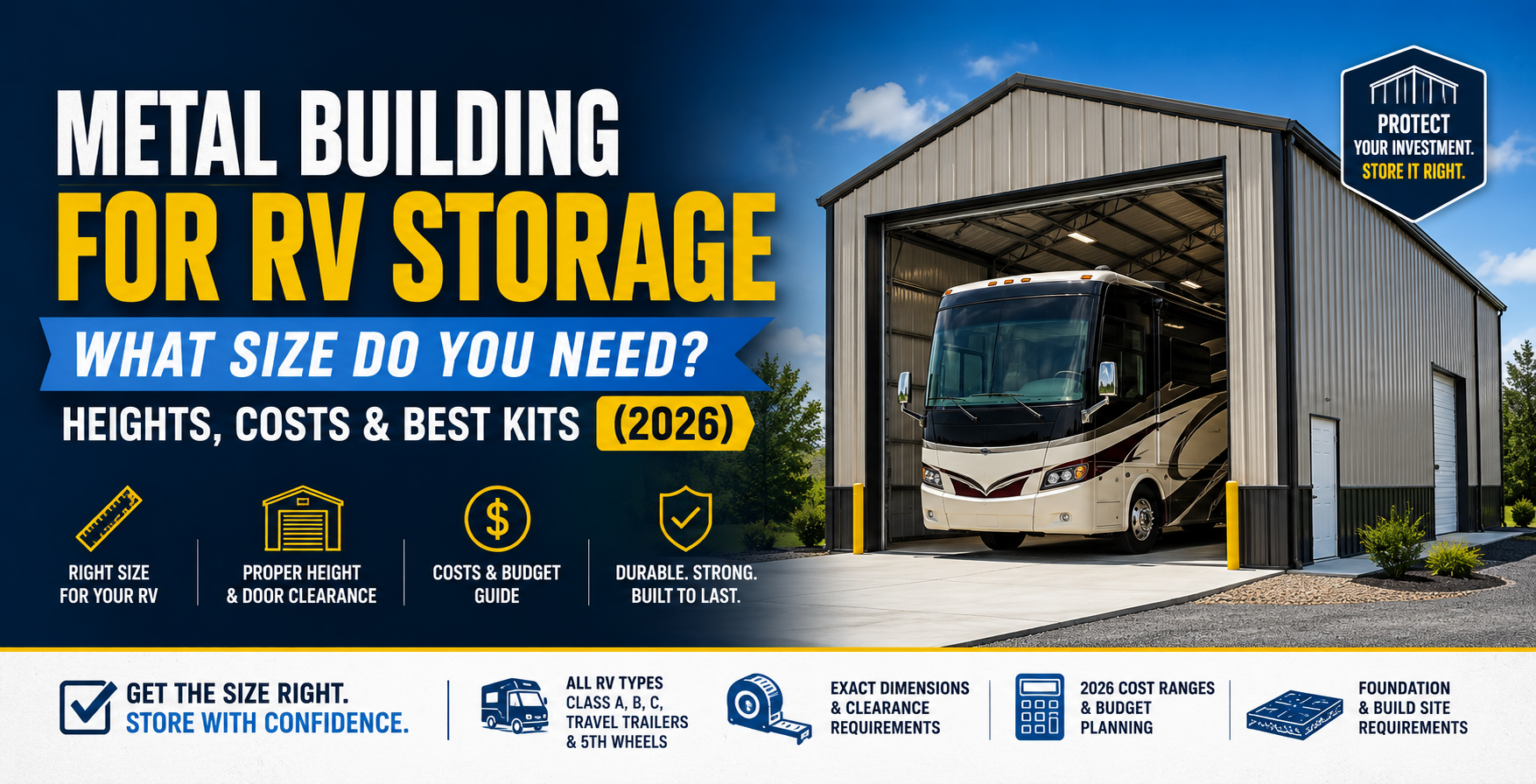
Choosing the right metal building for RV storage starts with one uncomfortable truth: most buyers get the footprint right and the height completely wrong. A metal building for RV storage that is 40 feet wide and 60 feet long sounds enormous — until you realize a 12-foot eave height won’t let your Class A inside.
At SteelBuildingKit.com, we research steel building kits independently without manufacturer bias. Before you get a quote, read this guide. We have done the math on door heights, eave clearances, and kit costs so you do not end up with a $30,000 building your RV cannot enter. For a broader starting point, use our steel building cost calculator to ballpark your budget before diving into RV-specific sizing.
Quick Answer: What Size Metal Building Do I Need for RV Storage?
For a single Class A motorhome (30-45 ft): minimum 20×45 at 14-foot eave height. Recommended: 24×50 at 16-foot eave.
For a single Class C or travel trailer: minimum 16×40 at 12-foot eave. Recommended: 20×45 at 14-foot eave.
For one RV plus one car: 30×50 minimum at 14-foot eave.
For multiple RVs: 40×60 minimum at 14-foot eave, 40×80 if you want workspace.
The eave height needs to exceed your RV’s roof height by at least 12-18 inches to allow for roof-mounted AC units, antennas, and safe clearance during entry. The door must be at least 1 foot taller than your RV’s highest point.
Section 1: RV Dimensions You Need to Know Before Buying
Before you look at a single kit price, pull out your RV’s spec sheet. These numbers determine your building size, not the other way around.
| RV Class | Length | Roof Height | Width | Slide-Out Width (extended) |
|---|---|---|---|---|
| Class A Motorhome | 30-45 ft | 12-13.5 ft | 8.5 ft | Up to 12 ft |
| Class B (Van Camper) | 18-24 ft | 9-10 ft | 7-7.5 ft | Rare |
| Class C Motorhome | 22-35 ft | 11-12.5 ft | 8-8.5 ft | Up to 11 ft |
| Travel Trailer | 12-40 ft | 10-13 ft | 8-8.5 ft | Up to 12 ft |
| 5th Wheel | 20-40 ft | 12.5-13.5 ft | 8.5 ft | Up to 13 ft |
Key insight: The building height matters more than the building footprint for most RV owners. A 45-foot Class A can fit inside a 50-foot building — but only if the eave height clears the roof AC unit and the door is tall enough to drive through. Get the height wrong and nothing else matters.
Also note slide-out width. If you plan to deploy slide-outs inside the building, your width needs to accommodate the RV’s fully extended profile, not just the body width. A Class A with full slide-outs can run 12-14 feet wide.
Section 2: What Size Metal Building Do You Need for RV Storage?
Here is the footprint math most buyers skip. The minimum building length is not just the RV length — it is the RV length plus working room.
Length formula: RV length + 6 feet (walking/access space at rear) + 4 feet (front door swing or buffer) = minimum building length
Width formula: RV body width + slide-out width (if deploying inside) + 3 feet each side (walkway) = minimum building width
| Storage Scenario | Minimum Size | Recommended Size |
|---|---|---|
| Single Class B or small trailer | 14×40 | 16×45 |
| Single Class C or mid-size trailer | 16×40 | 20×45 |
| Single Class A (30-38 ft) | 20×45 | 24×50 |
| Single Class A (40-45 ft) | 24×50 | 30×55 |
| Single 5th wheel (large) | 20×45 | 24×50 |
| Single RV + 1 car | 30×50 | 30×60 |
| Single RV + 2 cars | 40×50 | 40×60 |
| 2 RVs side by side | 40×60 | 40×80 |
| 2 RVs + workshop | 50×80 | 60×80 |
The “recommended” sizes give you room to actually work around the rig — change fluids, wash it, unload gear — without constantly shuffling vehicles. If you’re also storing cars alongside the RV, our metal garage size guide covers how many vehicles fit in each standard footprint. If you’re storing cars alongside the RV, our metal garage size guide covers exactly how many vehicles fit in each footprint.
Section 3: Can a 40×60 Fit an RV?
Yes, a 40×60 metal building can absolutely fit an RV — but the answer depends almost entirely on the eave height, not the footprint.
A 40×60 gives you 2,400 square feet of floor space. That is more than enough for a Class A motorhome, even a 45-footer (40 ft of building depth leaves 15 feet of front and rear buffer combined if you angle the approach). The width of 40 feet is generous for a single RV with slide-outs deployed.
Here is where eave height determines the outcome:
- 12-foot eave: Maximum interior clear height is around 10.5-11 feet. Only Class B vans and very small travel trailers fit. A standard Class A cannot enter.
- 14-foot eave: Maximum interior clear height is around 12.5-13 feet. Most Class A motorhomes (up to 13 feet tall) fit. Most 5th wheels fit. This is the most common RV storage configuration.
- 16-foot eave: Maximum interior clear height is around 14.5-15 feet. Every production RV fits, including tall diesel pushers and 5th wheels with extended roof antennas or solar panel frames.
Real example: A 45-foot Class A diesel pusher with a 13.5-foot roof height needs a door that is at least 14.5 feet tall. A 40×60 building at 14-foot eave can accommodate this — but only if you order a 14-foot tall door and confirm that the door frame opening matches. At 12-foot eave, this rig simply does not fit.
If you are storing one large Class A plus two cars, a 40×60 at 14-foot eave is a practical, cost-effective solution. For two RVs side by side, a 40×80 at 14-foot eave is the minimum. Check our 40×60 steel building kit cost guide for current pricing on that footprint.
Section 4: Door Height Requirements for RV Storage
This is the single most common buyer mistake. People order a 14-foot eave building and then put a 12-foot door on it — then wonder why their RV won’t fit.
Your door height must clear your RV’s highest point, including roof AC units (which add 12-18 inches to the listed roof height), antennas, and any roof rack hardware.
| RV Type | Minimum Door Width | Minimum Door Height | Notes |
|---|---|---|---|
| Class A (gas) | 14 ft | 13-14 ft | Roof AC units add 12-18″ to listed height |
| Class A (diesel pusher) | 14 ft | 14-16 ft | Taller profile, some need 16 ft |
| Class B (van camper) | 10 ft | 10 ft | Most comfortable fit |
| Class C | 12 ft | 12-13 ft | Check rooftop AC |
| Travel Trailer | 12 ft | 13 ft | Varies widely by model |
| 5th Wheel | 14 ft | 14-16 ft | Tallest profile in this class |
Buyer warning: Always measure your RV from the ground to the highest fixed point on the roof, then add 12 inches minimum for door clearance. If your RV is 12.5 feet tall, you need a 13.5-foot door minimum — which requires at least a 14-foot eave building. Many kit buyers confuse eave height with door height. They are not the same. The door rough opening is typically 2-3 feet shorter than the eave height at the sidewall.
When ordering, explicitly specify the door height in your quote and ask the manufacturer to confirm that the door frame fits within your chosen eave height. This conversation can save you $5,000-$10,000 in post-delivery modifications.
Section 5: Single RV Storage Building Sizes and Costs
Prices below are 2026 estimates for steel building kits delivered to the lower 48 states. Installed costs include concrete, erection labor, and a basic insulation package.
| Building Size | Configuration | Kit Cost | Installed Cost |
|---|---|---|---|
| 14×40 | Open carport style | $3,500-$6,000 | $8,000-$15,000 |
| 20×45 enclosed | Class C / trailer | $9,000-$15,000 | $22,000-$35,000 |
| 24×50 enclosed | Class A up to 38 ft | $12,000-$20,000 | $28,000-$45,000 |
| 30×50 enclosed | Class A + workshop | $14,000-$24,000 | $34,000-$58,000 |
| 30×60 enclosed | Class A + 1 car | $17,000-$28,000 | $40,000-$65,000 |
All enclosed buildings in the 20×45 range and above should be ordered at 14-foot eave minimum if storing anything larger than a Class B van. For a full price comparison across all popular sizes, see our metal building prices by size guide. For a full side-by-side comparison of kit costs across all footprints, see our metal building prices by size guide. Check our detailed 30×50 metal building kit cost guide for that footprint’s full pricing breakdown.
If you are considering a simpler covered (non-enclosed) solution for a travel trailer or boat, metal carport kits start around $3,500 and can be ordered with 12-16 foot leg heights for RV clearance. They are not weatherproof, but they protect against UV damage and light weather at a fraction of the enclosed cost.
Section 6: Multi-RV and RV + Car Combo Buildings
Once you move beyond a single RV, the cost math changes significantly — but so does the value. A shared RV and vehicle storage building often pencils out better than renting multiple spaces at a commercial storage facility.
40×60 at 14-foot eave (1 Class A + 2 cars): Kit cost $28,000-$45,000. This is the most popular multi-use RV storage configuration. The 40-foot width gives you enough room for an RV on one side and two cars on the other with a shared center aisle. See the full 40×60 steel building kit cost guide for configuration options.
40×80 at 14-foot eave (2 RVs side by side or 1 RV + full workshop): Kit cost $38,000-$60,000. This footprint gives you 3,200 square feet, enough for two full-size Class A motorhomes parked side by side with slide-outs retracted, or one RV plus a serious 1,200-square-foot workshop.
50×80 at 16-foot eave (3 RVs or 2 RVs + full workshop): Kit cost $50,000-$80,000. At this scale, you typically need a commercial permit in most counties, and a licensed engineer should review the foundation design. The 16-foot eave accommodates every production RV class with room to spare.
For any multi-vehicle building over 40 feet wide, consider adding steel building insulation from the start. Condensation is a real problem in large metal buildings, and it accelerates corrosion on RV exteriors and vehicle finishes.
Section 7: Eave Height Comparison for RV Buildings
| Eave Height | Max Door Height (approx.) | Best For | Price Adder vs. 10 ft Standard |
|---|---|---|---|
| 10 ft | 8 ft max | Not suitable for RV storage | Baseline |
| 12 ft | 10 ft max | Class B vans, small pop-up trailers | +$800-$1,500 |
| 14 ft | 12-13 ft | Most Class A, Class C, 5th wheels | +$1,500-$3,000 |
| 16 ft | 14-15 ft | All RV classes, tall diesel pushers | +$3,000-$6,000 |
The price adder is per building and varies by footprint. On a 30×50 building, going from 10-foot to 14-foot eave typically adds $2,000-$3,500 to the kit price. On a 40×80, that same upgrade can run $4,000-$7,000. Always get the height right in the initial order — adding height post-build is prohibitively expensive.
Section 8: Foundation Requirements for an RV Storage Building
RVs are not light. A Class A diesel pusher can weigh 30,000+ pounds fully loaded. A large 5th wheel with a full water tank and cargo can exceed 20,000 pounds. This matters for your concrete slab.
Minimum concrete spec for RV storage:
– Single RV (Class B/C, travel trailer): 4-inch slab, 3,000 PSI concrete, fiber reinforcement
– Single Class A or 5th wheel: 5-6 inch slab, 4,000 PSI concrete, rebar grid at 16-inch spacing
– Multiple heavy RVs: 6-inch slab minimum, engineered rebar layout, possibly thickened edges under tire paths
For any building over 40×60 with multiple heavy RVs, have a structural engineer review the foundation design. The building kit manufacturer can provide slab specs, but they are not engineers — and local soil conditions (expansive clay, high water table, frost depth) affect the design significantly.
Review the options in our steel building foundation types guide before finalizing your building order. The foundation is often 20-30% of the total installed cost, and skimping on it is how buildings develop wall alignment and door frame problems within 5 years.
Section 9: Best Metal Building Companies for RV Storage
Not every steel building manufacturer is set up to handle RV storage configurations well. These companies have established track records with large-door, high-eave buildings.
General Steel Buildings offers pre-engineered RV garage packages with 14-foot and 16-foot eave options. Their 40×60 RV kit comes pre-configured with door placement options and is one of the more turnkey solutions for first-time buyers.
Rhino Steel Buildings has a strong reputation for storage building warranty coverage. Their PBR (Purlin Bearing Roof) design handles snow loads well in northern climates, which matters if your RV storage building sits in a region with 30+ PSF ground snow load. See our full Rhino Steel Buildings review for detailed scoring.
SteelMaster Buildings uses a Quonset arch design that works particularly well for RV storage. The curved arch roof has no interior columns, which means you can pull an RV in and out without navigating around posts. The arch also sheds snow naturally, reducing live load concerns. Read our SteelMaster Buildings review for the full breakdown.
Mueller Inc. is a direct-to-consumer manufacturer based in Texas. They are popular for large RV buildings in the 40×60 to 60×100 range, with competitive pricing on high-eave configurations. Lead times run 8-14 weeks depending on season.
For side-by-side comparisons with scores and pricing, our top 10 steel building kit companies guide covers all the major manufacturers with independent ratings.
Section 10: RV Storage Building Permits
Most counties require a building permit for any enclosed structure over 200 square feet. An RV storage building almost always qualifies.
Common permit classification: Accessory structure or private garage. In most residential zones, an RV storage building is permitted as an accessory structure on the same lot as a primary residence, subject to setback requirements (typically 5-10 feet from property lines, 20+ feet from the front setback line).
Zoning check first: Some municipalities restrict RV storage outright — even on your own property. Check with your county planning department before purchasing a kit. RV storage restrictions are more common in HOA-governed neighborhoods and urban/suburban residential zones. Rural and agricultural-zoned properties rarely have restrictions.
What permits typically require:
– Engineered drawings (most steel building kit manufacturers provide these)
– Site plan showing building placement and setbacks
– Foundation plan (may require a licensed engineer’s stamp for large buildings)
– Wind and snow load compliance with local code (the kit manufacturer specifies this in the design)
Permit costs range from $200-$1,500 depending on jurisdiction and building size. Budget 60-90 days for permit approval in busy counties. Our metal building permit requirements guide walks through the full process state by state.
Common Mistakes When Buying a Metal Building for RV Storage
| Mistake | Why It Happens | What It Costs You |
|---|---|---|
| Ordering 12-ft eave for a Class A | Assumed eave height = interior height | $5,000-$15,000 to raise walls or rebuild |
| Door height shorter than RV height | Didn’t measure roof AC unit | RV won’t fit; door replacement $3,000-$8,000 |
| Width too narrow for slide-outs | Measured RV body, not extended slide-out | Slide-outs scrape walls or can’t deploy |
| 4-inch slab for a 30,000-lb Class A | Used residential slab spec | Cracking within 2-3 years, costly repair |
| Skipping insulation | Upfront cost savings | Condensation damage to RV exterior, mold |
| Not checking zoning first | Assumed it was allowed | Permit denied after kit is purchased |
| Buying kit without engineer-stamped drawings | Saved $500 | Permit rejected, drawings required anyway |
Article Summary
- RV roof height, not length, is the critical dimension when sizing a metal building for RV storage
- Class A motorhomes are 12-13.5 feet tall; diesel pushers and tall 5th wheels can exceed 13.5 feet
- Minimum building size for a single Class A: 20×45 at 14-foot eave
- A 40×60 at 14-foot eave fits most Class A motorhomes plus 2 cars; 16-foot eave fits all RV classes
- Door height must clear the RV’s highest point (including roof AC) by at least 12 inches
- Single RV enclosed kit prices range from $9,000 (20×45) to $28,000 (30×60) for the kit alone
- Multi-RV buildings (40×60 to 50×80) run $28,000-$80,000 kit cost
- Class A storage requires a 5-6 inch reinforced concrete slab, not a standard 4-inch residential pour
- General Steel, Rhino Steel, SteelMaster, and Mueller Inc. are the strongest RV storage specialists
- Check zoning and HOA rules before purchasing any kit — some municipalities restrict RV storage on residential lots
Frequently Asked Questions
Q: What is the minimum metal building size for RV storage?
A: The absolute minimum depends on your RV class. For a Class B van camper, a 14×24 at 10-foot eave works. For a Class C, plan on 16×35 at 12-foot eave minimum. For a Class A motorhome, the minimum is 20×45 at 14-foot eave — and realistically you want 24×50 at 14-16 foot eave to have usable space around the rig.
Q: How tall does a metal building need to be for RV storage?
A: The eave height needs to be at least 2 feet taller than your RV’s roof height (including rooftop AC units). Most Class A owners need a 14-foot or 16-foot eave. If your RV is 13 feet tall, you need at minimum a 14-foot eave — but 16-foot is strongly recommended to avoid clearance issues with antennas and roof hardware.
Q: Can a 40×60 metal building fit an RV?
A: Yes. A 40×60 at 14-foot eave comfortably fits one Class A motorhome up to 45 feet long, with room for 2 additional vehicles. At 16-foot eave, the same footprint fits any production RV class. The footprint is not the limitation — the eave height is.
Q: How much does a metal building for RV storage cost in 2026?
A: Kit-only prices run from $9,000-$15,000 for a 20×45 (single RV, Class C size) up to $28,000-$45,000 for a 40×60 (Class A plus cars). Installed costs including concrete, erection, and basic insulation typically run 2-2.5x the kit price. A 24×50 installed for single Class A storage runs $28,000-$45,000 total in most markets.
Q: Do I need a permit for an RV storage metal building?
A: Almost certainly yes for any enclosed building over 200 square feet. Most RV storage buildings are classified as accessory structures and require a building permit, foundation plan, and wind/snow load-compliant engineering drawings. Some municipalities also have zoning restrictions on RV storage — check with your county planning department before ordering a kit.
Q: What is the best metal building for RV storage?
A: For a single large RV, a 24×50 or 30×50 fully enclosed building at 14-16 foot eave from General Steel, Rhino Steel, or Mueller Inc. is the most practical setup. For RV storage where snow load is a concern, Rhino Steel’s PBR roof system is particularly well-regarded. For a no-column interior (which makes parking easier), SteelMaster’s Quonset arch design is hard to beat.