


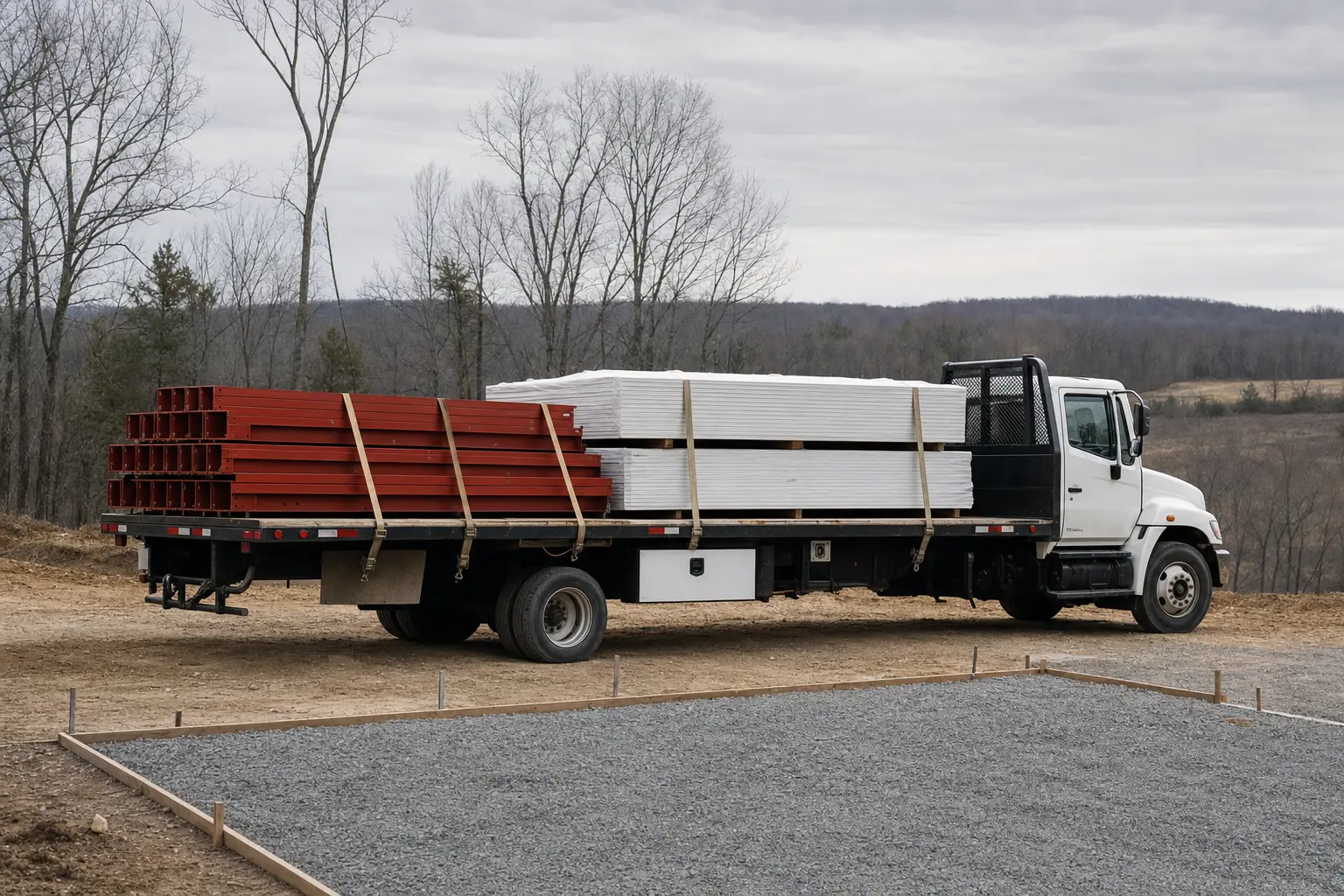
SteelBuildingKit Cost Index · Updated July 10, 2026 · Pricing collected June-July 2026
The most expensive metal building quotes are the ones that look cheapest. A quote with no line items can hide $6,000 to $15,000 of unpriced scope, “FOB factory” freight quietly adds $500 to $3,000+, generic load engineering resurfaces as an 8-15% kit surcharge at permit time, and a 50% deposit puts half your budget at risk before drawings exist (modeled exposure, July 2026). This guide is the pattern library: six red flags, what each one costs, and the exact fix for each.
None of these patterns proves a supplier is dishonest. Some are lazy habits, some are sales tactics, and a few are traps. What they share is that every one of them transfers risk from the seller’s ledger to yours, and every one of them has a one-sentence fix you can apply before signing anything. This page anchors the quote-defense side of our buying decisions hub; run each quote you collect through the table below first, then read the pattern sections for the fixes.
| Red flag | Typical exposure modeled | The fix |
|---|---|---|
| No line items, one lump number | $6,000 – $15,000 in unpriced scope | Itemized worksheet or no deposit |
| “FOB factory” freight | $500 – $3,000+ surprise at delivery | Freight to your address, in writing |
| Generic load engineering | +8 – 15% on the kit at permit time | Your county’s loads named on the quote |
| Same-day price pressure | Teaser specs off by 30 – 40% | Real quotes hold 7 – 30 days; use them |
| 50% deposit demand | Half the budget at risk pre-drawings | 10 – 25% deposit is the industry norm |
| Vague surcharge clause | Open-ended steel adders post-signing | Capped, dated price-lock language |
Exposure figures are modeled national ranges for mid-size projects (1,200-2,400 sqft), July 2026. Any single flag deserves a question; two or more on one quote deserve a different supplier.
Exposure ranges are modeled national estimates built from published supplier price lists and advertised kit pricing collected June-July 2026, cross-checked against component benchmarks for freight lanes, erection labor, and county load engineering premiums. Each figure represents the gap between what a flagged quote states and what the completed project actually invoices, and every number is labeled modeled. Full methodology lives in the SteelBuildingKit Cost Index.
Red flag 1: one lump number where line items should be
A legitimate metal building quote is a stack of parts: steel package, stamped engineering, freight, anchor hardware, doors, trim, and (if turnkey) concrete and labor. When a quote compresses all of that into a single number, you cannot tell what is included, which means you cannot compare it to anything, which is usually the point. The classic version quotes “$28,500 complete” and lets you assume concrete is in there; it is not, and the slab alone runs $6-$12 per square foot (modeled, July 2026).
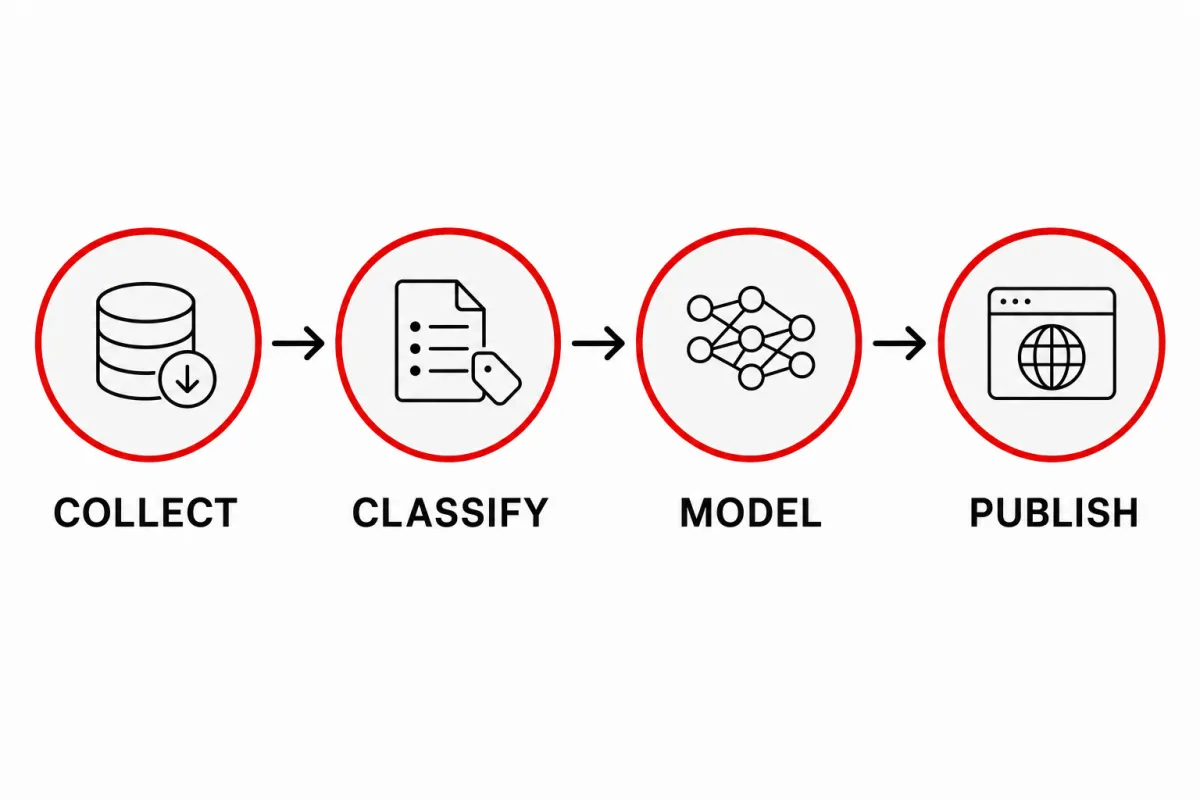
The fix: ask for the quote broken into the same lines our worksheet below uses. A supplier who prices buildings every day has these numbers; one who refuses to show them is telling you something. Our guide to reading a metal building estimate walks each line in detail.
Red flag 2: “FOB factory” hiding the freight bill
FOB (free on board) factory means the price covers the steel sitting at the plant, and everything after the loading dock is your problem: the flatbed, the fuel surcharge, sometimes the offload. On a regional delivery that is $500-$1,500; cross-country with an oversize escort it can pass $3,000 (modeled, July 2026). The flag is not the term itself, which is standard shipping language; it is a quote that leads with a delivered-sounding price while the FOB line hides in the terms.
The fix: one sentence in writing: “Price includes freight to [your address] with liftgate or offload plan stated.” If the supplier cannot commit to a freight number, ask for a capped estimate and the name of the shipping plant so you know the lane.
Red flag 3: generic loads that fail at the permit counter
Every advertised price assumes somebody’s snow and wind numbers, usually the gentlest ones: 20 psf snow, 115 mph wind. If your county requires 50 psf snow or 150 mph coastal wind, the kit gets re-engineered and re-priced, typically 8-15% higher (modeled, July 2026), and you find out after the deposit. This is the single most common gap between an advertised price and a permitted building.
The fix: get your county’s design loads before you collect quotes (the building department will tell you, or start with our steel building codes by state guide) and require every quote to name those loads on its face. A quote engineered to your real numbers can still be beaten on price; a quote engineered to fantasy numbers can only be beaten by reality.
Red flag 4: the price that dies at midnight
“This number is only good if you sign today” is a pressure tactic borrowed from car lots, and it inverts how steel pricing actually works. Mills publish pricing that suppliers hold for defined windows; a real written quote locks for 7 to 30 days (modeled market norm, July 2026). Same-day pressure almost always decorates a teaser spec, and teaser specs sit at the bottom of the accuracy ladder: advertised prices land within 30-40% of final cost, while a written spec-complete quote lands within 5-10%.
The fix: ask for the lock window in writing. Any supplier quoting real steel to a real spec can give you a week. If the price genuinely cannot survive seven days of thought, it was not a price; it was bait.
Red flag 5: deposits that fund someone else’s cash flow
Standard industry practice is a 10-25% deposit at order, a progress payment when stamped drawings are approved, and the balance at delivery (modeled norms, July 2026). A demand for 50% down before engineering exists moves half your project budget into a company you have never transacted with, months before steel ships. If that company oversold its production calendar or folds, you are an unsecured creditor.
The fix: hold to the standard schedule and put every milestone in the contract: what you pay, when, and what you receive at each step. Paying the balance at delivery, against a bill of materials you check off the truck, is the single strongest protection a buyer has.
Red flag 6: surcharge language with no ceiling
Steel prices move, and honest contracts handle that with a dated price-lock window and, past it, a defined index or capped adjustment. The red flag is the open-ended version: “prices subject to steel surcharges at time of fabrication.” That sentence converts your signed number into an opening bid, and buyers report it surfacing as a 4-8% adder weeks after signing (modeled from June-July 2026 market terms).
The fix: three questions before signing. How long is the price locked? What happens on day 31? Is any adjustment capped and calculated from a published index? Cross-shopping this language is as important as cross-shopping the price; our guide on how to compare metal building quotes shows the full side-by-side method.
The worksheet an honest quote matches
Here is the anti-red-flag in table form: the lines a complete mid-size turnkey quote itemizes. If a quote you are holding cannot be mapped onto these rows, you have found your gap.
| Line item | Typical range modeled | Red flag if… |
|---|---|---|
| Steel kit with stamped drawings | $17,000 – $25,000 | Loads not named |
| Freight to site | $800 – $2,000 | “FOB factory” or absent |
| Concrete slab, 4-inch reinforced | $7,200 – $14,400 | “By others” but implied included |
| Erection labor | $6,000 – $9,600 | No crew, insurance, or warranty stated |
| Permits, plan review, engineering extras | $500 – $3,000 | “Not our problem” |
| Complete turnkey total | $36,000 – $54,000 | A lump sum far below this band |
Worked example at mid-range rates: a $20,000 kit engineered to county loads, $1,400 freight, $10,200 slab ($8.50/sqft), $7,800 erection ($6.50/sqft), and $1,200 in permits totals $40,600, about $34 per square foot (modeled, July 2026). Any quote dramatically below that either excludes lines or specs a lighter building. The steel building cost calculator builds this worksheet for your own dimensions so you can see which lines a quote skipped.
Contract terms worth negotiating before you sign
| Protection | Typical value modeled | Worth pushing for when |
|---|---|---|
| 30-day written price lock | Removes 4 – 8% surcharge risk | Always; it costs the seller little |
| Freight named to your address | $500 – $3,000 certainty | Any delivery beyond 100 miles |
| Deposit at 10 – 25% with milestones | Caps pre-drawing exposure | Always; walk if refused |
| County loads on the quote face | Avoids +8 – 15% re-engineering | Every permitted building |
| Delivery window with notice period | Saves idle crew days at $500+/day | Whenever a crew is scheduled |
| Anchor bolts and closures itemized | $300 – $1,200 in “gotcha” parts | Every kit purchase |
How your location changes the red flags
Location decides which red flag bites hardest. In heavy snow and coastal wind counties, generic-load engineering is the expensive one: 8-15% of the kit, discovered at plan review, plus $300-$800 per drawing revision (modeled, July 2026). In the rural middle of the country, freight is the trap; sites 250+ miles from a roll-forming plant see $2-$4 per mile added past that radius, which is how “FOB factory” becomes a $2,500 line. Cold-climate buyers should watch slab scope: frost footings add $800-$2,000 on small buildings and $2,000-$6,000 on large ones, and a lump-sum quote that never mentions frost depth is a quote that has not met your building inspector. Permit costs swing from $150 rural stamps to $4,000 metro plan reviews, and high-fee counties are where “permits by owner” hides real money. Wherever you build, the pattern is the same: the vaguer the line, the more your ZIP code will fill in.
The accuracy ladder: where a red-flag quote actually sits
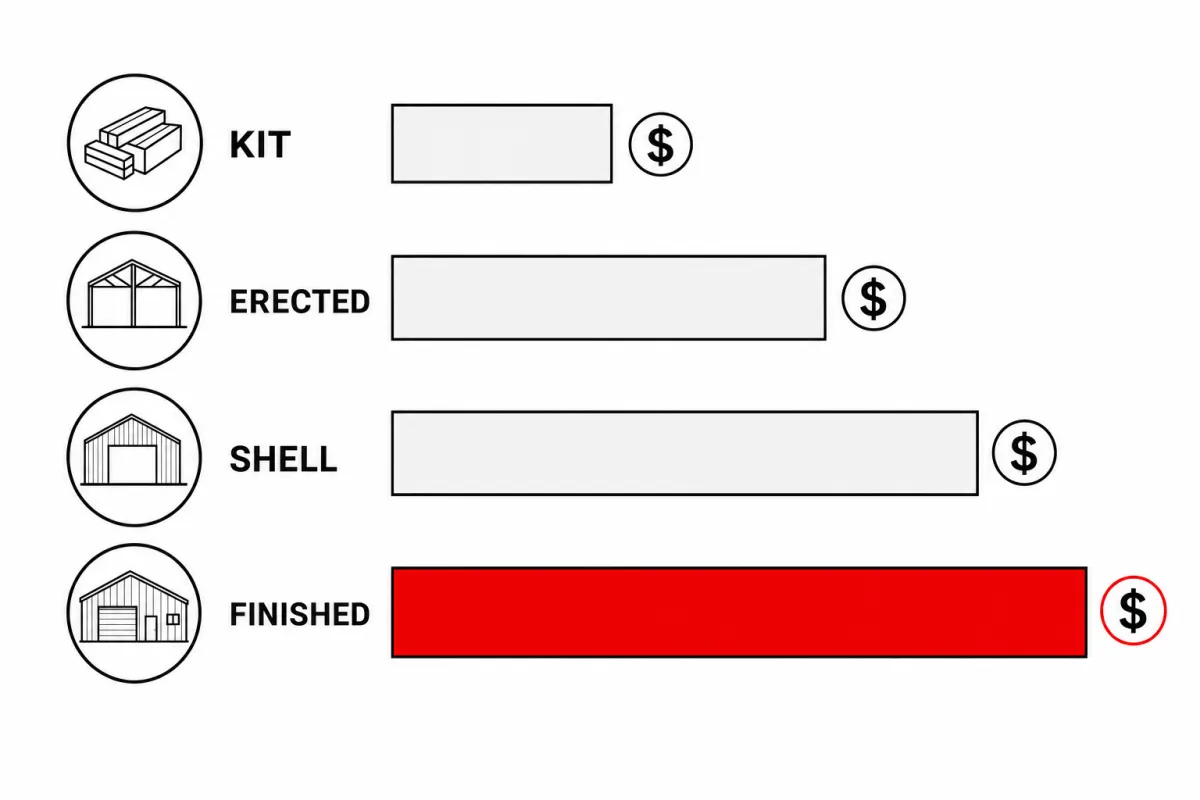
Every number you collect belongs to a rung. Advertised and teaser prices land within 30-40% of final cost; calculator estimates within 10-20%; a written, spec-complete quote within 5-10%; a signed contract with locked pricing within 0-5% (modeled, July 2026). Red flags are, almost by definition, attempts to make a bottom-rung number wear a top-rung costume. The defense is procedural, not psychological: collect three written quotes at one identical spec, map each onto the worksheet above, and let the line items argue. Quotes that survive that process rarely carried flags in the first place.
The red-flag screening checklist
Ten minutes with this list before any deposit. Every item is a yes/no with a paper trail.
- Quote itemizes kit, freight, concrete, labor, and permits as separate lines
- Your county’s snow, wind, and seismic loads are printed on the quote
- Freight is priced to your address with an offload plan, not FOB factory
- Price-lock window stated in writing, 7-30 days minimum
- Surcharge language is capped, dated, and tied to a published index
- Deposit is 10-25% with payment milestones mapped to drawings and delivery
- Anchor bolts, base trim, and closures are itemized or marked included
- Door and window schedule matches what you actually requested
- Erection quote names the crew’s insurance and workmanship warranty
- You have two other written quotes at the same spec to compare against
The next guide in this series, standard vs custom size, continues the same cost model.
Metal building quote red flag FAQs
What is the biggest red flag on a metal building quote?
A single lump-sum price with no line items. It hides $6,000-$15,000 of ambiguous scope on a typical mid-size project (modeled, July 2026), makes comparison impossible, and usually conceals excluded concrete or freight. Any serious supplier can itemize; refusal is the answer.
Is a 50% deposit normal for a steel building?
No. Industry-standard structure is a 10-25% deposit at order, a progress payment at approved drawings, and the balance at delivery (modeled norms, July 2026). Fifty percent before engineering exists concentrates risk on you and often signals a supplier funding operations from deposits.
What does ‘FOB factory’ mean on my quote?
It means the price ends at the factory loading dock; shipping is yours. Budget $500-$1,500 regionally and $3,000+ for long hauls with oversize loads (modeled, July 2026). The term is legitimate shipping language; the flag is a quote that leads with it while reading as a delivered price.
Why did my price jump after the deposit?
Usually generic load engineering: the advertised price assumed 20 psf snow and 115 mph wind, your county required more, and re-engineering added 8-15% to the kit (modeled, July 2026). The prevention is having your loads named on the quote before any money moves.
How long should a metal building quote stay valid?
Written quotes typically lock for 7-30 days (modeled market norms, July 2026). Same-day-only pricing is a pressure tactic, not a market condition. If steel is genuinely volatile, an honest supplier says so with a dated lock and a capped, index-linked adjustment, not a midnight deadline.
How many quotes should I get before ordering?
Three written quotes at one identical spec is the working standard: same dimensions, same loads, same door schedule, same scope. Fewer than that and you have no baseline to spot a flag; identical specs are what make the 5-10% written-quote accuracy band meaningful.
Are online metal building prices trustworthy at all?
As orientation, yes; as commitments, no. Advertised prices model within 30-40% of final cost and good calculators within 10-20% (July 2026). Use them to set a sanity band, then let written, county-load quotes carry the decision.
Ready to price this building for real? Compare verified metal building companies for this project type, with real reviews and track records.
Sources and methodology: published supplier price lists and advertised kit pricing (June-July 2026); component cost benchmarks for ready-mix concrete, erection labor, and freight; IBC and ASCE 7 for load context. All figures are modeled national estimates, labeled as modeled, and reviewed quarterly; see the full Cost Index methodology. This guide links to our independent company directory; listings never change published numbers.
Written by the Steel Building Editorial Team | Last updated July 10, 2026