

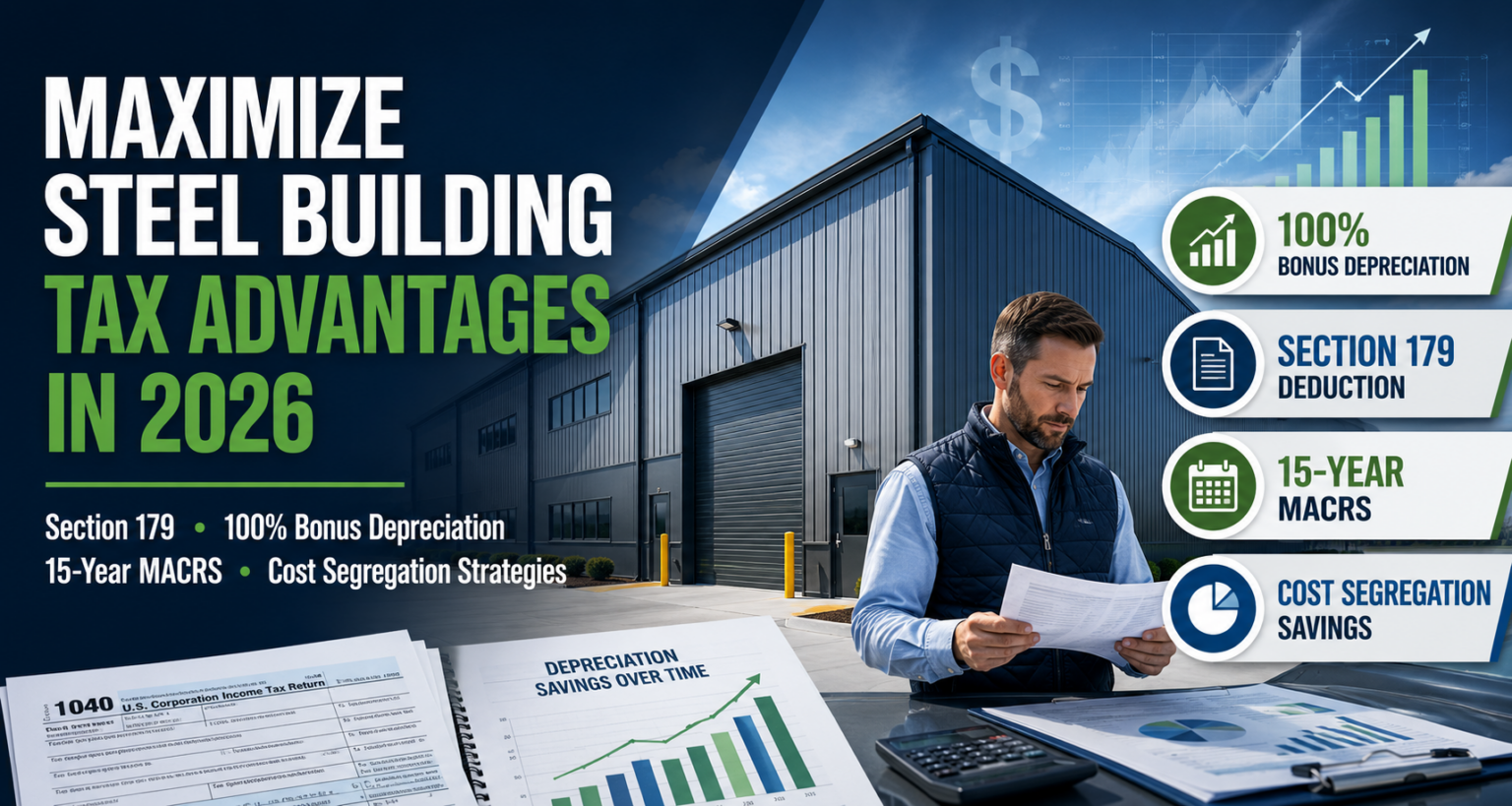
The One Big Beautiful Act (OBBBA), signed in 2025, permanently changed the steel building tax landscape for commercial buyers. Bonus depreciation is back to 100% for the first time since 2022, Section 179 limits were raised, and steel buildings now qualify for 15-year MACRS classification — meaning buyers can write off the entire cost of a commercial steel building in year one. This guide explains exactly how each tax advantage works and what the real dollar savings look like in 2026.
1. Bonus Depreciation: 100% Restored in 2026
Bonus depreciation allows businesses to deduct a large percentage of a qualifying asset’s cost in the year it’s placed in service, rather than spreading the deduction over the asset’s useful life. The Tax Cuts and Jobs Act of 2017 set bonus depreciation at 100% through 2022, after which it phased down 20% per year. By 2025 it had fallen to 40%. The One Big Beautiful Act permanently restored bonus depreciation to 100% starting in 2025 — the best year-one deduction environment since 2022.
For a steel building buyer: a $350,000 turnkey commercial steel building placed in service in 2026 qualifies for a 100% first-year bonus depreciation deduction of $350,000. At a 21% corporate tax rate, that is a $73,500 tax savings in year one. At a 37% individual rate for pass-through entities, the savings reach $129,500. See our steel building financing guide for how to structure the purchase to maximize this deduction.
2. Section 179 Deduction
Section 179 allows businesses to deduct the full purchase price of qualifying equipment and property in the year of purchase, up to an annual limit. For 2026, the Section 179 deduction limit is $1.16 million, with a phase-out beginning at $2.89 million in total purchases.
Steel buildings qualify for Section 179 when they are used for business purposes and classified as nonresidential real property improvements. The deduction cannot exceed your business’s taxable income for the year. Section 179 and bonus depreciation can be used together — Section 179 is typically applied first, with bonus depreciation covering any remaining basis.
| Building Cost | Section 179 Deduction | Tax Savings (21% rate) | Tax Savings (37% rate) |
|---|---|---|---|
| 200,000 | 200,000 | 42,000 | 74,000 |
| 500,000 | 500,000 | 105,000 | 185,000 |
| 900,000 | 900,000 | 189,000 | 333,000 |
| 1,160,000 | 1,160,000 (max) | 243,600 | 429,200 |
3. 15-Year MACRS Classification
The Modified Accelerated Cost Recovery System (MACRS) determines how commercial real property is depreciated over time. Standard commercial buildings use 39-year straight-line depreciation. However, steel buildings used as agricultural facilities, manufacturing plants, or qualifying commercial structures can be classified under the 15-year MACRS schedule — cutting the depreciation period by more than half and dramatically accelerating the annual deduction.
15-year MACRS property also qualifies for 100% bonus depreciation, meaning the entire cost can potentially be deducted in year one rather than spread over 15 years. This combination — 15-year classification plus 100% bonus depreciation — is the most powerful tax strategy available for steel building buyers in 2026.
4. Cost Segregation Studies
A cost segregation study is an engineering analysis that separates a building’s components into shorter depreciation categories — electrical systems, HVAC, specialty flooring, site improvements — which can be depreciated over 5, 7, or 15 years rather than 39. For steel buildings, cost segregation can reclassify 20% to 40% of the total building cost into shorter-lived categories that qualify for bonus depreciation.
Cost segregation studies typically cost $5,000 to $15,000 for a mid-size commercial building. The ROI is almost always positive for buildings over $500,000 in value. Consult a CPA or cost segregation specialist before purchasing — the study needs to be conducted by a qualified engineer for IRS acceptance. For financing strategies that complement these deductions, see our steel building financing options guide.
5. Real Dollar Examples by Building Size
| Building Size | Turnkey Cost Estimate | Year-1 Deduction (100% bonus) | Tax Savings at 37% |
|---|---|---|---|
| 30×40 workshop | 55,000 | 55,000 | 20,350 |
| 40×60 commercial shop | 125,000 | 125,000 | 46,250 |
| 60×80 commercial building | 300,000 | 300,000 | 111,000 |
| 80×120 warehouse | 600,000 | 600,000 | 222,000 |
| 100×200 distribution center | 1,400,000 | 1,160,000 (Sec 179 cap) | 429,200 |
Note: These are estimates based on 2026 tax rules. Actual deductions depend on your tax situation, business structure, and how the building is classified. Always consult a CPA or tax advisor before making purchasing decisions based on tax projections.
6. Who Qualifies for These Deductions?
These deductions apply to businesses purchasing steel buildings for commercial use — shops, warehouses, agricultural facilities, manufacturing plants, and commercial storage. The building must be used in a trade or business (not personal use) and placed in service during the tax year you claim the deduction. Sole proprietors, partnerships, S-corps, and C-corps all qualify, though the tax rates and pass-through mechanics differ by entity type.
Residential steel buildings (barndominiums used primarily as a personal residence) do not qualify for bonus depreciation or Section 179. A steel building used partly for business and partly for personal use can be depreciated proportionally based on the business-use percentage. See our steel building home kits guide for how home use affects tax treatment.
Frequently Asked Questions
Can I deduct the full cost of a steel building in year one?
Yes, if the building qualifies as business property and you apply 100% bonus depreciation (available in 2026 under the One Big Beautiful Act). You can deduct the full cost — or up to the Section 179 limit of $1.16 million — in the year the building is placed in service. The deduction cannot exceed your business’s taxable income for the year, but any unused Section 179 deduction can be carried forward.
Does a steel building qualify for Section 179?
Yes. Commercial steel buildings used in a trade or business qualify for Section 179 deduction in 2026. Agricultural steel buildings (barns, equipment storage) qualify as well. Residential-use buildings do not qualify. The building must be placed in service during the tax year you claim the deduction.
What is the bonus depreciation rate for steel buildings in 2026?
100%. The One Big Beautiful Act permanently restored bonus depreciation to 100% starting in 2025, reversing the phase-down that had reduced it to 40% by 2025. This means qualifying steel buildings placed in service in 2026 can be fully deducted in year one.
Should I use Section 179 or bonus depreciation?
In most cases, both. Section 179 is applied first and is limited to your business’s taxable income. Bonus depreciation can create a net operating loss (which can be carried forward). For buildings under $1.16 million, Section 179 alone may cover the full deduction. For larger buildings, use Section 179 up to the limit and bonus depreciation for any remaining basis. A CPA should model both scenarios for your specific situation before you finalize the purchase.