


STEEL BUILDING KIT GUIDE | Updated June 2026 | 11 min read
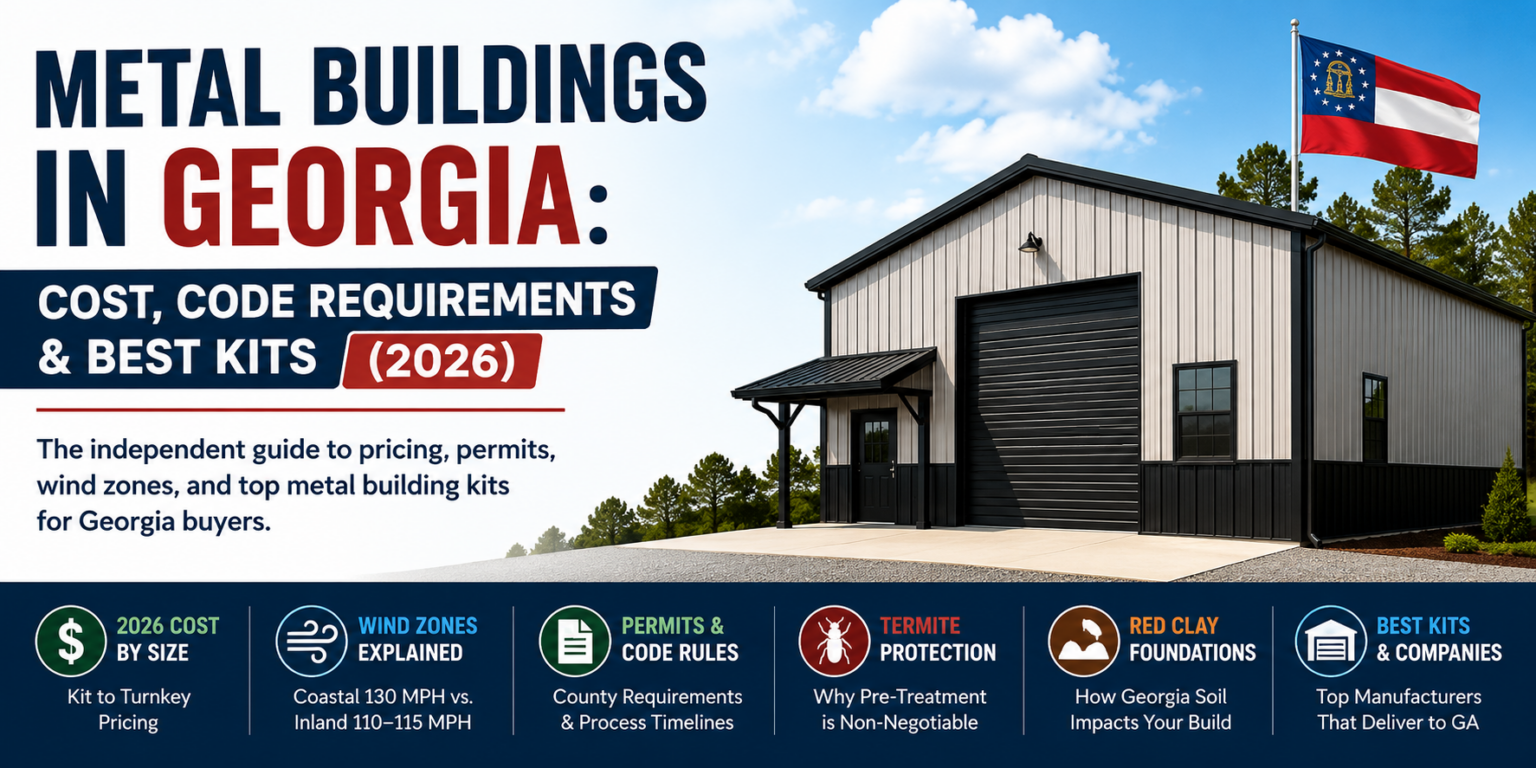
Metal Buildings in Georgia: Cost, Code Requirements & Best Kits (2026)
What You’ll Learn
– What a metal building in Georgia actually costs in 2026, from kit-only to turnkey, by size
– Why coastal Georgia buildings (Savannah, Brunswick) cost 12–18% more than inland builds
– How Georgia’s hot-humid climate causes condensation damage and what insulation solves it
– What Georgia county permit requirements apply and how long the process takes
– Why termite pre-treatment under your slab is non-negotiable in Georgia’s Zone 3 territory
– How red clay soil in north and central Georgia affects your foundation design and cost
– Which metal building companies serve Georgia and what their kit prices look like
– The six most expensive mistakes Georgia metal building buyers make and how to avoid them
A metal building in Georgia is not the same purchase as a metal building in Ohio. Georgia’s wind zones, humidity, red clay soil, and county-by-county permit rules each add cost and complexity that national pricing guides simply ignore. If you have been getting quotes based on generic online calculators, you are likely looking at numbers that are $3,000 to $8,000 short of what you will actually spend once your county engineer gets involved.
This guide is written from an independent standpoint. SteelBuildingKit.com does not sell buildings; we research what buyers actually pay, what codes actually require, and which manufacturers actually deliver in Georgia. For a broader view of how Georgia compares to other states, see our Steel Building Codes by State guide.
QUICK ANSWER
A 30×40 metal building in Georgia costs $25,000–$42,000 turnkey in 2026. A 40×60 runs $38,000–$65,000. Coastal Georgia buyers (Savannah, Brunswick, Darien) pay 12–18% more than inland buyers due to 130 mph wind zone engineering requirements. All permanent structures require a county building permit, engineered drawings are required for anything 1,200 sq ft or larger, and termite soil pre-treatment is required by many Georgia counties before a Certificate of Occupancy is issued.
1. Metal Building Costs in Georgia (2026 by Size)
Metal building prices in Georgia run 10–15% above the national average. The reasons are straightforward: wind engineering adds cost in coastal counties, labor in the Atlanta metro carries a 15–20% premium over rural areas, and material transport to some parts of south Georgia adds to the base kit price.
| Building Size | Kit-Only | Erected Shell | Turnkey |
|---|---|---|---|
| 30×40 | $9,500–$15,000 | $18,000–$25,000 | $25,000–$42,000 |
| 40×60 | $14,000–$22,000 | $28,000–$38,000 | $38,000–$65,000 |
| 50×100 | $28,000–$42,000 | $52,000–$72,000 | $75,000–$120,000 |
Note: Coastal Georgia counties add 12–18% to the erected shell and turnkey figures above due to 130 mph wind zone engineering requirements. A 40×60 in Savannah will cost $4,500–$7,000 more than the same building in Macon. Kit-only prices are less affected because the engineering premium hits the fabrication and delivery package, not just the raw steel.
What drives the range within each size: Foundation complexity (red clay vs. sandy coastal soil), insulation package, number of doors and windows, roof pitch, interior liner panels, and whether you use an Atlanta-metro contractor or a rural south Georgia crew. A basic 30×40 shop in rural Tifton will land closer to $25,000. The same building finished out as a workshop in Alpharetta will clear $42,000.
Use our Steel Building Cost Calculator to get a size-specific estimate, and see our full Metal Building Prices by Size breakdown for more detail across size categories.
2. Georgia Wind Zone Requirements and What They Cost You
Georgia is not a flat, uniform state when it comes to wind loads. The coastal plain, the Piedmont, and the north Georgia mountains each carry different design wind speed requirements under ASCE 7-22, which Georgia has adopted statewide.
Coastal Georgia (Savannah, Brunswick, Darien, St. Simons Island): 130 mph design wind speed. This is the highest exposure category in the state. Buildings here require heavier gauge primary framing steel, a higher density of anchor bolts in the foundation, additional bracing in the endwalls, and a Georgia Professional Engineer stamp that specifically accounts for the coastal wind exposure.
Atlanta metro, Macon, Augusta, Columbus: 110–115 mph. Standard engineering applies. This is the bracket where most national manufacturers’ default packages land, so buyers in these areas are less likely to be surprised.
North Georgia mountains (Blue Ridge, Dalton, Ellijay): 105–110 mph. The least restrictive wind zone in Georgia. North Georgia buyers sometimes get away with slightly lighter engineering than Piedmont buyers, though local counties still require PE-stamped drawings for larger structures.
KEY INSIGHT
A 40×60 metal building in Savannah will cost $4,500–$7,000 more than the same building in Atlanta, purely due to wind engineering requirements. Always get a Georgia-specific engineering package, not a generic national one. A manufacturer who quotes you a flat price without asking your county is selling you a national package that may not pass your local inspector’s review.
The practical implication: when you are getting quotes for a metal building in Georgia, tell every manufacturer your specific county. The difference between a Chatham County (Savannah) package and a Bibb County (Macon) package is real money and real engineering.
3. Georgia’s Condensation Problem (and How to Solve It)
Georgia sits in ASHRAE Climate Zone 2A (hot-humid, coastal and south Georgia) and Zone 3A (mixed-humid, central and north Georgia). Both zones share the same fundamental problem for uninsulated metal buildings: steel panels sweat.
Here is what happens. During Georgia’s summer months, humidity outside the building runs 75–90%. Overnight temperatures drop 15–25 degrees. The steel panels cool quickly, the warm humid air contacts the cold steel, and moisture condenses on the inside of the roof and walls. By morning, you have water dripping from the ceiling and puddling on the floor.
What condensation damages: Tools rust. Sheet metal shelving corrodes. Stored lumber warps. Boxes of parts and supplies get wet from above, not from a roof leak. Vehicles stored inside accumulate surface rust faster than they would outdoors. Georgia metal building owners who skip insulation consistently report this as their biggest regret.
Solution 1: Vinyl-backed insulation. The industry standard fix for Georgia’s climate is a minimum 2-inch vinyl-backed fiberglass blanket on the roof panels and 2-inch vinyl-backed blanket on the walls. The vinyl face acts as a vapor retarder, stopping humid air from reaching the cold steel surface. This is not optional in Georgia if you are storing anything of value.
Solution 2: Ridge ventilation plus intake vents. For buildings that still need airflow (workshops, garages with running engines), pairing insulation with ridge vents at the peak and eave vents at the base creates a convective loop that exhausts humid air before it contacts the steel.
Solution 3: Vapor barrier under the slab. A 10-mil poly vapor barrier under the concrete slab prevents ground moisture from wicking up through the concrete and evaporating inside the building. Standard practice in Georgia for any occupied or semi-conditioned structure.
Cost of insulation for a 30×40 building: $1,800–$3,200, depending on the insulation package and whether you have it installed by the erection crew or a separate insulation contractor.
Cost of skipping insulation: Condensation damage can destroy $10,000 or more in stored goods in a single Georgia summer. One flooded floor from a heavy dew cycle can warp hardwood flooring, rust a motorcycle, and soak a year’s worth of landscaping supplies. The math is not complicated.
See the full breakdown in our Steel Building Insulation Cost Guide.
4. Termite Protection Under Your Georgia Metal Building Slab
Georgia is classified as Termite Infestation Probability Zone 3, the highest activity zone in the United States. The entire state, from the Florida border to the Tennessee line, carries significant subterranean termite pressure. Formosan termites are active in south Georgia. Eastern subterranean termites are present statewide.
The good news: Steel frame members do not attract termites. The primary framing, secondary framing, and steel panels are all pest-resistant.
The bad news: Almost every metal building has some wood in it. Wood blocking under base plates. Wood headers above doors. Interior trim. Any OSB or plywood used in the floor. Wooden shelving installed after construction. Termites will find every board.
Standard practice in Georgia: Treat the soil under the footprint of your slab before the concrete is poured. Borate-based treatments (like Tim-bor) applied to wood framing plus a liquid termiticide barrier in the soil is the dual-layer approach most Georgia pest control companies recommend. Liquid barriers (bifenthrin, fipronil) in the soil directly under and around the slab perimeter provide the primary protection.
Cost: Soil pre-treatment for a 30×40 slab runs $300–$800 depending on the treatment method and your county. Get quotes from two licensed Georgia pest control operators.
County requirement: Many Georgia counties, including Chatham, Fulton, Gwinnett, and Cobb, require a termite pre-treatment certificate from a licensed pest control company before they will issue a Certificate of Occupancy. Check your specific county’s requirements before scheduling your pour.
BUYER WARNING
Skipping termite pre-treatment under your slab is a mistake that is almost impossible to fix later. Once the concrete is poured, re-treating requires drilling into the slab at roughly 12-inch intervals around the perimeter, injecting termiticide under pressure, and patching the holes. That process costs $1,500–$3,000 on a 30×40 slab. The pre-treatment before you pour costs $300–$800. Budget it in from the start.
5. Georgia Building Permit Requirements for Metal Buildings
Georgia does not have a statewide permit threshold that applies uniformly everywhere. The state adopts the International Building Code for commercial structures and the International Residential Code for residential, but enforcement and thresholds are set at the county level.
The practical rule: In virtually every Georgia county, any permanent structure on a permanent foundation requires a building permit. The theoretical exemption for structures under 144 square feet (a common rural allowance) is narrowing; many Georgia counties have eliminated it or require registration even for small outbuildings.
Georgia contractor license requirement: Under Georgia law, any construction project valued at more than $2,500 requires a licensed general contractor. If you are hiring a crew to erect a metal building kit in Georgia, verify their Georgia General Contractor license before signing anything. Ask for their license number and verify it through the Georgia Secretary of State’s Contractor Licensing portal.
Documentation typically required for a Georgia metal building permit:
– Site plan showing building location, setbacks from property lines, and distance to other structures
– Setback survey from a licensed Georgia land surveyor (required in most metro counties)
– Engineered drawings with Georgia PE stamp (required for most buildings and virtually all buildings over 1,200 sq ft)
– Zoning compliance letter or verification from the county planning department
– Soil report for larger buildings (typically 5,000 sq ft or more) in geotechnically complex areas
Timeline: Rural Georgia counties (Mitchell, Candler, Echols): 1–3 weeks. Mid-size counties (Hall, Lowndes, Whitfield): 2–4 weeks. Metro Atlanta counties (Fulton, Gwinnett, Cobb, DeKalb): 4–8 weeks during busy season.
Cost: Permit fees in Georgia range from $500 in rural counties to $2,500 or more for larger projects in metro counties. Some counties calculate fees as a percentage of project value.
Full details at our Metal Building Permit Requirements guide.
6. Foundation Requirements in Georgia’s Soil
Georgia’s soil varies more than most buyers expect. The north Georgia mountains have rocky ground with shallow topsoil. The Piedmont (Atlanta, Athens, Macon) is dominated by dense red clay. South and coastal Georgia transitions to sandy loam and, along the coast, to loose sandy soil with a high water table.
Red clay (north and central Georgia): Georgia’s red clay is expansive when wet and contracts when dry. This shrink-swell behavior is hard on concrete slabs that are not properly designed. Red clay requires deeper perimeter footings (typically 18–24 inches, sometimes 30 inches depending on depth of active clay), a thicker perimeter grade beam, and proper drainage grading around the slab to keep water away from the building footprint. Skimping on the perimeter beam in red clay soil is a reliable way to get cracking within five years.
Sandy coastal soil: Loose sandy soil has lower bearing capacity than compacted clay. Coastal Georgia builders often need engineered fill compacted to a specific proctor density before the slab is poured. In some areas, especially near the barrier islands, pier-and-beam systems are required rather than a continuous slab.
Standard Georgia recommendation for a metal building slab: 4-inch slab thickness with a 6-inch thickened perimeter beam, #4 rebar on 24-inch centers in both directions, rebar tied and supported at mid-depth of the slab. In red clay areas, increase to a 12-inch perimeter beam at 36-inch depth for buildings over 40×60.
Foundation costs in Georgia:
– 30×40 slab (standard soil): $5,000–$9,000
– 40×60 slab (standard soil): $9,000–$18,000
– Coastal or clay soil premium: add 15–25% to the above figures
For a full breakdown of slab vs. pier options, see our Steel Building Foundation Types Guide.
7. Best Companies for Metal Buildings in Georgia
Georgia is a strong market for metal buildings, and several major manufacturers have either regional dealer networks or direct operations serving the state. Below is a straightforward comparison based on publicly available pricing, dealer coverage, and buyer reviews specific to Georgia customers.
| Company | Georgia Coverage | Starting Kit Price (30×40) | Strength |
|---|---|---|---|
| General Steel | Statewide | $10,000 | Online configurator, PE-stamped drawings for GA counties |
| Mueller Inc. | Strong Southeast presence | $9,500 | Regional dealers, fast turnaround quotes, SE market expertise |
| Worldwide Steel | National, serves Georgia | $9,000 | Price-competitive, strong buyer reviews, good customization |
| Rhino Steel | Statewide | $10,500 | Multiple gauge options, detailed engineering packages |
A note on Mueller Inc.: Mueller has a particularly strong presence in the Southeast. They have been operating in the Georgia and surrounding markets for decades and understand the regional wind zone and humidity requirements better than many national brands. Their dealer network in south Georgia is especially robust.
A note on buying direct vs. through a broker: Many companies posing as metal building sellers are actually brokers who purchase kits from manufacturers and resell them with a $2,000–$5,000 markup. Always ask the company you are speaking with whether they manufacture the building themselves. General Steel, Mueller, Worldwide Steel, and Rhino all manufacture directly.
For detailed reviews of individual manufacturers, see our General Steel Buildings review, our Mueller Inc. review, and our full Top 10 Steel Building Kit Companies guide.
8. Georgia vs. National Average: Are Metal Buildings More Expensive Here?
Yes. Georgia runs approximately 10–15% above the national average for turnkey metal building construction. Understanding why helps you budget accurately.
Wind engineering costs more in Georgia than in most states. Coastal Georgia’s 130 mph wind zone is among the most demanding in the continental United States outside of Florida and the Gulf Coast. Even Atlanta’s 110 mph zone is slightly above the national median. Manufacturers have to engineer specifically for Georgia’s requirements, and that engineering is priced in.
Atlanta metro labor is expensive. General contractors, erection crews, concrete subs, and electricians in Fulton, Gwinnett, Cobb, and surrounding counties charge 15–20% more than their counterparts in rural Georgia. If you can have the work done in a smaller market, even 60–90 minutes outside Atlanta, you will save meaningful money.
South Georgia rural is closest to national average. Buyers in Tifton, Valdosta, Waycross, and Bainbridge will find pricing closest to national benchmarks because labor costs are lower and the wind zone engineering requirements are inland (110–115 mph).
KEY INSIGHT
Georgia buyers should budget $3,000–$6,000 more than national average pricing guides suggest for a 30×40 turnkey build. Wind zone engineering alone adds $1,500–$4,000 in coastal counties. If you are using a national price guide to estimate your Georgia project, add 12–15% before you start talking to contractors.
Steel pricing note for 2026: Steel prices have stabilized after the volatility of 2021–2024. Current 2026 pricing reflects normalized supply chains, and most manufacturers are quoting with 60–90 day price holds. Lock in your quote with a purchase agreement once you have your permit application submitted.
9. Georgia Zoning and Land-Use Considerations
Zoning determines what you can build, where you can build it, and how large it can be. In Georgia, zoning is a county-level and municipal-level function. There is no statewide zoning code.
Agricultural land (A-1, AG zoning): The most permissive category for metal building buyers in Georgia. Most Georgia counties allow agricultural structures on agricultural-zoned land with a streamlined permit process. Some rural counties allow agricultural buildings over a certain square footage threshold without full commercial-grade engineered drawings. Verify with your specific county, but agricultural land is generally the lowest-friction path for large metal buildings.
Residential land: Standard county permit process applies. Accessory structures (garages, workshops, barns) are subject to setback requirements that typically run 5–10 feet from rear and side property lines for residential accessory structures. Check your deed and your county’s zoning ordinance before buying a kit, not after. Some residential zones cap accessory structure square footage as a percentage of the main dwelling’s square footage.
Commercial and industrial land: The International Building Code applies in full. Larger commercial metal buildings may require fire suppression systems (sprinklers) depending on occupancy classification and square footage thresholds. If your building will be used for manufacturing or storage of inventory, work with a Georgia architect or PE to determine the correct occupancy classification before permitting.
HOA restrictions: Common in suburban and exurban Georgia subdivisions. HOAs can and do prohibit metal buildings, restrict exterior colors, and require architectural review board approval even for accessory structures. Verify your deed restrictions and HOA covenants before ordering a kit. HOA rules are enforced separately from county permitting and a county permit does not override HOA restrictions.
Certified Local Governments: Some Georgia municipalities (Athens, Savannah historic district, etc.) have additional review processes for structures within historic districts. If your property is in or near a historic overlay zone, add 4–8 weeks for historic preservation review.
10. Georgia Metal Building Maintenance in a Hot-Humid Climate
Georgia’s heat, humidity, pine pollen, and termite pressure create a maintenance environment that is harder on metal buildings than northern climates. An annual inspection catches small problems before they become expensive ones.
Annual Georgia metal building maintenance checklist:
- Check all penetrations for rust creep. Pipe boots, HVAC penetrations, conduit entries, and antenna mounts are the points where water infiltrates and rust starts. Look for orange streaking down the panel below any penetration point.
- Clean gutters every spring. Georgia’s loblolly and longleaf pines drop needles and pollen constantly. Clogged gutters in a high-rainfall state cause water to back up under eave trim and migrate into the building. Clean gutters in March and again in October.
- Inspect sealant at ridge cap and eave trim. UV radiation in Georgia degrades exterior sealant faster than in northern states. A bead of sealant applied at installation has a 5–7 year useful life in Georgia’s sun. Check it annually and reapply wherever it has cracked or separated.
- Check for termite evidence around wood trim and blocking twice per year. Spring (March–April) is peak swarm season for Georgia subterranean termites. Fall (October) is the second inspection. Look for mud tubes on the foundation wall, on wood blocking at door frames, and on any interior wood trim. Catch it early.
- Re-coat exposed fasteners with rust-inhibiting paint where oxidation appears. Self-drilling fasteners at panel seams and trim attachment points are the first place surface rust shows up. A small brush and a can of Rust-Oleum Cold Galvanizing Compound handles this in an afternoon.
For a full year-round maintenance schedule, see our Steel Building Maintenance Guide.
Common Mistakes Georgia Metal Building Buyers Make
| Mistake | Why It Costs You | Fix |
|---|---|---|
| Skipping insulation | Condensation destroys tools, vehicles, and stored goods in a single summer | Install vinyl-backed insulation at time of construction; adding it later costs 40% more |
| Using a national quote without Georgia wind zone engineering | Building fails county inspection; manufacturer may charge to re-engineer | Get a Georgia-specific PE stamp before you order |
| Skipping termite pre-treatment | Concrete drilling and injection after the pour costs $1,500–$3,000 | Budget $500–$800 for soil treatment before the pour |
| Not checking county setback rules | May have to relocate the building or lose the permit | Pull the zoning map and call the county planner before buying |
| Buying from a broker instead of a manufacturer | $2,000–$5,000 markup with no added value | Ask every company whether they manufacture the building themselves |
| Underestimating foundation cost in red clay soil | Red clay requires deeper footings and thicker perimeter beams | Get a soil test before finalizing your budget |
Article Summary
- Metal buildings in Georgia cost 10–15% above the national average due to wind zone engineering requirements and Atlanta metro labor premiums.
- A 30×40 metal building in Georgia runs $25,000–$42,000 turnkey; a 40×60 runs $38,000–$65,000 in 2026.
- Coastal Georgia (Savannah, Brunswick) carries a 130 mph wind zone design speed, adding 12–18% to building costs compared to inland locations.
- Georgia’s hot-humid climate (ASHRAE Zone 2A/3A) causes significant condensation on uninsulated metal panels; a minimum 2-inch vinyl-backed insulation package is strongly recommended.
- Georgia is Termite Zone 3, the highest activity level in the US; soil pre-treatment before slab pour is non-negotiable and required by many counties for CO issuance.
- Metal building permits in Georgia are required for all permanent structures in virtually all counties; PE-stamped drawings are required for most buildings over 1,200 sq ft.
- Georgia contractor law requires a licensed general contractor for any project over $2,500.
- Red clay soil in north and central Georgia requires deeper footings and thicker perimeter slabs than national guidelines suggest; sandy coastal soil may require engineered fill or pier systems.
- Mueller Inc., General Steel, Worldwide Steel, and Rhino Steel are the primary manufacturers serving Georgia with direct (non-broker) sales.
- Annual maintenance in Georgia should focus on penetration rust, gutter cleaning, sealant inspection at ridge and eave trim, termite evidence, and fastener touch-up.
Frequently Asked Questions About Metal Buildings in Georgia
How much does a metal building cost in Georgia?
A metal building in Georgia costs $25,000–$42,000 turnkey for a 30×40 and $38,000–$65,000 for a 40×60 in 2026. These figures run 10–15% above the national average. Coastal Georgia buyers in Chatham, Glynn, or Brantley counties pay an additional 12–18% premium due to 130 mph wind zone engineering requirements. Atlanta metro buyers pay a 15–20% labor premium compared to rural south Georgia. Use our Steel Building Cost Calculator for a size-specific estimate adjusted for your county.
Do I need a permit for a metal building in Georgia?
Yes, in virtually all Georgia counties, any permanent metal building on a permanent foundation requires a building permit. Georgia follows the International Building Code for commercial structures and the International Residential Code for residential. While the theoretical threshold for permit exemption in some rural counties is structures under 144 sq ft, most counties enforce permit requirements below that threshold as well. Anything over $2,500 in construction value also requires a licensed Georgia general contractor. See our Metal Building Permit Requirements guide for county-specific details.
What wind speed do metal buildings in Georgia need to be rated for?
Design wind speeds in Georgia vary by location. Coastal counties including Chatham (Savannah), Glynn (Brunswick), and McIntosh (Darien) require 130 mph design wind speed under ASCE 7-22. The Atlanta metro, Macon, Augusta, and Columbus areas require 110–115 mph. North Georgia mountain counties (Fannin, Murray, Gilmer) fall at 105–110 mph. Always tell your metal building manufacturer your specific county so they can provide the correct engineering package. A generic national package will not pass a Georgia coastal county inspection.
Is insulation required for metal buildings in Georgia?
Insulation is not universally mandated by Georgia code for all metal building types, but it is effectively required for any building used to store vehicles, equipment, or goods in Georgia’s hot-humid climate. Without insulation, condensation on the inside of steel panels drips water onto everything stored inside during Georgia’s humid summer months. Most Georgia counties do require insulation in buildings with electrical or HVAC systems. A minimum 2-inch vinyl-backed insulation package on the roof and walls costs $1,800–$3,200 for a 30×40 building and prevents damage worth far more. See our Steel Building Insulation Cost Guide.
What is the termite risk for metal buildings in Georgia?
Georgia is in Termite Infestation Probability Zone 3, the highest risk classification in the United States. While steel framing does not attract termites, every metal building contains some wood: door headers, blocking, interior trim, and any shelving or flooring added later. Soil pre-treatment with a liquid termiticide before the slab is poured is standard practice in Georgia and is required by many counties (including Fulton, Gwinnett, Chatham, and Cobb) before a Certificate of Occupancy is issued. Pre-treatment costs $300–$800. Treating after the slab is poured requires drilling and costs $1,500–$3,000.
Which metal building companies serve Georgia?
The primary direct manufacturers serving Georgia are General Steel (statewide, with an online configurator that produces Georgia-specific PE drawings), Mueller Inc. (strong Southeast regional presence, particularly in south Georgia), Worldwide Steel Buildings (national coverage with competitive Georgia pricing), and Rhino Steel Buildings (statewide, multiple gauge options). When comparing quotes, ask each company whether they manufacture the building themselves or act as a broker reselling another manufacturer’s kit, as brokers typically add $2,000–$5,000 in markup. See our Top 10 Steel Building Kit Companies guide for detailed comparisons.